
 한국어
 English
 日本語
 中文(简体)
Summary
- Main use
- Treatment of chronic hepatitis C (genotypes 1, 2, 4, etc.)
- Who takes it
- Adults · Children
- Adult dose
- Treatment with this medicine should be initiated and monitored by a physician experienced in the management of patients with chronic hepatitis C. Adults and pediatric patients aged 12 years to less than 18 years The recommended dosage is 1 tablet orally once daily, with or without food. Patients with genotype 1 chronic hepatitis C** — treatment-naive patients without cirrhosis: This medicine for 12 weeks. An 8-week treatment duration may be considered in treatment-naive patients with baseline HCV RNA ≤ 6,000,000 IU/mL Patients with genotype 1 chronic hepatitis C** — treatment-naive patients with compensated cirrhosis: This medicine for 12 weeks Patients with genotype 1 chronic hepatitis C** — treatment-experienced patients without cirrhosis: This medicine for 12 weeks. A treatment duration of this medicine + ribavirinᵃ for 12 weeks or this medicine (without ribavirin) for 24 weeks may be considered for patients at high risk of clinical disease progression for whom subsequent retreatment options are unclear. Patients with genotype 1 chronic hepatitis C** — treatment-experienced patients with compensated cirrhosis: This medicine + ribavirinᵃ for 12 weeks or this medicine (without ribavirin) for 24 weeks. A treatment duration of this medicine (without ribavirin) for 12 weeks may be considered for patients at low risk of clinical disease progression who have subsequent retreatment options Patients with decompensated cirrhosis, regardless of liver transplant status: This medicine + ribavirinᵇ for 12 weeks Patients with genotype 1 or 4 chronic hepatitis C** — post-liver transplant patients without cirrhosis or with compensated cirrhosis: This medicine + ribavirinᵃ for 12 weeks Patients with genotype 2, 4, 5, or 6 chronic hepatitis C** — treatment-naive and treatment-experienced patients without cirrhosis or with compensated cirrhosis: This medicine for 12 weeks * Includes patients coinfected with human immunodeficiency virus (HIV) ** Treatment-naive patients and patients who failed previous treatment (including peginterferon alfa/ribavirin or HCV protease inhibitor + peginterferon/ribavirin regimens) ᵃ When administered in combination with ribavirin, ribavirin should be administered twice daily at a dose adjusted according to body weight. The total daily dose is 1000mg for adults weighing <75kg and 1200mg for adults weighing ≥75kg, and should be taken with food. ᵇ When administered in combination with ribavirin in patients with decompensated cirrhosis, the initial ribavirin dose is 600mg per day, divided into 2 doses. If well tolerated, the dose should be adjusted according to body weight to a total daily dose of 1000mg for adults weighing <75kg and 1200mg for adults weighing ≥75kg. If the initial dose is not well tolerated, reduce the dose according to hemoglobin concentration and other adverse reactions to ribavirin. Ribavirin should be taken with food. When ribavirin is used in combination with this medicine, also refer to the prescribing information for ribavirin. Ribavirin dose modification in adults receiving 1,000-1,200 mg of ribavirin daily When this medicine is used in combination with ribavirin and the patient experiences a serious adverse event potentially related to ribavirin, the ribavirin dose should be modified or discontinued, if appropriate, until the adverse event resolves or decreases in severity. For additional information on dose modification and discontinuation based on the patient's hemoglobin concentration and cardiac status, refer to the prescribing information for ribavirin. Elderly patients No dose adjustment is required in elderly patients. Renal impairment No dose adjustment of this medicine is required regardless of the degree of renal impairment, including end-stage renal disease (ESRD) requiring dialysis. Take this medicine with or without ribavirin according to the recommendations in Tables 1 and 2 (see Precautions for Use, “4. Adverse Reactions” and “10. Administration to Patients with Renal Impairment”). When this medicine is used in combination with ribavirin, refer to the prescribing information for ribavirin for patients with creatinine clearance (CrCl) less than 50 mL/min. Hepatic impairment No dose adjustment of this medicine is required in patients with mild, moderate, or severe hepatic impairment (Child‑Pugh‑Turcotte [CPT] class A, B, or C). Pediatric patients younger than 12 years The safety and efficacy of this medicine in pediatric patients younger than 12 years have not been evaluated, and no data are available. The film-coated tablet is for oral administration. Patients should be instructed to swallow the film-coated tablet whole, with or without food. The film-coated tablet should preferably not be chewed or crushed because of its bitter taste. If vomiting occurs within 5 hours of taking the medicine, patients should be instructed to take an additional tablet. If vomiting occurs more than 5 hours after administration, no additional dose is needed. If a dose is missed and it is within 18 hours of the usual dosing time, patients should be instructed to take the tablet as soon as possible. The next dose should then be taken at the usual time. If more than 18 hours have passed, patients should be instructed to wait and take the next dose at the usual time. Patients should be instructed not to take a double dose.
- Child dose
- Pediatric patients aged 12 years to under 18 years — patients with genotype 1 chronic hepatitis C**, treatment-naive, without cirrhosis: This medicine for 12 weeks. An 8-week treatment duration may be considered in treatment-naive patients with baseline HCV RNA ≤ 6,000,000 IU/mL Pediatric patients aged 12 years to under 18 years — patients with genotype 1 chronic hepatitis C**, treatment-naive, with compensated cirrhosis: This medicine for 12 weeks Pediatric patients aged 12 years to under 18 years — patients with genotype 1 chronic hepatitis C**, previously treated, without cirrhosis: This medicine for 12 weeks Pediatric patients aged 12 years to under 18 years — patients with genotype 2, 4, 5, or 6 chronic hepatitis C**, without cirrhosis or with compensated cirrhosis, treatment-naive or previously treated: This medicine for 12 weeks * Includes patients coinfected with human immunodeficiency virus (HIV) ** Treatment-naive patients and patients who failed previous treatment (including peginterferon alfa/ribavirin or HCV protease inhibitor + peginterferon/ribavirin regimens)
Ingredients
- Importer
- Gilead
Efficacy & effects
Treatment of chronic hepatitis C (genotypes 1, 2, 4, etc.)
- Chronic Hepatitis C
View approved original textHide original text
This drug is used to treat chronic Hepatitis C infections of genotypes 1, 2, 4, 5, and 6 in adults and children aged 12 to less than 18 years. It can be combined with other medications if necessary to enhance treatment efficacy. It helps to effectively suppress chronic Hepatitis C and improve liver health.
How to take
Adult dose
Treatment with this medicine should be initiated and monitored by a physician experienced in the management of patients with chronic hepatitis C. Adults and pediatric patients aged 12 years to less than 18 years The recommended dosage is 1 tablet orally once daily, with or without food. Patients with genotype 1 chronic hepatitis C** — treatment-naive patients without cirrhosis: This medicine for 12 weeks. An 8-week treatment duration may be considered in treatment-naive patients with baseline HCV RNA ≤ 6,000,000 IU/mL Patients with genotype 1 chronic hepatitis C** — treatment-naive patients with compensated cirrhosis: This medicine for 12 weeks Patients with genotype 1 chronic hepatitis C** — treatment-experienced patients without cirrhosis: This medicine for 12 weeks. A treatment duration of this medicine + ribavirinᵃ for 12 weeks or this medicine (without ribavirin) for 24 weeks may be considered for patients at high risk of clinical disease progression for whom subsequent retreatment options are unclear. Patients with genotype 1 chronic hepatitis C** — treatment-experienced patients with compensated cirrhosis: This medicine + ribavirinᵃ for 12 weeks or this medicine (without ribavirin) for 24 weeks. A treatment duration of this medicine (without ribavirin) for 12 weeks may be considered for patients at low risk of clinical disease progression who have subsequent retreatment options Patients with decompensated cirrhosis, regardless of liver transplant status: This medicine + ribavirinᵇ for 12 weeks Patients with genotype 1 or 4 chronic hepatitis C** — post-liver transplant patients without cirrhosis or with compensated cirrhosis: This medicine + ribavirinᵃ for 12 weeks Patients with genotype 2, 4, 5, or 6 chronic hepatitis C** — treatment-naive and treatment-experienced patients without cirrhosis or with compensated cirrhosis: This medicine for 12 weeks * Includes patients coinfected with human immunodeficiency virus (HIV) ** Treatment-naive patients and patients who failed previous treatment (including peginterferon alfa/ribavirin or HCV protease inhibitor + peginterferon/ribavirin regimens) ᵃ When administered in combination with ribavirin, ribavirin should be administered twice daily at a dose adjusted according to body weight. The total daily dose is 1000mg for adults weighing <75kg and 1200mg for adults weighing ≥75kg, and should be taken with food. ᵇ When administered in combination with ribavirin in patients with decompensated cirrhosis, the initial ribavirin dose is 600mg per day, divided into 2 doses. If well tolerated, the dose should be adjusted according to body weight to a total daily dose of 1000mg for adults weighing <75kg and 1200mg for adults weighing ≥75kg. If the initial dose is not well tolerated, reduce the dose according to hemoglobin concentration and other adverse reactions to ribavirin. Ribavirin should be taken with food. When ribavirin is used in combination with this medicine, also refer to the prescribing information for ribavirin. Ribavirin dose modification in adults receiving 1,000-1,200 mg of ribavirin daily When this medicine is used in combination with ribavirin and the patient experiences a serious adverse event potentially related to ribavirin, the ribavirin dose should be modified or discontinued, if appropriate, until the adverse event resolves or decreases in severity. For additional information on dose modification and discontinuation based on the patient's hemoglobin concentration and cardiac status, refer to the prescribing information for ribavirin. Elderly patients No dose adjustment is required in elderly patients. Renal impairment No dose adjustment of this medicine is required regardless of the degree of renal impairment, including end-stage renal disease (ESRD) requiring dialysis. Take this medicine with or without ribavirin according to the recommendations in Tables 1 and 2 (see Precautions for Use, “4. Adverse Reactions” and “10. Administration to Patients with Renal Impairment”). When this medicine is used in combination with ribavirin, refer to the prescribing information for ribavirin for patients with creatinine clearance (CrCl) less than 50 mL/min. Hepatic impairment No dose adjustment of this medicine is required in patients with mild, moderate, or severe hepatic impairment (Child‑Pugh‑Turcotte [CPT] class A, B, or C). Pediatric patients younger than 12 years The safety and efficacy of this medicine in pediatric patients younger than 12 years have not been evaluated, and no data are available. The film-coated tablet is for oral administration. Patients should be instructed to swallow the film-coated tablet whole, with or without food. The film-coated tablet should preferably not be chewed or crushed because of its bitter taste. If vomiting occurs within 5 hours of taking the medicine, patients should be instructed to take an additional tablet. If vomiting occurs more than 5 hours after administration, no additional dose is needed. If a dose is missed and it is within 18 hours of the usual dosing time, patients should be instructed to take the tablet as soon as possible. The next dose should then be taken at the usual time. If more than 18 hours have passed, patients should be instructed to wait and take the next dose at the usual time. Patients should be instructed not to take a double dose.
Child dose
Pediatric patients aged 12 years to under 18 years — patients with genotype 1 chronic hepatitis C**, treatment-naive, without cirrhosis: This medicine for 12 weeks. An 8-week treatment duration may be considered in treatment-naive patients with baseline HCV RNA ≤ 6,000,000 IU/mL Pediatric patients aged 12 years to under 18 years — patients with genotype 1 chronic hepatitis C**, treatment-naive, with compensated cirrhosis: This medicine for 12 weeks Pediatric patients aged 12 years to under 18 years — patients with genotype 1 chronic hepatitis C**, previously treated, without cirrhosis: This medicine for 12 weeks Pediatric patients aged 12 years to under 18 years — patients with genotype 2, 4, 5, or 6 chronic hepatitis C**, without cirrhosis or with compensated cirrhosis, treatment-naive or previously treated: This medicine for 12 weeks * Includes patients coinfected with human immunodeficiency virus (HIV) ** Treatment-naive patients and patients who failed previous treatment (including peginterferon alfa/ribavirin or HCV protease inhibitor + peginterferon/ribavirin regimens)
Precautions
This medication may pose a risk of reactivation of Hepatitis B virus (HBV) in patients co-infected with Hepatitis C virus (HCV) and HBV. Therefore, testing for HBV infection must be conducted before starting treatment, and liver function and viral load should be periodically monitored during and after treatment. This drug should not be taken with other medications containing sofosbuvir, especially amiodarone, which can cause drastically reduced heart rate or heart block. Use during pregnancy is not recommended, and effective contraception must be employed by both men and women when taken in conjunction with ribavirin. Additionally, co-administration with certain HIV medications may increase the concentration of tenofovir, necessitating careful observation of renal function. The risk of muscular issues increases when taken with statin drugs, particularly, concomitant use with rosuvastatin is prohibited. Patients with allergies to any of the drug’s ingredients or who are on certain concomitant therapies should not take it, and those with genetic lactose intolerance should also avoid it. Diabetic patients should closely monitor their blood sugar levels during the first three months of treatment, as it may vary after starting this medication. This drug can interact with multiple medications, so patients taking other drugs must inform their healthcare provider, and dose adjustment or monitoring may be needed. Pregnant or breastfeeding women should avoid this medication, and it is not recommended for pediatric patients under 12 years of age due to lack of safety data. In cases of overdose, there is no specific antidote; therefore, immediate medical attention should be sought to monitor vital signs and receive appropriate treatment. This medication should be stored out of reach of children and kept in its original container.
Side effects
- HBV reactivation
- acute hepatitis
- liver failure
- death
- severe bradycardia
- heart block
- fatigue
- headache
- dyspepsia
- constipation
Show 86 moreCollapse
- nausea
- diarrhea
- abdominal pain
- vomiting
- gastritis
- abdominal discomfort
- irritable bowel syndrome
- chapped lips
- paralytic ileus
- dizziness
- migraine
- tremor
- weakness
- fever
- feeling hot
- pruritus
- urticaria
- alopecia
- acne
- upper respiratory infection
- cystitis
- anemia
- myalgia
- myopathy
- rheumatoid arthritis
- insomnia
- sleep disorders
- emphysema
- decreased appetite
- liver cysts
- increased aspartate aminotransferase
- increased alkaline phosphatase
- dysuria
- palpitations
- skin rash
- vesicles
- angioedema
- vascular edema
- Stevens-Johnson syndrome
- dyspepsia
- peripheral edema
- edema
- herpes simplex
- oral herpes
- dyspnea
- neutropenia
- hypochromic anemia
- thrombocytopenia
- upper abdominal discomfort
- gingival hyperplasia
- oral discomfort
- oral paresthesia
- syncope
- diabetic neuropathy
- neuralgia
- taste disorder
- chest discomfort
- influenza-like illness
- facial edema
- chills
- generalized edema
- weight loss
- sleep disorders
- flushing
- tachycardia
- upper abdominal pain
- diarrhea
- gastroesophageal reflux disease
- stomatitis
- abdominal distension
- lower abdominal pain
- gastrointestinal disturbance
- pain
- increased sputum
- flank pain
- muscle weakness
- decreased intake
- sternum fracture
- ureteral stones
- bilirubinuria
- benign neoplasm
- blurred vision
- eye fatigue
- goiter
- dizziness
- hypersensitivity
Not everyone experiences these, and they can vary from person to person.
Storage
This medication must be stored in a tightly sealed container to prevent exposure to air or moisture. It should be kept in a safe temperature, avoiding excessively hot or cold places, ideally at room temperature, between 1 degree Celsius and 30 degrees Celsius.
Appearance and packaging
Appearance
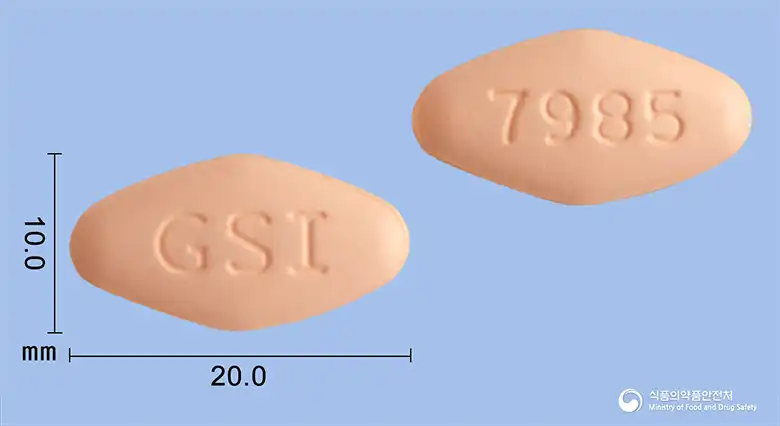
A film-coated tablet in a diamond shape, orange in color, with 'GSI' engraved on one side and '7985' on the other side.
Package unit
28 tablets/bottle
Questions about this medicine
No questions yet.
For anything that needs medical judgment, consult a doctor or pharmacist.