
 한국어
 English
 日本語
 中文(简体)
Summary
- Main use
- Combination treatment with bedaquiline and linezolid for adults with drug-resistant pulmonary tuberculosis
- Who takes it
- Adults
- Adult dose
- This medicine should be administered only as part of a combination regimen with bedaquiline and linezolid. Administration under directly observed therapy (Directly Observed Therapy, DOT) is recommended. Administer this medicine with bedaquiline and linezolid as follows: · Administer 1 tablet (200mg) of this medicine orally once daily for 26 weeks. The tablet should be swallowed whole with water. · Administer bedaquiline 400mg orally once daily for 2 weeks, followed by 200mg 3 times weekly for 24 weeks, with at least 48 hours between doses (total 26 weeks). · Administer linezolid 600mg orally daily for up to 26 weeks. If adverse reactions due to known linezolid toxicity (myelosuppression, peripheral and optic neuropathy) occur, reduce the dose to 300mg or discontinue treatment. Take the combination regimen with food. If, for safety reasons, the physician decides to temporarily interrupt administration of this medicine, bedaquiline, and linezolid, administer the missed doses of the medicines at the end of treatment; if only linezolid was not administered due to an adverse reaction to linezolid, do not add the missed linezolid doses at the end of treatment. If necessary, administration of the combination regimen may be extended beyond 26 weeks (see “Precautions for Use, 12. Information for Healthcare Professionals, 3) Clinical Trial Information” ). Discontinuation If administration of this medicine or bedaquiline is discontinued, discontinue the entire combination regimen. If linezolid is permanently discontinued within the first consecutive 4 weeks of the combination regimen, discontinue this medicine and bedaquiline as well. If linezolid is discontinued after the first consecutive 4 weeks of the combination regimen, continue administering this medicine and bedaquiline.
Ingredients
- Importer
- Viatris
Efficacy & effects
Combination treatment with bedaquiline and linezolid for adults with drug-resistant pulmonary tuberculosis
- Pulmonary tuberculosis
- latent infection
- extrapulmonary tuberculosis
View approved original textHide original text
This medication is used for the treatment of pulmonary tuberculosis caused by Mycobacterium tuberculosis. It is specifically administered in combination with bedaquiline and linezolid to adult patients infected with strains of Mycobacterium tuberculosis resistant to isoniazid, rifampicin, fluoroquinolones, and second-line injectable agents. It may also be used in cases where the standard treatment is ineffective or intolerant. Limited use may be considered for latent tuberculosis, drug-susceptible tuberculosis, and extrapulmonary tuberculosis, but it is not recommended for treatment of strains resistant to bedaquiline and linezolid. Caution is needed as the safety and efficacy of combination therapy with other drugs has not been established. This drug aims to provide effective improvement in the treatment of drug-resistant pulmonary tuberculosis.
How to take
Adult dose
This medicine should be administered only as part of a combination regimen with bedaquiline and linezolid. Administration under directly observed therapy (Directly Observed Therapy, DOT) is recommended. Administer this medicine with bedaquiline and linezolid as follows: · Administer 1 tablet (200mg) of this medicine orally once daily for 26 weeks. The tablet should be swallowed whole with water. · Administer bedaquiline 400mg orally once daily for 2 weeks, followed by 200mg 3 times weekly for 24 weeks, with at least 48 hours between doses (total 26 weeks). · Administer linezolid 600mg orally daily for up to 26 weeks. If adverse reactions due to known linezolid toxicity (myelosuppression, peripheral and optic neuropathy) occur, reduce the dose to 300mg or discontinue treatment. Take the combination regimen with food. If, for safety reasons, the physician decides to temporarily interrupt administration of this medicine, bedaquiline, and linezolid, administer the missed doses of the medicines at the end of treatment; if only linezolid was not administered due to an adverse reaction to linezolid, do not add the missed linezolid doses at the end of treatment. If necessary, administration of the combination regimen may be extended beyond 26 weeks (see “Precautions for Use, 12. Information for Healthcare Professionals, 3) Clinical Trial Information” ). Discontinuation If administration of this medicine or bedaquiline is discontinued, discontinue the entire combination regimen. If linezolid is permanently discontinued within the first consecutive 4 weeks of the combination regimen, discontinue this medicine and bedaquiline as well. If linezolid is discontinued after the first consecutive 4 weeks of the combination regimen, continue administering this medicine and bedaquiline.
Precautions
This drug is part of a combination therapy with bedaquiline and linezolid, thus the warnings associated with these two drugs apply equally. It may cause liver damage, so patients with hepatic impairment should avoid taking other medications or consuming alcohol that may burden the liver during treatment. Regular blood tests should be conducted during treatment to monitor liver function, and if abnormalities are discovered, treatment may be discontinued immediately. It can suppress bone marrow function, leading to anemia, leukopenia, and thrombocytopenia, so blood tests should be conducted before and during treatment to monitor the condition. If bone marrow suppression is severe, dosage adjustments or discontinuation of treatment may be necessary. It may affect peripheral nerves and the eyes, so if sensory disturbances or changes in vision occur, immediate medical attention should be sought, and dosage may be reduced or stopped as needed. There may be an extended QT interval related to heart rhythm, so an electrocardiogram (ECG) should be performed before and during treatment, and electrolyte levels should be checked. Patients with a history of heart disease or electrolyte imbalances should exercise particular caution. Patients allergic to this drug or its components, or who cannot use bedaquiline and linezolid, should not take this medication. Patients with lactose intolerance should also avoid this drug. This drug is metabolized by the CYP3A4 enzyme, so concomitant use with drugs that induce this enzyme may decrease its effectiveness, thus co-administration should be avoided. Pregnant or breastfeeding women should consult a healthcare professional before taking this medication as its safety has not been established. Dizziness or visual disturbances may occur, so caution is advised when driving or operating machinery. In case of overdose, urgent measures such as monitoring vital functions and ECG may be necessary. Keep out of reach of children and do not transfer to another container.
Side effects
Nausea, vomiting, increased amino transferase levels, peripheral neuropathy, anemia, leukopenia, thrombocytopenia, pancytopenia, decreased appetite, hypoglycemia, hypomagnesemia, lactic acidosis, dehydration, hypocalcemia, decreased blood volume, insomnia, anxiety, depression, altered taste, dizziness, headache, visual disturbances, eye irritation, eye pain, dry eyes, optic nerve disease, lens abnormalities, eye pruritus, eye swelling, optic disc edema, presbyopia, hearing loss, palpitations, homogenous tachycardia, hypotension, cough, nasal bleeding, dyspepsia, gastritis, diarrhea, constipation, gastroesophageal reflux disease, pancreatitis, abdominal pain, abdominal distension, mouth pain, hematemesis, hyperbilirubinemia, hepatomegaly, jaundice, acne, dry skin, alopecia, pruritus, rash, allergic dermatitis, skin hyperpigmentation, musculoskeletal pain, muscle spasms, erectile dysfunction, abnormal uterine bleeding, fatigue, malaise, increased gamma-glutamyl transferase, prolonged QT interval on ECG, increased blood alkaline phosphatase, increased blood creatine phosphokinase, increased blood urea, increased lipase, increased amylase, increased blood creatinine, presence of urinary albumin, increased blood creatine phosphokinase MB, increased blood uric acid, decreased renal creatinine clearance, oral candidiasis
Not everyone experiences these, and they can vary from person to person.
Storage
This medication should be stored in a tightly sealed container to prevent air or moisture from entering. It should be kept in a cool place at a temperature below 30 degrees Celsius to maintain its effectiveness.
Appearance and packaging
Appearance
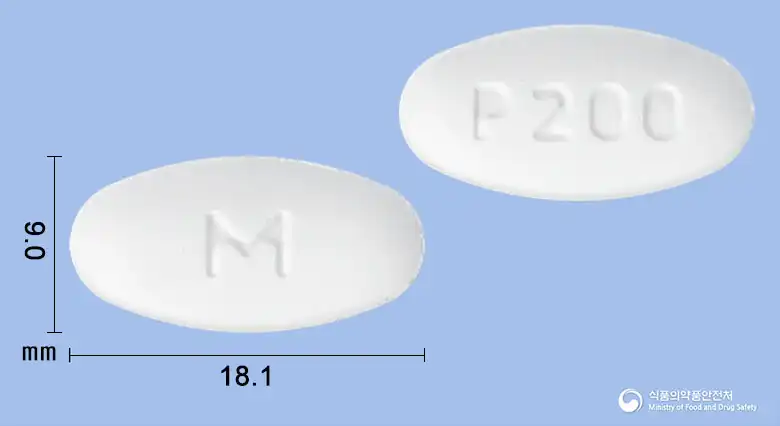
An oval tablet that is white or slightly off-white, engraved with 'M' on one side and 'P200' on the other side.
Package unit
Bottle - 26 tablets/bottle, Bottle - 182 tablets/bottle, PTP - 14 tablets/PTP
Questions about this medicine
No questions yet.
For anything that needs medical judgment, consult a doctor or pharmacist.