
 한국어
 English
 日本語
 中文(简体)
Dosage form image
Viewing nowVfend Injection 200 mg (Voriconazole) (For Injection)
Voriconazole 200mg
Prescription medication
Pfizer Korea Ltd.
MFDS item code 200108818 · Approved 2001.07.30 · Insurance code 648900371
Treatment of fungal infections (e.g., Aspergillus and Candida) and prevention of invasive fungal infections
Vfend is effective in treating invasive Aspergillus infections, particularly those caused by Aspergillus fumigatus. It is also used for candidemia occurring in patients without neutropenia and for Candida infections of the skin, abdomen, kidneys, bladder wall, and wound sites. This medication is suitable for patients with severe fungal infections caused by Scedosporium apiospermum and Fusarium species who are resistant to or have failed other treatments. It is also utilized for preventing invasive fungal infections following hematopoietic stem cell transplant in patients who have failed treatment for acute leukemia or lymphoma or have chronic myeloid leukemia. Due to these efficacies, Vfend is widely used for treating and preventing various fungal infections.
Vfend injection should first be reconstituted with sterile water for injection to a concentration of 10 mg/mL, then diluted to a concentration of 5 mg/mL or less before administration and given by intravenous infusion. Administration at a maximum rate of 3 mg/kg per hour over 1 to 3 hours is recommended. Administration in adults and adolescents (aged 12 to under 15 years weighing 50 kg or more, and aged 15 to under 18 years): - Loading dose: Administer 6 mg/kg at 12-hour intervals (during the first 24 hours) - Maintenance dose: Administer 4 mg/kg at 12-hour intervals - Oral formulation: Administer 200 mg at 12-hour intervals Candidemia and deep-tissue infections in patients without neutropenia: - Loading dose: Administer 6 mg/kg at 12-hour intervals (during the first 24 hours) - Maintenance dose: Administer 3-4 mg/kg at 12-hour intervals - Oral formulation: Administer 200 mg at 12-hour intervals Prevention of invasive fungal infections in hematopoietic stem cell transplant patients, including those with acute leukemia: - Loading dose: Administer 6 mg/kg at 12-hour intervals (during the first 24 hours) - Maintenance dose: Administer 4 mg/kg at 12-hour intervals - Oral formulation: Administer 200 mg at 12-hour intervals Patients weighing 40 kg or more should receive 200 mg at 12-hour intervals; patients weighing less than 40 kg should receive 100 mg at 12-hour intervals. For dose adjustment, if the patient cannot tolerate 4 mg/kg per dose at 12-hour intervals, reduce the dose to 3 mg/kg. Phenytoin may be coadministered when increasing the dose to 5 mg/kg per dose at 12-hour intervals. The duration of treatment is determined according to the patient's medical history and clinical response.
Children (aged 2 to under 12 years) and adolescents (aged 12 to under 15 years weighing less than 50 kg): - Loading dose (first 24 hours): Administer 9 mg/kg at 12-hour intervals - Maintenance dose (after the first 24 hours): Administer 8 mg/kg twice daily Dose adjustment: - If treatment is inadequate, consider increasing the dose by 1 mg/kg - If treatment is not tolerated, consider reducing the dose by 1 mg/kg Use in children under 2 years of age is not recommended.
This medication includes the ingredient Voriconazole and should not be administered to certain patients. It should not be used in patients allergic to Voriconazole or any other ingredients in this medication. Additionally, it can cause serious side effects when combined with medications that heavily rely on the enzyme CYP3A4 for metabolism, so co-administration should be avoided. Drugs that should not be used with this medication include terfenadine, astemizole, cisapride, pimobendan, lurasidone, quinidine, ivabradine, ergotamine derivatives, sirolimus, naloxegol, tolcapone, finerenone, eplerenone, bococizumab, and venetoclax. Furthermore, it should not be combined with drugs that induce CYP3A4, lowering Voriconazole blood concentration. This medication can affect the heart, so it should be administered cautiously to patients at risk of QT interval prolongation or arrhythmias. It is important to periodically check heart status through ECG if there is any electrolyte imbalance. Caution is also advised for patients allergic to other azole drugs. This medication has many interactions with other drugs, so be sure to inform healthcare professionals of any other medications being taken and monitor drug concentration and side effects carefully. Liver function may be impacted, so liver function tests should be performed regularly for at least one month after starting administration, and use should be discontinued if abnormal signs are present. Kidney function should also be monitored, as there is a risk of acute renal failure and caution is needed. Serious allergic reactions or photosensitivity reactions may appear on the skin, so immediate consultation with a healthcare professional is necessary if skin abnormalities occur. Exposure to sunlight should be minimized and the use of sunscreen is recommended while taking this medication. Visual disturbances may temporarily occur, so it is advisable to avoid driving or operating hazardous machinery. Safety for the fetus during pregnancy has not been established, so it should only be administered when necessary, and women of childbearing age should use effective contraception. If breastfeeding, it is best to avoid administration and discontinue breastfeeding. In case of overdose, there is no specific antidote, and treatment should be symptomatic and supportive, though some removal can occur through hemodialysis. This medication must be administered according to the precise doses and methods instructed by a healthcare professional, and care should be taken with dilution and administration procedures. Store in a sealed container to prevent air or moisture ingress, and keep in a cool room temperature, preferably below 25 degrees Celsius. This will help maintain the drug's effectiveness for a longer period.
Visual impairment, abnormal liver function tests, fever, rash, vomiting, nausea, diarrhea, headache, peripheral edema, abdominal pain, sinusitis, pseudomembranous colitis, agranulocytosis, pancytopenia, thrombocytopenia, leukopenia, anemia, bone marrow failure, lymphadenopathy, eosinophilia, disseminated intravascular coagulation, hypersensitivity, pseudo-anaphylactoid reaction, adrenal insufficiency, hypothyroidism, hyperthyroidism, hypoglycemia, hypokalemia, hyponatremia, depression, hallucinations, anxiety, insomnia, restlessness, confusion, convulsions, syncope, tremors, hypertonia, sensory disturbances, drowsiness, dizziness, cerebral edema, encephalopathy, extrapyramidal disorder, peripheral neuropathy, ataxia, decreased sensation, taste disturbances, hepatic encephalopathy, Guillain-Barré syndrome, eye tremors, retinal hemorrhage, optic nerve disorder, papilledema, ocular motor seizures, diplopia, scleritis, blepharitis, optic atrophy, corneal opacity, hearing loss, vertigo, tinnitus, ventricular arrhythmia, tachycardia, bradycardia, ventricular fibrillation, ventricular extrasystoles, ventricular tachycardia, QT prolongation on ECG, supraventricular tachycardia, torsades de pointes, complete heart block, block, nodal rhythm, hypotension, phlebitis, thrombophlebitis, lymphangitis, acute respiratory distress syndrome, pulmonary edema, cheilitis, dyspepsia, constipation, gingivitis, peritonitis, pancreatitis, tongue edema, duodenitis, gastritis, glossitis, jaundice, cholestatic jaundice, hepatitis, hepatic failure, hepatomegaly, cholecystitis, cholelithiasis, exfoliative dermatitis, alopecia, maculopapular rash, pruritus, erythema, Stevens-Johnson syndrome, phototoxic reaction, purpura, urticaria, maculopapular rash, papular rash, allergic dermatitis, eczema, toxic epidermal necrolysis, angioedema, pseudoporphyria, erythema multiforme, psoriasis, drug eruption, actinic keratosis, cutaneous lupus erythematosus, drug reaction with eosinophilia and systemic symptoms, freckles, nevus, back pain, arthritis, acute renal failure, hematuria, acute tubular necrosis, proteinuria, nephritis, chest pain, facial edema, asthenia, chills, infusion site reaction, influenza-like illness, increased serum creatinine, increased blood urea nitrogen, increased serum cholesterol, taste disturbances, flushing, sweating, syncope, pruritus
Not everyone experiences these, and they can vary from person to person.
This medication should be stored in a sealed container to prevent air or moisture ingress, and it is best to keep it at cool room temperature, i.e., below 25 degrees Celsius. This maintains the effectiveness of the medication for a longer period.
Vial filled with white powder
Vial X 1
Even with the same ingredient, strength, dosage form and how it is taken can differ.
Voriconazole 200mg
Prescription medication
Pfizer Korea Ltd.
Voriconazole
Prescription medication
Pfizer Korea Co., Ltd.
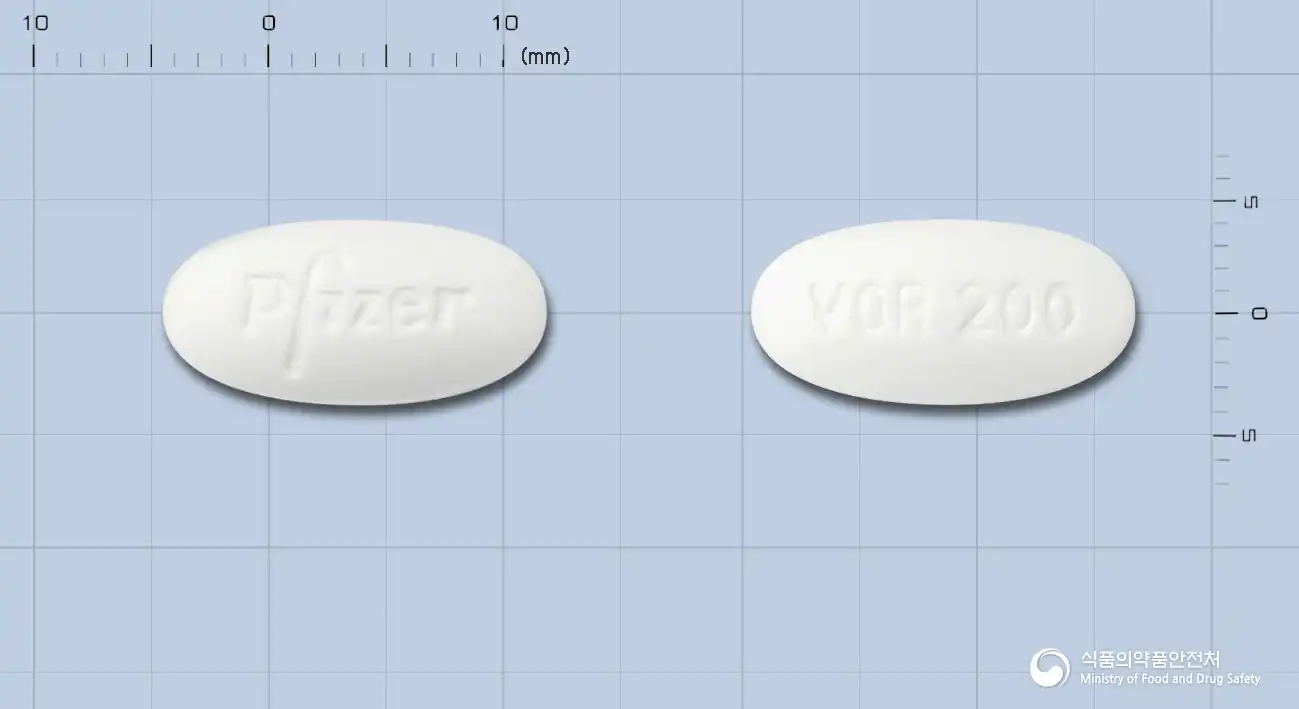
Voriconazole 200mg
Tablet · Prescription medication
Pfizer Korea Co., Ltd.
Voriconazole
Prescription medication
Pfizer Korea Co., Ltd.
Voriconazole 200mg
Prescription medication
Jongkundang Co., Ltd.
Even with the same ingredient, the dose and directions can differ by strength and dosage form. Talk to a doctor or pharmacist before switching from a medication you are already taking.
No questions yet.
For anything that needs medical judgment, consult a doctor or pharmacist.
This drug information is based on data provided by the Korea Ministry of Food and Drug Safety.
Consult a doctor or pharmacist for accurate dosage, administration, and usage instructions.