
 한국어
 English
 日本語
 中文(简体)
Dosage form image
Viewing nowVfend Tablets 50 Milligrams (Voriconazole)
Voriconazole
Prescription medication
Pfizer Korea Co., Ltd.
MFDS item code 200108816 · Approved 2001.07.30
This product's status changed to Expired on 2023.04.01. It may no longer be sold, so consult a doctor or pharmacist before taking it.
Treatment of fungal infections (e.g., Aspergillus and Candida) and prevention of fungal infections in transplant patients
Vfend is used to treat invasive Aspergillus infections, especially those caused by Aspergillus fumigatus. It also treats candidemia and Candida infections of the skin, abdomen, kidneys, bladder, and wound sites in patients without neutropenia. It is effective for esophageal candidiasis and is used when existing treatments for severe fungal infections due to Scedosporium apiospermum and Fusarium species are resistant or ineffective. It helps prevent invasive fungal infections in patients undergoing hematopoietic stem cell transplantation after treatment failure for acute leukemia and lymphoma, and chronic myeloid leukemia. This medication is widely used for the treatment and prevention of various fungal infections.
VFEND tablets should be taken at least 1 hour before or 1 hour after a meal. Electrolyte disturbances such as hypokalemia, hypomagnesemia, and hypocalcemia should be corrected before starting treatment with VFEND. Adult patients (18 years or older) and adolescents (adolescents aged 12 to under 15 years weighing 50 kg or more and adolescents aged 15 to under 18 years of any weight) Invasive Aspergillus infections and severe fungal infections caused by Scedosporium apiospermum (the asexual form of Pseudallescheria boydii) and Fusarium species (including Fusariumsolani): Treatment should be initiated with the specified loading dose of the injection to achieve adequate plasma concentrations on the first day of treatment. Intravenous treatment should continue for at least 7 days before switching to oral treatment. If the patient has clinically improved and can tolerate oral treatment, the oral tablets or oral suspension of this medicine may be used. VFEND has high oral bioavailability (96%); therefore, the injection and oral formulations may be used interchangeably when clinically necessary. If the patient is able to take oral treatment, they may be switched to the tablets. Candidemia in non-neutropenic patients and the following Candida infections: disseminated infections of the skin and infections of the abdomen, kidney, bladder wall, or wound site: Treatment should continue for the longer of the following periods: at least 14 days after symptoms have resolved, or at least 14 days after the last positive culture result. Esophageal candidiasis: Treatment should continue for at least 14 days and for at least 7 days after symptoms have resolved. Prevention of invasive fungal infections in hematopoietic stem cell transplant recipients with acute leukemia, lymphoma that has failed treatment, or chronic myeloid leukemia Invasive Aspergillus infections and severe fungal infections caused by Scedosporium apiospermum and Fusarium species: Loading dose of injection 6 mg/kg every 12 hours (during the first 24 hours); maintenance dose of injection 4 mg/kg every 12 hours; tablets 200 mg every 12 hours Candidemia and other deep-tissue Candida infections in non-neutropenic patients: Loading dose of injection 6 mg/kg every 12 hours (during the first 24 hours); maintenance dose of injection 3~4 mg/kg every 12 hours; tablets 200 mg every 12 hours. In clinical trials, patients with candidemia received 3 mg/kg every 12 hours as first-line therapy, whereas patients with Candida infections in other deep tissues received 4 mg/kg every 12 hours as salvage therapy. The appropriate dose should be administered according to the severity and nature of the infection. Esophageal candidiasis: Tablets 200 mg every 12 hours. Not evaluated in patients with esophageal candidiasis. Prevention of invasive fungal infections in hematopoietic stem cell transplant recipients with acute leukemia, lymphoma that has failed treatment, or chronic myeloid leukemia: Loading dose of injection 6 mg/kg every 12 hours (during the first 24 hours); maintenance dose of injection 4 mg/kg every 12 hours; tablets 200 mg (5 mL) every 12 hours If the patient's response to treatment is inadequate, the maintenance dose (oral administration) may be increased from 200 mg every 12 hours to 300 mg every 12 hours for patients weighing 40 kg or more, and from 100 mg every 12 hours to 150 mg every 12 hours for patients weighing less than 40 kg. If the patient cannot tolerate this increased dose, reduce the dose gradually in increments of 50 mg to 200 mg every 12 hours for patients weighing 40 kg or more (or 100 mg every 12 hours for patients weighing less than 40 kg). When increasing the maintenance dose from 200 mg every 12 hours to 400 mg every 12 hours (or from 100 mg every 12 hours to 200 mg every 12 hours for patients weighing less than 40 kg), phenytoin may be coadministered. The duration of treatment should be determined according to the patient's medical history, recovery from immunosuppressive therapy, and clinical response. Use in elderly patients: No dose adjustment is necessary. Patients with hepatic impairment: In clinical trials, patients with liver function test values, such as ALT and AST, elevated up to 5 times the upper limit of normal were included. No dose adjustment is necessary for patients with this degree of abnormal liver function, but continued monitoring for further increases in liver function test values is recommended. For patients with mild to moderate cirrhosis (Child-Pugh A, B), the standard loading dose and half the standard maintenance dose are recommended. Voriconazole has not been studied in patients with severe cirrhosis (Child-Pugh C), chronic hepatitis B, or chronic hepatitis C. Voriconazole is associated with increases in liver function test values and clinical signs of liver injury (e.g., jaundice). Therefore, voriconazole should be administered to patients with severe hepatic impairment only when the expected benefit outweighs the anticipated risk. Patients with hepatic impairment should be carefully monitored for drug-related toxicity. Patients with renal impairment: When voriconazole is administered orally, its pharmacokinetics are not affected by renal impairment. Therefore, no dose adjustment is necessary for oral administration in patients with mild to severe renal impairment. Voriconazole is removed by hemodialysis at a rate of 121 ml/min. Hemodialysis over 4 hours does not remove enough voriconazole to require a dose adjustment.
Patients weighing 40kg or more should receive 200mg every 12 hours. Patients weighing less than 40kg should receive 100mg every 12 hours.
This medication contains the antifungal agent voriconazole and should not be administered to certain patients. For example, patients allergic to this medication or its excipients, those taking the drug St John's Wort, and when used with drugs such as rifabutin, rifampicin, carbamazepine, and phenobarbital may reduce the efficacy of this medication, thus contraindicated. Also, concomitant use with high doses of ritonavir may significantly reduce the blood concentration of this medication, so they should not be used together. Caution is required when using it in combination with drugs that may affect the heart, as it may pose risks such as arrhythmias. Since this medication contains lactose, it should not be used in patients with lactose intolerance. It is essential to use this medication carefully in patients with cardiovascular diseases or a history of cardiac issues such as QT interval prolongation, and to monitor for signs of electrolyte imbalance through electrocardiograms. Close monitoring of drug concentrations and adverse reactions is necessary when used with other medications, and it is advisable to avoid concomitant use if the risks do not outweigh the benefits. This medication can cause various adverse reactions, with common symptoms including visual disturbances, fever, rash, vomiting, nausea, diarrhea, headache, peripheral edema, and abdominal pain. Most adverse reactions are mild to moderate, and if skin rashes or severe allergic reactions occur, discontinue use immediately. Liver function abnormalities have been frequently reported, so liver function tests should be conducted at the beginning of treatment, and if abnormalities are observed, discontinuation is necessary. Serious side effects such as acute renal failure and interstitial pneumonia can also occur, necessitating rapid diagnosis and treatment when symptoms arise. This medication can be administered to children, but its safety in children under 2 years has not been established, and children may experience photosensitivity reactions more intensely, necessitating sunlight exposure avoidance and appropriate skin protection. Safety during pregnancy has not been established; therefore, it should only be administered when the benefits to the mother clearly outweigh the risks to the fetus, and women of childbearing age should use effective contraceptives while taking this medication. It is recommended that breastfeeding women discontinue breastfeeding while taking this medication. In the case of overdose, there is no specific antidote; symptomatic and supportive care is necessary, and hemodialysis may assist in the removal of this medication. This medication interacts with many other drugs; therefore, it is crucial to inform healthcare providers of all medications being taken and require careful monitoring and dosage adjustments. Finally, during the intake of this medication, visual disturbances such as blurred vision or glare may occur, so it is advisable to avoid performing hazardous tasks such as driving or operating machinery, particularly at night.
Not everyone experiences these, and they can vary from person to person.
This medication should be stored in tightly closed containers to avoid exposure to air or moisture. Also, it should be kept away from direct sunlight and stored at room temperature below 25 degrees Celsius.
White to off-white round film-coated tablets
Packaging unit of the manufacturer
Even with the same ingredient, strength, dosage form and how it is taken can differ.
Voriconazole
Prescription medication
Pfizer Korea Co., Ltd.
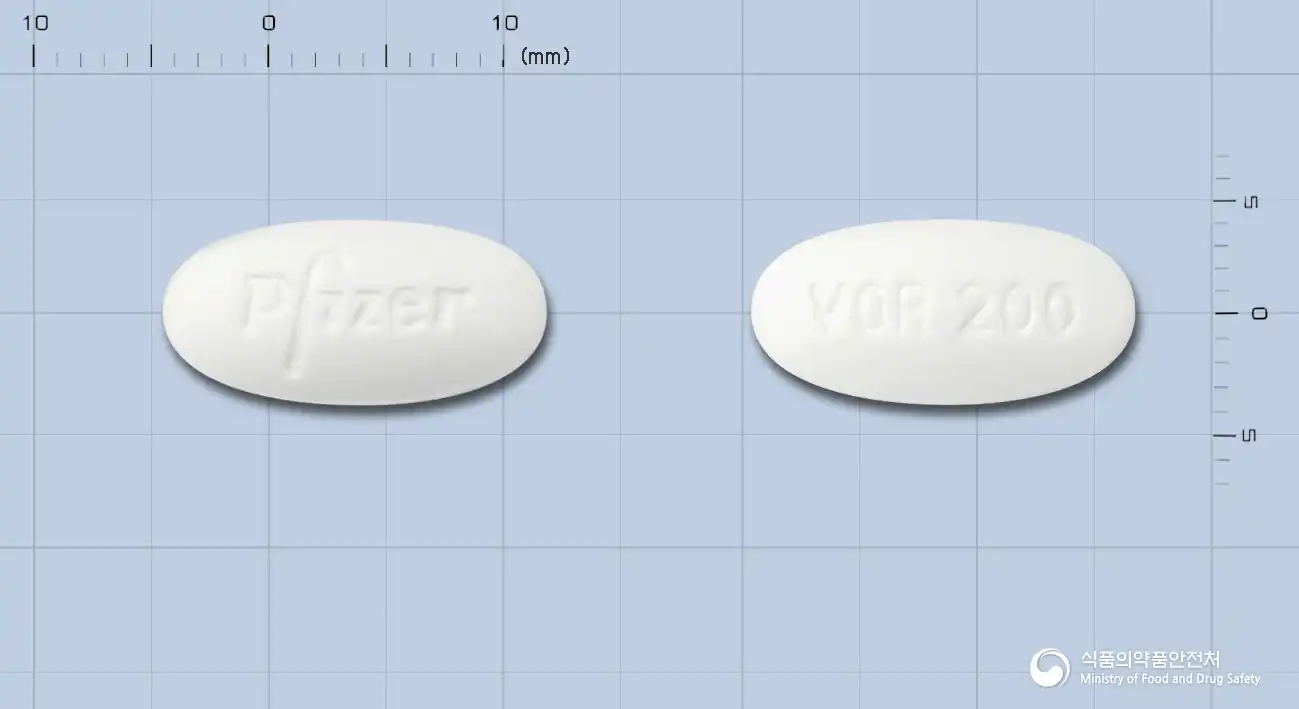
Voriconazole 200mg
Tablet · Prescription medication
Pfizer Korea Co., Ltd.
Voriconazole 200mg
Prescription medication
Pfizer Korea Ltd.
Voriconazole
Prescription medication
Pfizer Korea Co., Ltd.
Voriconazole 200mg
Prescription medication
Jongkundang Co., Ltd.
Even with the same ingredient, the dose and directions can differ by strength and dosage form. Talk to a doctor or pharmacist before switching from a medication you are already taking.
No questions yet.
For anything that needs medical judgment, consult a doctor or pharmacist.
This drug information is based on data provided by the Korea Ministry of Food and Drug Safety.
Consult a doctor or pharmacist for accurate dosage, administration, and usage instructions.