
 한국어
 English
 日本語
 中文(简体)
Summary
- Main use
- Treatment of chronic liver disease before procedures and chronic immune thrombocytopenia refractory to treatment
- Who takes it
- Adults
- Adult dose
- 1. Patients with chronic liver disease This medicine is taken once daily with food for 5 days, at a dose of 40mg (2 tablets) or 60mg (3 tablets) according to the patient’s platelet count, starting 10~13 days before the scheduled procedure (Table 1). The scheduled procedure should be performed 5~8 days after the final dose of this medicine. If a dose is missed, take it as soon as you remember. Do not take 2 doses at once to make up for a missed dose. Complete the full 5-day course. Table 1. Dose and duration of treatment for patients with chronic liver disease scheduled for a procedure Platelet count (×109/L) | Once-daily dose | Duration of treatment Less than 40 | 60mg (3 tablets) | 5 days 40 or more to less than 50 | 40mg (2 tablets) | 5 days This medicine should not be given to patients with chronic liver disease to normalize their platelet count. Monitoring Measure the platelet count before treatment with this medicine and on the day of the procedure to confirm an adequate increase in platelet count. 2. Patients with chronic immune thrombocytopenia To reduce the risk of bleeding, use the lowest dose of this medicine necessary to achieve and maintain the required platelet count (50×109/L). Adjust the dose according to the platelet count response. This medicine should not be used to normalize the platelet count. In clinical trials, platelet counts generally increased 1 week after starting treatment and decreased within 1~2 weeks after discontinuation. Initial dose Take 20mg (1 tablet) of this medicine once daily with food (dose level 4). Monitoring After starting treatment with this medicine, measure the platelet count at least once weekly until a stable count of 50×109/L or higher is achieved. For patients receiving this medicine 1~2 times per week, monitor the platelet count twice during the first week of treatment. During treatment, measure the platelet count twice weekly after dose adjustments. Because of the potential risk that the platelet count may exceed 400x109/L during the first week of treatment, carefully monitor for symptoms or signs of increased platelet counts. Once the platelet count is stable, measure it at least once a month. Measure the platelet count weekly for at least 4 weeks after discontinuing this medicine. Dose adjustment Adjust the dose according to the platelet count results (see Tables 2 and 3). Do not exceed 40mg (2 tablets) per day. Table 2. Dose adjustments for this medicine in patients with chronic immune thrombocytopenia Platelet count (×109/L) | Dose adjustment or action Less than 50 after treatment with this medicine for at least 2 weeks • Increase the dose by one dose level according to Table 3. Wait 2 weeks to assess the effect of this dose regimen and subsequent dose adjustments. More than 200 and up to 400 • Decrease the dose by one dose level according to Table 3. Wait 2 weeks to assess the effect of this dose regimen and subsequent dose adjustments. More than 400 • Discontinue this medicine. • Increase platelet monitoring to twice weekly. After the platelet count falls below 150×109/L, restart treatment at one dose level below the current dose level according to Table 3. Less than 50 after taking 40mg of this medicine once daily for 4 weeks Discontinue this medicine. More than 400 after taking 20mg of this medicine once weekly for 2 weeks Discontinue this medicine. Table 3. Dose levels of this medicine for titration in patients with chronic immune thrombocytopenia Dose≠ | Dose level 40mg once daily | 6 40mg 3 times per week and 20mg on the remaining 4 days of the same week | 5 20mg once daily* | 4 20mg 3 times per week | 3 20mg twice per week or 40 mg once per week | 2 20mg once per week | 1 * Initial dose regimen for all patients except those taking moderate or strong dual inducers or moderate or strong dual inhibitors of CYP2C9 and CYP3A4. ≠ Patients taking this medicine less frequently than once daily should take it consistently each week. Dose level 3: Do not take the medicine on 3 consecutive days in a week. (For example, take it on Monday, Wednesday, and Friday.) Dose level 2: Do not take the medicine on 2 consecutive days in a week.. (For example, take it on Monday and Friday.) Dose level 1: Take the medicine on the same day each week. (For example, take it every Monday.) If a dose is missed, take it as soon as you remember. Do not take 2 doses at once to make up for a missed dose; take the next dose according to the dose for the applicable dose level. Discontinuation Discontinue this medicine if the platelet count does not increase to 50×109/L or higher after 4 weeks at the maximum dose of 40mg once daily (dose level 6). Discontinue this medicine if the platelet count exceeds 400×109/L after 2 weeks at 20mg once weekly (dose level 1). 3. Concomitant administration with moderate or strong dual inducers or inhibitors of CYP2C9 and CYP3A4 in patients with chronic immune thrombocytopenia The recommended initial doses of this medicine for patients with chronic immune thrombocytopenia receiving concomitant medications are summarized in Table 4. Table 4. Initial doses of this medicine for patients with chronic immune thrombocytopenia receiving concomitant medications Concomitant medication | Recommended initial dose Moderate or strong dual inhibitors of CYP2C9 and CYP3A4 (e.g., fluconazole) | 20mg (1 tablet) 3 times per week Moderate or strong dual inducers of CYP2C9 and CYP3A4 (e.g., rifampicin, enzalutamide) | 40mg (2 tablets) once daily
Ingredients
- Importer
- Handok Inc.
Efficacy & effects
Treatment of chronic liver disease before procedures and chronic immune thrombocytopenia refractory to treatment
- Thrombocytopenia
View approved original textHide original text
This medication is used to treat thrombocytopenia in adult patients with chronic liver disease who are scheduled for procedures. It also helps improve thrombocytopenia in adult patients with chronic immune thrombocytopenia who do not respond adequately to corticosteroids, immunoglobulin treatment, or splenectomy. By restoring platelet counts to the normal range, it supports safe procedures and maintenance of good health. Overall, it is effective for the treatment of thrombocytopenia.
How to take
Adult dose
1. Patients with chronic liver disease This medicine is taken once daily with food for 5 days, at a dose of 40mg (2 tablets) or 60mg (3 tablets) according to the patient’s platelet count, starting 10~13 days before the scheduled procedure (Table 1). The scheduled procedure should be performed 5~8 days after the final dose of this medicine. If a dose is missed, take it as soon as you remember. Do not take 2 doses at once to make up for a missed dose. Complete the full 5-day course. Table 1. Dose and duration of treatment for patients with chronic liver disease scheduled for a procedure Platelet count (×109/L) | Once-daily dose | Duration of treatment Less than 40 | 60mg (3 tablets) | 5 days 40 or more to less than 50 | 40mg (2 tablets) | 5 days This medicine should not be given to patients with chronic liver disease to normalize their platelet count. Monitoring Measure the platelet count before treatment with this medicine and on the day of the procedure to confirm an adequate increase in platelet count. 2. Patients with chronic immune thrombocytopenia To reduce the risk of bleeding, use the lowest dose of this medicine necessary to achieve and maintain the required platelet count (50×109/L). Adjust the dose according to the platelet count response. This medicine should not be used to normalize the platelet count. In clinical trials, platelet counts generally increased 1 week after starting treatment and decreased within 1~2 weeks after discontinuation. Initial dose Take 20mg (1 tablet) of this medicine once daily with food (dose level 4). Monitoring After starting treatment with this medicine, measure the platelet count at least once weekly until a stable count of 50×109/L or higher is achieved. For patients receiving this medicine 1~2 times per week, monitor the platelet count twice during the first week of treatment. During treatment, measure the platelet count twice weekly after dose adjustments. Because of the potential risk that the platelet count may exceed 400x109/L during the first week of treatment, carefully monitor for symptoms or signs of increased platelet counts. Once the platelet count is stable, measure it at least once a month. Measure the platelet count weekly for at least 4 weeks after discontinuing this medicine. Dose adjustment Adjust the dose according to the platelet count results (see Tables 2 and 3). Do not exceed 40mg (2 tablets) per day. Table 2. Dose adjustments for this medicine in patients with chronic immune thrombocytopenia Platelet count (×109/L) | Dose adjustment or action Less than 50 after treatment with this medicine for at least 2 weeks • Increase the dose by one dose level according to Table 3. Wait 2 weeks to assess the effect of this dose regimen and subsequent dose adjustments. More than 200 and up to 400 • Decrease the dose by one dose level according to Table 3. Wait 2 weeks to assess the effect of this dose regimen and subsequent dose adjustments. More than 400 • Discontinue this medicine. • Increase platelet monitoring to twice weekly. After the platelet count falls below 150×109/L, restart treatment at one dose level below the current dose level according to Table 3. Less than 50 after taking 40mg of this medicine once daily for 4 weeks Discontinue this medicine. More than 400 after taking 20mg of this medicine once weekly for 2 weeks Discontinue this medicine. Table 3. Dose levels of this medicine for titration in patients with chronic immune thrombocytopenia Dose≠ | Dose level 40mg once daily | 6 40mg 3 times per week and 20mg on the remaining 4 days of the same week | 5 20mg once daily* | 4 20mg 3 times per week | 3 20mg twice per week or 40 mg once per week | 2 20mg once per week | 1 * Initial dose regimen for all patients except those taking moderate or strong dual inducers or moderate or strong dual inhibitors of CYP2C9 and CYP3A4. ≠ Patients taking this medicine less frequently than once daily should take it consistently each week. Dose level 3: Do not take the medicine on 3 consecutive days in a week. (For example, take it on Monday, Wednesday, and Friday.) Dose level 2: Do not take the medicine on 2 consecutive days in a week.. (For example, take it on Monday and Friday.) Dose level 1: Take the medicine on the same day each week. (For example, take it every Monday.) If a dose is missed, take it as soon as you remember. Do not take 2 doses at once to make up for a missed dose; take the next dose according to the dose for the applicable dose level. Discontinuation Discontinue this medicine if the platelet count does not increase to 50×109/L or higher after 4 weeks at the maximum dose of 40mg once daily (dose level 6). Discontinue this medicine if the platelet count exceeds 400×109/L after 2 weeks at 20mg once weekly (dose level 1). 3. Concomitant administration with moderate or strong dual inducers or inhibitors of CYP2C9 and CYP3A4 in patients with chronic immune thrombocytopenia The recommended initial doses of this medicine for patients with chronic immune thrombocytopenia receiving concomitant medications are summarized in Table 4. Table 4. Initial doses of this medicine for patients with chronic immune thrombocytopenia receiving concomitant medications Concomitant medication | Recommended initial dose Moderate or strong dual inhibitors of CYP2C9 and CYP3A4 (e.g., fluconazole) | 20mg (1 tablet) 3 times per week Moderate or strong dual inducers of CYP2C9 and CYP3A4 (e.g., rifampicin, enzalutamide) | 40mg (2 tablets) once daily
Precautions
This medication may increase the risk of thrombosis in patients with chronic liver disease, so caution is needed when administering it to patients with risk factors for thromboembolism. Platelet counts must be kept below the normal range, and in patients with chronic immune thrombocytopenia, there may be a recurrence of thrombocytopenia and bleeding upon discontinuation of treatment, so platelet counts should be closely monitored even after stopping treatment. Changes in bone marrow cells may occur, so blood tests and cellular morphology examinations should be conducted before and during treatment to identify any abnormalities. This medication should not be used in patients with myelodysplastic syndromes, and tests to rule out related diseases are necessary, especially in patients over 60 years of age. Patients with lactose intolerance should not be administered this medication, and it should be used cautiously in patients with severe liver impairment. As this medication increases platelet counts, its safety and efficacy have not been sufficiently established in patients undergoing major surgeries. When used in conjunction with interferon preparations, consider the possibility of reduced platelet counts, and its safety has not been established in patients with specific viral infections or cardiovascular diseases. When using this medication, consider potential drug interactions that may necessitate dose adjustments or monitoring of platelet counts. Pregnant or nursing women should avoid using this medication, and its safety and effectiveness in pediatric patients have not been confirmed. Elderly patients or those with mild to moderate renal or hepatic impairment do not require special dosage adjustments; however, patients with severe liver impairment should use it cautiously. In cases of overdose, platelet counts may increase excessively, so administration should be stopped immediately and platelet counts should be closely monitored.
Side effects
- Thromboembolism
- portal vein thrombosis
- recurrent thrombocytopenia
- increased reticulin in bone marrow
- myelofibrosis
- anemia
- splenomegaly
- leukocytosis
- hypersensitivity
- hyperlipidemia
Show 104 moreCollapse
- decreased appetite
- dehydration
- hypertriglyceridemia
- increased appetite
- iron deficiency
- mood swings
- headache
- dizziness
- head discomfort
- migraine
- paresthesia
- cerebrovascular accident
- cognitive impairment
- dysgeusia
- sensory reduction
- sensory disorders
- transient ischemic attack
- abnormal eye sensations
- eye irritation
- ocular pruritus
- eyelid edema
- increased tear secretion
- eye discomfort
- photophobia
- retinal artery occlusion
- blurred vision
- visual impairment
- ear pain
- auditory hypersensitivity
- myocardial infarction
- hypertension
- deep vein thrombosis
- jugular vein thrombosis
- vasoconstriction
- nasal bleeding
- shortness of breath
- hemoptysis
- nasal congestion
- pulmonary embolism
- nausea
- diarrhea
- vomiting
- upper abdominal pain
- bloating
- abdominal discomfort
- abdominal distension
- lower abdominal pain
- anal rectal varices
- constipation
- belching
- gastroesophageal reflux disease
- abdominal pain
- hemorrhoids
- oral paresthesia
- tongue edema
- tongue disorders
- portal vein thrombosis
- rash
- acne
- petechiae
- pruritus
- hair loss
- dry skin
- macular hemorrhage
- excessive sweating
- pigmentation disorders
- pruritic rash
- skin hemorrhage
- skin irritation
- arthralgia
- back pain
- limb pain
- myalgia
- musculoskeletal pain
- arthropathy
- limb discomfort
- muscle cramps
- muscle weakness
- musculoskeletal chest pain
- hematuria
- heavy menstruation
- nipple pain
- fatigue
- asthenia
- chest discomfort
- hunger
- pain
- peripheral edema
- increased blood glucose
- increased platelet count
- decreased blood glucose
- increased blood triglycerides
- increased blood lactate dehydrogenase
- decreased platelet count
- increased alanine aminotransferase
- increased blood gastrin
- increased aspartate aminotransferase
- increased blood pressure
- irregular heart rate
- increased liver enzymes
- pruritus
- rash
- facial edema
- tongue edema
Not everyone experiences these, and they can vary from person to person.
Storage
This medication may be sensitive to air and moisture, so it should be stored in a tightly sealed container. Additionally, avoid too hot or too cold environments, and it is recommended to store it at room temperature between 1 to 30 degrees Celsius.
Appearance and packaging
Appearance
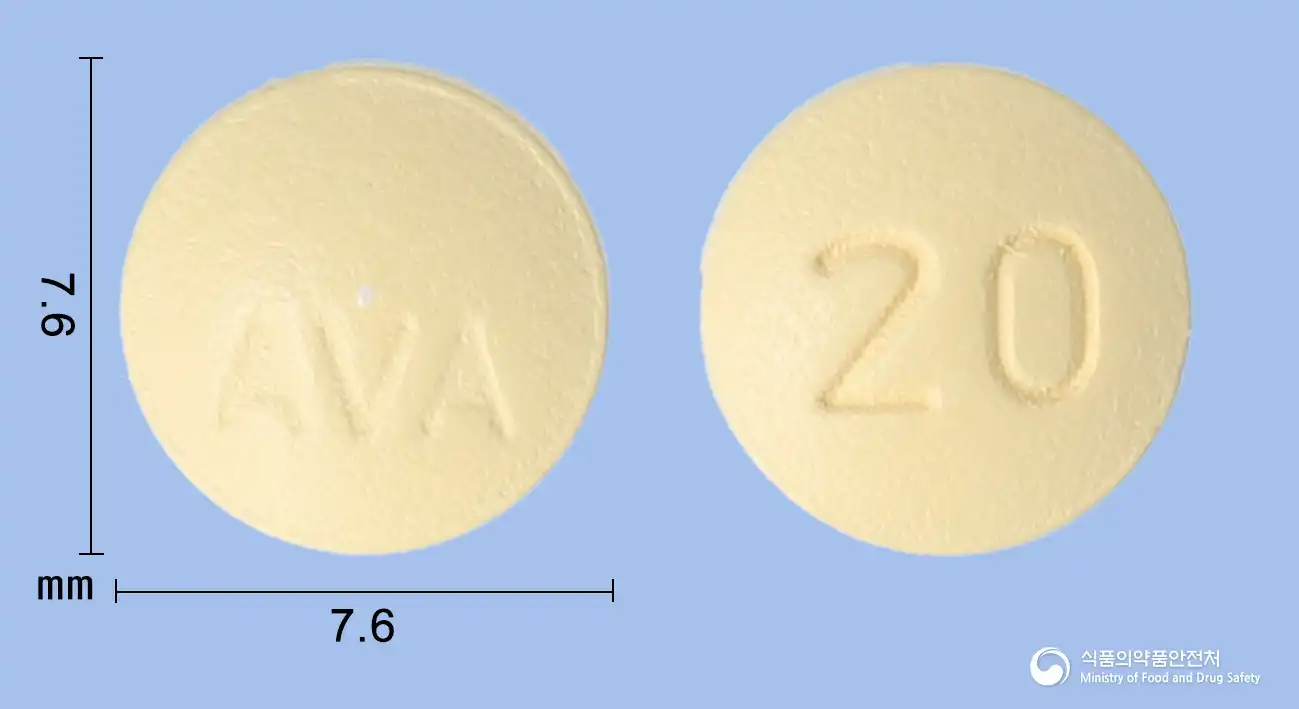
Pale yellow, round, film-coated tablet with 'AVA' engraved on one side and '20' on the other side.
Package unit
10 tablets/box [10 tablets/PTP], 15 tablets/box [15 tablets/PTP], 30 tablets/box [15 tablets/PTP x 2]
Questions about this medicine
No questions yet.
For anything that needs medical judgment, consult a doctor or pharmacist.