한국어
 English
 日本語
 中文(简体)
 Viewing now
Jaypushka Jeong 100 mg (Pertobrutinib)
Pirtobrutinib 100mg
Tablet · Prescription medication
Korea Lilly Co., Ltd.
MFDS item code 202402004 · Approved 2024.08.19 · Insurance code 670801400
Treatment of relapsed or refractory mantle cell lymphoma in adults who have received prior therapy
This medication is used as monotherapy for adult patients with recurrent or refractory mantle cell lymphoma (MCL) who have received two or more prior treatments, including Bruton's tyrosine kinase (BTK) inhibitors. However, there is currently no proven data for the efficacy of this drug through therapeutic confirmation clinical trials. Therefore, it is important to carefully plan treatment in consultation with a physician.
Administer 200mg orally once daily. It should be taken at approximately the same time each day, if possible. Continue treatment until disease progression or unacceptable toxicity occurs. Take this drug with water at a consistent time each day, with or without food. Swallow the drug whole; do not break, crush, or chew it. If more than 12 hours have passed since the missed dose, skip it and take the next dose at the scheduled time. If vomiting occurs, do not take an additional dose; continue with the next scheduled dose. Based on individual safety and tolerability, this drug may be temporarily withheld, the dose may be reduced, or treatment may be permanently discontinued. If any adverse reaction listed in Table 1 occurs, temporarily withhold this drug until the reaction resolves to Grade 1 or baseline. Grade 3 or higher nonhematologic toxicity, Grade 3 neutropenia accompanied by fever and/or infection, Grade 4 neutropenia lasting 7 days or longer, Grade 3 thrombocytopenia accompanied by bleeding, or Grade 4 or higher thrombocytopenia: 1 occurrence: Temporarily withhold this drug until recovery to Grade 1 or baseline. When treatment is resumed, administer 200mg once daily (the original starting dose). 2 occurrences: Temporarily withhold this drug until recovery to Grade 1 or baseline. When treatment is resumed, administer 100mg once daily. 3 occurrences: Temporarily withhold this drug until recovery to Grade 1 or baseline. When treatment is resumed, administer 50mg once daily. 4 occurrences: Permanently discontinue this drug. Do not use this drug concomitantly with a strong CYP3A inhibitor. If concomitant use of a strong CYP3A inhibitor is unavoidable, reduce the dose of this drug to 50mg. If the current dose is 50mg once daily, temporarily withhold treatment with this drug while the strong CYP3A inhibitor is being used. After discontinuing the strong CYP3A inhibitor, resume the dose of this drug that was taken before starting the inhibitor after 5 half-lives have elapsed. Do not use this drug concomitantly with a strong or moderate CYP3A inducer. If concomitant use with a moderate CYP3A inducer is unavoidable and the current dose of this drug is 200mg once daily, increase the dose to 300mg. If the current dose is 50mg or 100mg once daily, increase the dose by 50mg. For patients with severe renal impairment (eGFR 15-29ml/min), if the current dose is 200mg once daily, reduce the dose of this drug to 100mg once daily; if it is 100mg, reduce it to 50mg. If the current dose is 50mg once daily, discontinue this drug. Patients with end-stage renal disease receiving dialysis have not been studied.
This drug should not be used in patients who are allergic to this drug or any of its components. This drug contains lactose, so patients with a genetic disorder that prevents lactose digestion should not take it. Patients with symptoms of infection or at high risk for infections should use this medication cautiously, as there may be an increased risk of infection. If an infection is severe, the medication may be temporarily discontinued. There may be an increased risk of bleeding; therefore, patients with bleeding symptoms or taking anticoagulants or antiplatelet drugs should be particularly cautious. If severe bleeding occurs, discontinuation of the drug may be necessary. Blood cell counts may decrease, so regular blood tests should be conducted. If severe cytopenia develops, drug administration may need to be temporarily discontinued. Cardiac rhythm abnormalities, particularly atrial fibrillation or atrial flutter, may occur; therefore, patients with a history of heart disease should have their heart condition checked regularly. There is a risk of secondary cancers, such as skin cancer, so sun exposure should be avoided and skin conditions should be closely monitored. A rare complication known as tumor lysis syndrome may occur; therefore, patients with a large tumor burden should be particularly cautious. This drug should not be used during pregnancy as it may be harmful to the fetus, and women of childbearing potential and men must use effective contraception during the treatment period and for a certain duration afterward. This medication may cause symptoms like fatigue and dizziness, necessitating caution while driving or operating machinery. There are many drug interactions; therefore, caution is particularly advised when used in combination with drugs that strongly inhibit or induce specific enzymes, and dose adjustments may be required. This medication has not established safety and efficacy in children, and elderly patients may have a higher risk of adverse reactions, so caution is necessary. Patients with compromised liver or kidney function may require special dose adjustments, and particularly those with severe renal impairment should have their dose reduced. In cases of overdose of this drug, there is no specific antidote, so the patient's condition should be closely monitored and general treatment should be applied. This drug must be swallowed whole and should not be crushed, chewed, or broken. Finally, it should be stored out of reach of children in a safe place.
Not everyone experiences these, and they can vary from person to person.
This medication should be stored in a tightly sealed container to prevent air or moisture from entering. Furthermore, it is advisable to store it at room temperature between 1 and 30 degrees Celsius. Doing so will help maintain the medication's efficacy for a longer period.
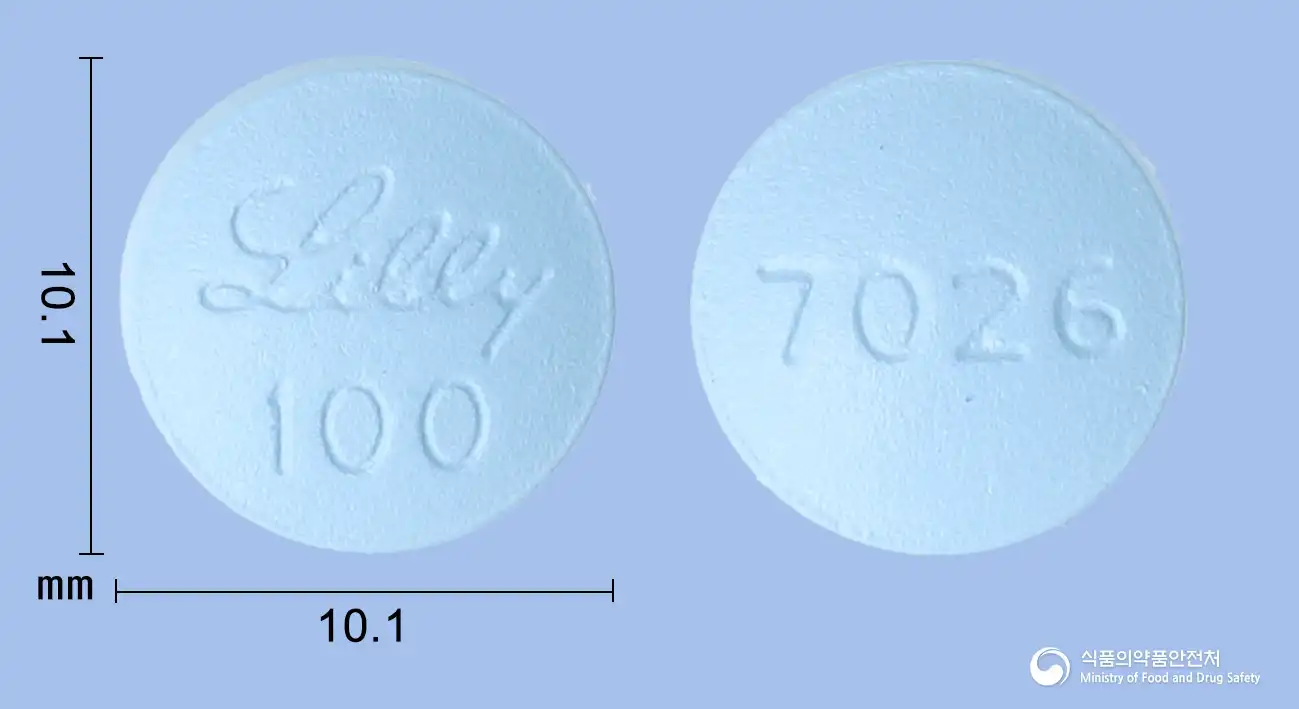
A blue round film-coated tablet, with "Lilly 100" embossed on one side and "7026" embossed on the other side.
Box - 28 tablets/box [14 tablets/PTPX2], Box - 56 tablets/box [14 tablets/PTPX4]
Even with the same ingredient, strength, dosage form and how it is taken can differ.
Even with the same ingredient, the dose and directions can differ by strength and dosage form. Talk to a doctor or pharmacist before switching from a medication you are already taking.
No questions yet.
For anything that needs medical judgment, consult a doctor or pharmacist.
This drug information is based on data provided by the Korea Ministry of Food and Drug Safety.
Consult a doctor or pharmacist for accurate dosage, administration, and usage instructions.