
 한국어
 English
 日本語
 中文(简体)
 Viewing now
Balvesazone 4mg (Erdafitinib)
Erdafitinib 4mg
Tablet · Prescription medication
Korea Janssen Co., Ltd.
MFDS item code 202204248 · Approved 2022.11.24
Treatment of FGFR3-mutated urothelial carcinoma that has progressed after prior treatment
This medication is used to treat adult patients with locally advanced or metastatic urothelial carcinoma that is not amenable to surgical removal and has progressed during or after systemic treatment that includes at least one PD-1 or PD-L1 inhibitor, specifically those with FGFR3 gene mutations.
The recommended starting dose of this drug is 8 mg orally once daily. The dose of this drug may be increased to 9 mg once daily based on serum phosphate levels and tolerability assessed between 14 and 21 days after initiation of treatment. This drug should be swallowed whole, with or without food. If vomiting occurs after taking this drug, take the next dose according to the regular schedule the following day. If a dose of this drug is missed, take it as soon as possible on the same day. Resume the regular dosing schedule for this drug the next day. Do not take an additional dose of this drug to make up for a missed dose. Serum phosphate (PO4) levels should be assessed between 14 and 21 days after initiation of treatment. If the serum phosphate (PO4) level is less than 9.0 mg/dL and there is no ocular disorder or adverse reaction of Grade 2 or higher, increase the dose to 9 mg once daily. Phosphate levels should be monitored monthly. If the phosphate level is 9.0mg/dL or higher, refer to Table 2 and follow the applicable dose modification. After 21 days, serum phosphate levels should not be used as the basis for dose escalation. Table 1. Dose reduction schedule for this drug 9mg: First dose reduction 8mg, second dose reduction 6mg, third dose reduction 5mg, fourth dose reduction 4mg, fifth dose reduction discontinue 8mg: First dose reduction 6mg, second dose reduction 5mg, third dose reduction 4mg, fourth dose reduction discontinue Patients with serum phosphate levels of 5.50 mg/dL (1.75 mmol/L) or higher should restrict their dietary phosphate intake to 600 ∼ 800mg per day. <6.99mg/dL (<2.24mmol/L): Maintain this drug at the current dose. 7.00∼8.99mg/dL (2.25∼2.90mmol/L): Maintain this drug at the current dose. Administer phosphate binders with food until the serum phosphate level is less than 7.00mg/dL. Dose reduction should be implemented if the serum phosphate level remains at 7.00mg/dL or higher for more than 2 months, or if clinically indicated. 9.00~10.00mg/dL (2.91~ 3.20mmol/L): Withhold this drug until the level recovers to less than 7.00mg/dL. (Weekly reassessment is recommended) Administer phosphate binders with food until the serum phosphate level is less than 7.00mg/dL. Then resume this drug at the same dose. Dose reduction should be implemented if the serum phosphate level remains at 9.00mg/dL or higher for more than 1 month, or if clinically indicated. Greater than 10.00mg/dL (greater than 3.20mmol/L): Withhold this drug until the level recovers to less than 7.00mg/dL. (Weekly reassessment is recommended) Then resume this drug at the next lower dose level. This drug should be permanently discontinued if the serum phosphate level remains at 10.00mg/dL or higher for more than 2 weeks. Manage symptoms as clinically appropriate. Significant change in baseline renal function or Grade 3 hypocalcemia due to hyperphosphatemia: This drug should be permanently discontinued. To prevent and treat dry eyes, use artificial tear substitutes, hydration, or lubricating ophthalmic gels or ointments frequently while awake, at least every 2 hours. Grade 1: Refer for an ophthalmologic examination. If an ophthalmologic examination cannot be performed within 7 days, withhold this drug until an examination can be performed. If there is no evidence of ocular toxicity on examination, continue this drug at the same dose level. If keratitis or retinal abnormality (e.g., CSRa) is diagnosed on examination, withhold this drug until recovery. If recovery occurs within 4 weeks (complete recovery and asymptomatic), resume this drug at the next lower dose. Monitor for recurrence every 1~2 weeks for 1 month after resuming treatment and thereafter as clinically appropriate. If there is no recurrence, consider stepwise dose escalation. Grade 2: Immediately withhold this drug and refer for an ophthalmologic examination. If there is no evidence of drug-related corneal or retinal pathology on examination, withhold this drug until recovery. If recovery occurs, resume this drug at the next lower dose. If keratitis or retinal abnormality (e.g., CSR) is diagnosed on examination, withhold this drug until recovery. If recovery occurs within 4 weeks (complete recovery and asymptomatic), resume treatment at the next lower dose. Monitor for recurrence every 1∼2 weeks for 1 month after resuming treatment and thereafter as clinically appropriate. Grade 3: Immediately withhold this drug and refer for an ophthalmologic examination. If recovery occurs within 4 weeks (complete recovery and asymptomatic), treatment with this drug may be resumed at a dose level 2 steps lower. Monitor for recurrence every 1∼2 weeks for 1 month after resuming treatment and thereafter as clinically appropriate. Consider permanent discontinuation of this drug if the condition recurs. Grade 4: Permanently discontinue this drug. Monitor until complete recovery or stabilization. Nail disorder Grade 1: Maintain the current dose Nail disorder Grade 2: Consider withholding treatment and reassess within 1~2 weeks. If the condition resolves to Grade 1 or baseline within 2 weeks after the first occurrence, resume treatment at the existing dose; if it recurs or takes more than 2 weeks to resolve to Grade 1 or baseline, resume treatment at the next lower dose level Nail disorder Grade 3: Withhold treatment and reassess within 1~2 weeks. If the condition resolves to Grade 1 or baseline, resume treatment at the next lower dose level Nail disorder Grade 4: Permanently discontinue treatment Dry skin and skin toxicity Grade 1: Maintain the current dose Dry skin and skin toxicity Grade 2: Maintain the current dose Dry skin and skin toxicity Grade 3: Withhold treatment (for up to 28 days) and reassess weekly. If the condition resolves to Grade 1 or baseline, resume treatment at the next lower dose level Dry skin and skin toxicity Grade 4: Permanently discontinue treatment Oral mucositis Grade 1: Maintain the current dose Oral mucositis Grade 2: Consider withholding treatment if another adverse reaction of Grade 2 or higher is also present. Withhold treatment if symptom management has been ongoing for more than 1 week. If treatment is withheld, reassess within 1~2 weeks. If the condition resolves to Grade 1 or baseline within 2 weeks, resume treatment at the same dose. If it recurs or takes more than 2 weeks to resolve to Grade 1 or baseline, resume treatment at the next lower dose level Oral mucositis Grade 3: Withhold treatment and reassess within 1~2 weeks. If the condition resolves to Grade 1 or baseline, resume treatment at the next lower dose level Oral mucositis Grade 4: Permanently discontinue treatment Dry mouth Grade 1: Maintain the current dose Dry mouth Grade 2: Maintain the current dose Dry mouth Grade 3: Withhold treatment (for up to 28 days) and reassess weekly. If the condition resolves to Grade 1 or baseline, resume treatment at the next lower dose level Dry mouth Grade 4: Permanently discontinue treatment Other adverse reactions Grade 1: Maintain the current dose Other adverse reactions Grade 2: Maintain the current dose; withhold treatment if recovery does not occur within 1 week. If the condition resolves to Grade 1 or baseline, resume treatment at the same dose or the next lower dose level Other adverse reactions Grade 3: Withhold treatment for up to 28 days, with weekly reassessment of clinical status. If the condition resolves to Grade 1 or baseline, resume treatment at the next lower dose level Other adverse reactions Grade 4: Discontinue treatment No dose adjustment is required for patients with mild or moderate renal impairment. Data are limited for patients with severe renal impairment. No dose adjustment is required for patients with mild or moderate hepatic impairment. No data are available for patients with severe hepatic impairment.
This medication should not be used in patients who are allergic to this drug or its components. Various side effects may occur during the course of taking this medication. For example, changes in nails, oral ulcers, diarrhea, fatigue, dry skin, hair loss, and dry eyes are commonly reported. Additionally, it may affect kidney function, as serum phosphate levels may increase or creatinine levels may rise, requiring regular monitoring. Serious eye conditions such as central serous retinopathy may develop during treatment, so regular ophthalmological examinations are necessary after starting therapy, and any changes in vision or visual acuity should be reported to healthcare professionals immediately. Dietary modifications may be necessary due to potentially elevated serum phosphate levels, and phosphate binders may be considered if phosphate levels are high. Pregnant women should use effective contraception before, during, and for a certain period after treatment, as this drug can harm the fetus, and women of childbearing potential are advised to take a pregnancy test before starting treatment. This drug may result in elevated serum concentrations in patients with certain genotypes (CYP2C9*3/*3), thus careful monitoring for side effects is advised in cases where the genotype is known or suspected. Interactions may occur when used in combination with other drugs, especially those affecting CYP3A4 and CYP2C9 enzymes, necessitating dose adjustments or consideration of alternative medications. Pregnant and breastfeeding women should avoid using this medication, and breastfeeding should be discontinued during and for a period after treatment. The safety in pediatric patients has not been established, and animal studies have shown side effects on bones and teeth, therefore it is advisable not to use this drug in children. No special dose adjustments are required for elderly patients, but careful monitoring for side effects is recommended. In case of overdose, administration should be stopped immediately, and general supportive treatment should be provided until symptoms improve. If side effects affecting the eyes occur, it is safer to avoid driving or operating machinery until symptoms have resolved.
Not everyone experiences these, and they can vary from person to person.
This medication may be sensitive to air and moisture; therefore, it should be stored in a tightly closed container. It is important to maintain storage temperatures between 1 to 30 degrees Celsius to ensure the drug's effectiveness is preserved and it is safe for use.
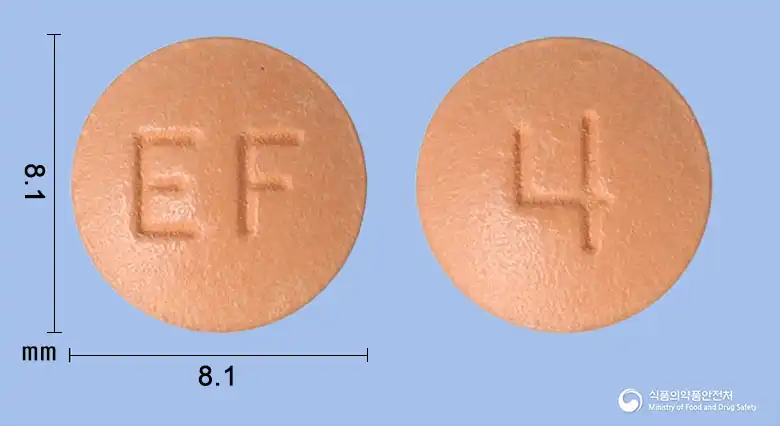
Orange, double convex, round film-coated tablet
28 tablets/bottle, 56 tablets/bottle
Even with the same ingredient, strength, dosage form and how it is taken can differ.
Viewing nowErdafitinib 4mg
Tablet · Prescription medication
Korea Janssen Co., Ltd.
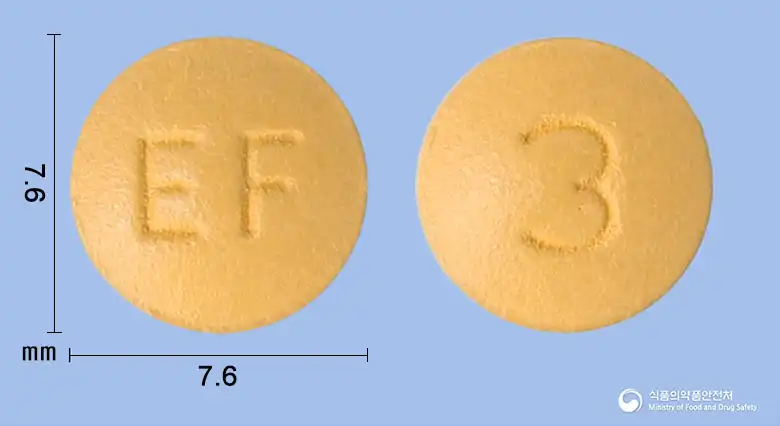
Erdafitinib 3mg
Tablet · Prescription medication
Korea Janssen Co., Ltd.
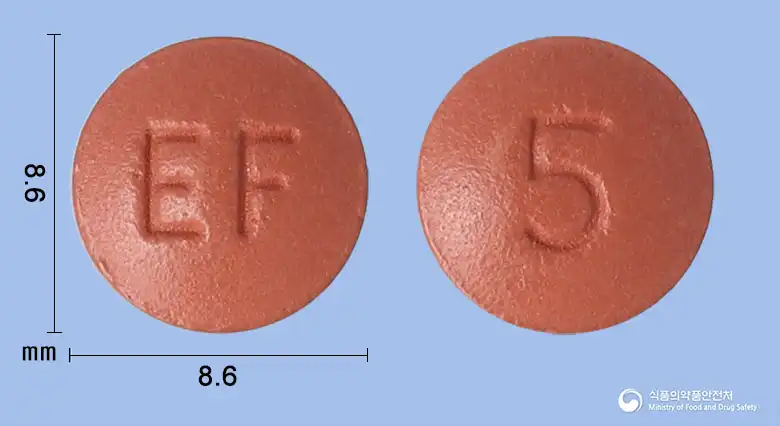
Erdafitinib 5mg
Tablet · Prescription medication
Korea Janssen Co., Ltd.
Even with the same ingredient, the dose and directions can differ by strength and dosage form. Talk to a doctor or pharmacist before switching from a medication you are already taking.
No questions yet.
For anything that needs medical judgment, consult a doctor or pharmacist.
This drug information is based on data provided by the Korea Ministry of Food and Drug Safety.
Consult a doctor or pharmacist for accurate dosage, administration, and usage instructions.