
 한국어
 English
 日本語
 中文(简体)
 Viewing now
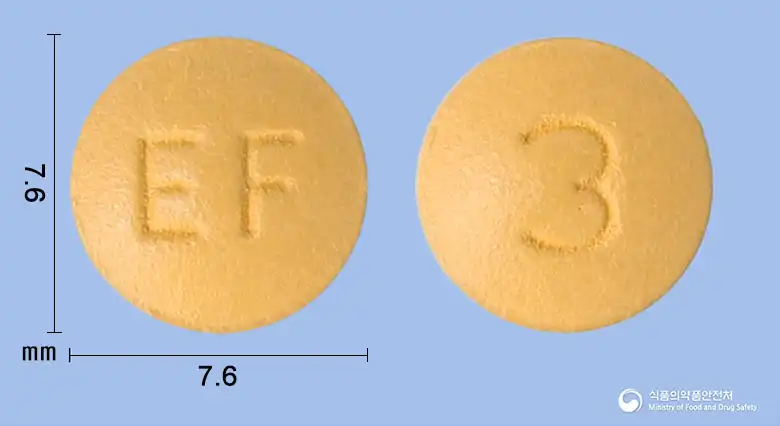
Balbesajeng 3 mg (Erdafitinib)
Erdafitinib 3mg
Tablet · Prescription medication
Korea Janssen Co., Ltd.
MFDS item code 202204247 · Approved 2022.11.24
Treatment of advanced or metastatic urothelial carcinoma with FGFR3 mutations
This medication is used for the treatment of adult patients with unresectable locally advanced or metastatic urothelial carcinoma with FGFR3 gene mutation who have received at least one systemic therapy including a PD-1 or PD-L1 inhibitor, or whose disease has progressed after such treatment.
The recommended starting dose of this drug is 8mg orally once daily. The dose may be increased to 9mg once daily based on serum phosphate levels and tolerability assessed between 14 and 21 days after initiation of treatment. This drug should be swallowed whole, with or without food. If vomiting occurs after taking this drug, take the next dose as scheduled the following day. Treatment should continue until disease progression or unacceptable toxicity occurs. If a dose of this drug is missed, take it as soon as possible on the same day. Resume the regular dosing schedule for this drug the next day. Do not take an additional dose of this drug to make up for a missed dose. Serum phosphate (PO4) levels should be assessed between 14 and 21 days after initiation of treatment. If the serum phosphate (PO4) level is less than 9.0 mg/dL and there is no eye disorder or adverse reaction of Grade 2 or higher, increase the dose to 9mg once daily. Phosphate levels should be monitored monthly. If the phosphate level is 9.0mg/dL or higher, refer to Table 2 and follow the applicable dose adjustment. After 21 days, serum phosphate levels should not be used as the basis for dose escalation decisions. Refer to Tables 1 through 5 for dose reduction and management of adverse reactions. Table 1. Dose reduction schedule for this drug Dose / First dose reduction / Second dose reduction / Third dose reduction / Fourth dose reduction / Fifth dose reduction 9mg / 8mg / 6mg / 5mg / 4mg / Discontinue 8mg / 6mg / 5mg / 4mg / Discontinue Phosphate levels should be monitored monthly. Table 2. Dose adjustment based on serum phosphate levels Patients with serum phosphate levels of 5.50 mg/dL (1.75 mmol/L) or higher should restrict their dietary phosphate intake to 600 ∼ 800mg per day. <6.99mg/dL (<2.24mmol/L): Continue this drug at the current dose. 7.00∼8.99mg/dL (2.25∼2.90mmol/L): Continue this drug at the current dose. Administer phosphate binders with food until the serum phosphate level is less than 7.00mg/dL. If the serum phosphate level remains at 7.00mg/dL or higher for more than 2 months, or if clinically necessary, reduce the dose. 9.00~10.00mg/dL (2.91~ 3.20mmol/L): Withhold this drug until the level returns to less than 7.00mg/dL. (Weekly reassessment is recommended) Administer phosphate binders with food until the serum phosphate level is less than 7.00mg/dL. Then resume this drug at the same dose. If the serum phosphate level remains at 9.00mg/dL or higher for more than 1 month, or if clinically necessary, reduce the dose. Greater than 10.00mg/dL (greater than 3.20mmol/L): Withhold this drug until the level returns to less than 7.00mg/dL. (Weekly reassessment is recommended) Then resume this drug at the next lower dose level. If the serum phosphate level remains at 10.00mg/dL or higher for more than 2 weeks, permanently discontinue this drug. Manage symptoms as clinically appropriate. Significant change in baseline renal function or Grade 3 hypocalcemia due to hyperphosphatemia: Permanently discontinue this drug. Before starting this drug, perform a baseline ophthalmologic examination, including an Amsler grid test, funduscopic examination, visual acuity assessment, and optical coherence tomography, if available. To prevent and treat dry eyes, use artificial tear substitutes, hydration, or lubricating ophthalmic gels or ointments frequently while awake, at least every 2 hours. Severe treatment-related dry eyes should be evaluated by an ophthalmologist. Thereafter, examine the patient monthly, including an Amsler grid test, and if abnormalities are observed, follow the management guidelines in Table 3. Table 3. Recommended dose adjustments for eye disorders associated with use of this drug Grade 1: Asymptomatic or mild; clinical or diagnostic findings only, or abnormal Amsler grid test: Refer for an ophthalmologic examination. If an ophthalmologic examination cannot be performed within 7 days, withhold this drug until the examination can be performed. If there is no evidence of ocular toxicity on ophthalmologic examination, continue this drug at the same dose level. If keratitis or a retinal abnormality (e.g., CSRa) is diagnosed on ophthalmologic examination, withhold this drug until resolution. If resolved within 4 weeks on ophthalmologic examination (complete resolution and asymptomatic), resume this drug at the next lower dose. Monitor for recurrence every 1~2 weeks for one month after resuming treatment, and thereafter as clinically appropriate. If there is no recurrence, consider gradual dose escalation. Grade 2: Moderate; limitation of age-appropriate activities of daily living (ADL, Activities of Daily Living): Immediately withhold this drug and refer for an ophthalmologic examination. If there is no evidence of drug-related corneal or retinal pathology on ophthalmologic examination, withhold this drug until resolution. If resolved, resume this drug at the next lower dose. If keratitis or a retinal abnormality (e.g., CSR) is diagnosed on ophthalmologic examination, withhold this drug until resolution. If resolved within 4 weeks on ophthalmologic examination (complete resolution and asymptomatic), resume at the next lower dose. Monitor for recurrence every 1∼2 weeks for one month after resuming treatment, and thereafter as clinically appropriate. Grade 3: Severe or medically significant but not immediately sight-threatening; limitation of self-care activities of daily living (ADL): Immediately withhold this drug and refer for an ophthalmologic examination. If resolved within 4 weeks (complete resolution and asymptomatic), this drug may be resumed at a dose level 2 steps lower. Monitor for recurrence every 1∼2 weeks for one month after resuming treatment, and thereafter as clinically appropriate. Consider permanent discontinuation of this drug if recurrence occurs. Grade 4: Sight-threatening; blindness (20/200 or less): Permanently discontinue this drug. Monitor until complete resolution or stabilization. Table 4. Recommended dose adjustments for nail, skin, and mucosal adverse reactions associated with use of this drug Nail disorder Grade 1: Maintain the current dose Nail disorder Grade 2: Consider withholding treatment and reassess within 1~2 weeks. If resolved to Grade 1 or baseline within 2 weeks after the first occurrence, resume treatment at the existing dose; if recurrence occurs or resolution to Grade 1 or baseline takes more than 2 weeks, resume treatment at the next lower dose level Nail disorder Grade 3: Withhold treatment and reassess within 1~2 weeks. If resolved to Grade 1 or baseline, resume treatment at the next lower dose level Nail disorder Grade 4: Permanently discontinue treatment Dry skin and skin toxicity Grade 1: Maintain the current dose Dry skin and skin toxicity Grade 2: Maintain the current dose Dry skin and skin toxicity Grade 3: Withhold treatment (for a maximum of 28 days) and reassess weekly. If resolved to Grade 1 or baseline, resume treatment at the next lower dose level Dry skin and skin toxicity Grade 4: Permanently discontinue treatment Oral mucositis Grade 1: Maintain the current dose Oral mucositis Grade 2: Consider withholding treatment if another adverse reaction of Grade 2 or higher is also present. Withhold treatment if symptom management has been ongoing for more than 1 week. If treatment is withheld, reassess within 1~2 weeks. If resolved to Grade 1 or baseline within 2 weeks, resume treatment at the same dose. If recurrence occurs or resolution to Grade 1 or baseline takes more than 2 weeks, resume treatment at the next lower dose level Oral mucositis Grade 3: Withhold treatment and reassess within 1~2 weeks. If resolved to Grade 1 or baseline, resume treatment at the next lower dose level Oral mucositis Grade 4: Permanently discontinue treatment Dry mouth Grade 1: Maintain the current dose Dry mouth Grade 2: Maintain the current dose Dry mouth Grade 3: Withhold treatment (for a maximum of 28 days) and reassess weekly. If resolved to Grade 1 or baseline, resume treatment at the next lower dose level Dry mouth Grade 4: Permanently discontinue treatment Table 5. Recommended dose adjustments for adverse reactions associated with use of this drug Grade 1: Maintain the current dose Grade 2: Maintain the current dose; if not resolved within 1 week, withhold treatment. If resolved to Grade 1 or baseline, resume treatment at the same dose or the next lower dose level Grade 3: Withhold treatment for up to 28 days, with weekly reassessment of clinical status. If resolved to Grade 1 or baseline, resume treatment at the next lower dose level Grade 4: Discontinue treatment No dose adjustment is required in patients with mild or moderate renal impairment. Data are limited for patients with severe renal impairment. No dose adjustment is required in patients with mild or moderate hepatic impairment. No data are available for patients with severe hepatic impairment.
This drug should not be administered to patients with hypersensitivity to this drug or its components. Various adverse reactions may occur while taking this drug, so caution is needed. The most common adverse reactions include increased phosphate levels, nail disorders, oral inflammation, diarrhea, increased creatinine (a marker of kidney function), elevated liver enzyme levels, anemia, decreased sodium, fatigue, dry mouth, dry skin, decreased appetite, taste abnormalities, constipation, hair loss, dry eyes, and erythema with sensory abnormalities on the palms and soles. This drug can affect the eyes, causing central serous retinopathy leading to visual defects, thus regular ophthalmic examinations are necessary during treatment, and any visual disturbances should be examined immediately. Additionally, this drug can increase blood phosphate levels, and prolonged hyperphosphatemia can lead to various health issues, so phosphate levels need to be periodically monitored through blood tests. If phosphate levels are elevated, dietary adjustments or medication may be needed. Women who are pregnant should not take this drug as it may harm the fetus; therefore, effective contraception should be practiced before, during, and after treatment. Women of childbearing potential are recommended to take a pregnancy test before starting treatment. This drug may interact with enzymes that metabolize in the liver; therefore, caution for drug interactions is advised when taking other medications, especially those that inhibit or induce certain enzymes may require dose adjustments. To ensure child safety, this drug must be kept out of reach of children and stored in its original container to maintain quality. In case of overdose, treatment should be discontinued immediately, and appropriate care should be taken until symptoms improve. Extra caution should be exercised when driving or operating machinery if any visual disturbances occur.
Not everyone experiences these, and they can vary from person to person.
This medication may be sensitive to air or moisture, so it should be stored in a tightly sealed container. It is recommended to keep the storage temperature between 1 to 30 degrees Celsius to maintain the medication's efficacy and safety for a longer time.
Yellow, biconvex, round film-coated tablets
56 tablets/bottle, 84 tablets/bottle
Even with the same ingredient, strength, dosage form and how it is taken can differ.
Viewing nowErdafitinib 3mg
Tablet · Prescription medication
Korea Janssen Co., Ltd.
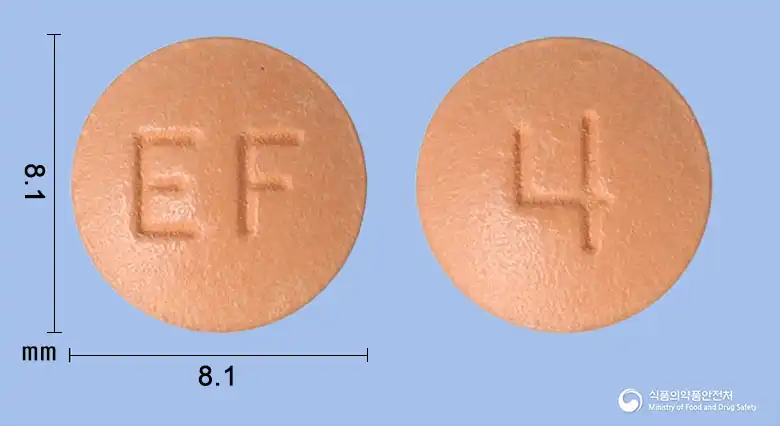
Erdafitinib 4mg
Tablet · Prescription medication
Korea Janssen Co., Ltd.
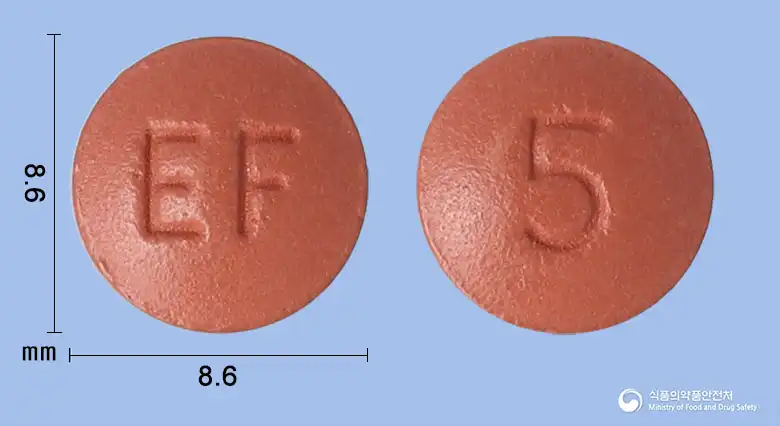
Erdafitinib 5mg
Tablet · Prescription medication
Korea Janssen Co., Ltd.
Even with the same ingredient, the dose and directions can differ by strength and dosage form. Talk to a doctor or pharmacist before switching from a medication you are already taking.
No questions yet.
For anything that needs medical judgment, consult a doctor or pharmacist.
This drug information is based on data provided by the Korea Ministry of Food and Drug Safety.
Consult a doctor or pharmacist for accurate dosage, administration, and usage instructions.