한국어
 English
 日本語
 中文(简体)
 Viewing now
Giselleca 100 mg (Filgotinib Maleate)
Filgotinib Maleate 127.24mg
Tablet · Prescription medication
Eisai Korea Co., Ltd.
MFDS item code 202201296 · Approved 2022.04.01 · Insurance code 621100270
Treatment of rheumatoid arthritis and ulcerative colitis
This medicine is used only when there is an appropriate response to previous treatments or when they are intolerable. It is primarily administered cautiously to patients aged 65 and older, those in high cardiovascular risk groups, and patients at risk of malignancy. It is used for the treatment of moderate to severe active rheumatoid arthritis patients who have not responded to one or more disease-modifying antirheumatic drugs (DMARDs) or cannot tolerate them. This medicine can be used in combination with methotrexate (MTX) but should not be combined with other biological DMARDs or Janus kinase inhibitors. For ulcerative colitis patients, it is used for moderate to severe active disease that has not responded to existing treatments or biological agents. This medicine is effectively used for the treatment of refractory rheumatoid arthritis and ulcerative colitis.
The recommended dose of this medicine for adult patients with rheumatoid arthritis is 200 mg once daily. For adults at increased risk of venous thromboembolism (VTE), major adverse cardiovascular events (MACE), and malignancy, the recommended dose of this medicine is 100mg once daily; if disease control is inadequate, the dose may be increased to 200mg once daily. If this medicine is used long term, the lowest effective dose should be used. The recommended induction dose is 200 mg once daily. For patients with ulcerative colitis who do not show adequate therapeutic benefit during the first 10 weeks of induction therapy, an additional 12 weeks of induction therapy (200 mg once daily) may be given to provide further relief of symptoms. If no therapeutic benefit is observed after 22 weeks of treatment, this medicine should be discontinued. The recommended maintenance dose is 200 mg once daily. For adults at increased risk of venous thromboembolism (VTE), major adverse cardiovascular events (MACE), and malignancy, the recommended maintenance dose is 100mg once daily; if the disease worsens, the dose may be increased to 200mg once daily. If this medicine is used long term, the lowest effective dose should be used. Do not initiate treatment if ANC is <1 × 10⁹ cells/L; discontinue treatment if the patient is receiving it. Treatment may be resumed when ANC recovers to at least this level. Do not initiate treatment if ALC is <0.5 × 10⁹ cells/L; discontinue treatment if the patient is receiving it. Treatment may be resumed when ALC recovers to at least this level. Do not initiate treatment if Hb is <8 g/dL; discontinue treatment if the patient is receiving it. Treatment may be resumed when Hb recovers to at least this level. Before treatment initiation and thereafter, follow routine patient management. Starting 12 weeks after treatment initiation, follow international clinical guidelines for hyperlipidemia. If the patient develops a serious infection, treatment should be interrupted until the infection is controlled. The recommended dose for patients aged 65 years and older with rheumatoid arthritis is 100mg once daily; if disease control is inadequate, the dose may be increased to 200mg once daily. If this medicine is used long term, the lowest effective dose should be used. For patients aged 65 years and older with ulcerative colitis, the recommended induction dose is 200 mg once daily, and the recommended maintenance dose is 100 mg once daily. If the disease worsens, the dose may be increased to 200mg once daily. If this medicine is used long term, the lowest effective dose should be used. There is no experience with administration in patients aged 75 years and older. No dose adjustment is necessary in patients with mild renal impairment (creatinine clearance [CrCl] 60 mL/min or greater). For patients with moderate or severe renal impairment (CrCl 15 mL/min or greater and less than 60 mL/min), administration of this medicine 100 mg once daily is recommended. This medicine has not been studied in patients with end-stage renal disease (CrCl less than 15 mL/min); therefore, its use is not recommended in patients with end-stage renal disease. No dose adjustment is necessary in patients with mild or moderate hepatic impairment (Child‑Pugh A or B). This medicine has not been studied in patients with severe hepatic impairment (Child‑Pugh C); therefore, its use is not recommended in patients with severe hepatic impairment. This medicine is administered orally with or without food. Whether this medicine can be chewed, crushed, or divided has not been studied; swallowing it whole is recommended.
The safety and efficacy of this medicine have not been established in children under 18 years of age.
This medicine poses a risk of serious infections, hence careful evaluation is necessary before administration to patients with a history of chronic infections or tuberculosis, or those with underlying conditions that make them susceptible to infections. Symptoms of infection should be closely monitored during and after treatment, and if an infection occurs, drug administration may be temporarily suspended along with appropriate treatment. Elderly patients and those with diabetes should be particularly vigilant as they are at higher risk of infections. This medicine may increase the mortality and risk of cardiovascular adverse reactions in patients with cardiovascular risks; thus, it should be used cautiously in patients aged 65 and older or with cardiovascular risk factors. Tuberculosis testing should be performed before starting treatment, and appropriate anti-tuberculosis therapy should be received if latent tuberculosis is present. Monitoring for viral reactivation, especially the risk of herpes zoster, is necessary, including tests for viral hepatitis. There is also a risk of malignancies; therefore, patients with a history of skin cancer or risk factors for malignancies require regular check-ups and careful evaluations. Hematological abnormalities may occur, so regular monitoring of neutrophil count, lymphocyte count, and hemoglobin levels is necessary, with discontinuation of treatment in cases of abnormalities. Live vaccine administration is not recommended during treatment or immediately before, and it is advisable to complete necessary vaccinations prior to starting treatment. There is a risk of thrombosis, so caution should be exercised in elderly, obese, or patients with a history of thrombosis, and treatment should be immediately stopped and assessed if thrombotic symptoms appear. As this medicine has immunosuppressive effects, combining it with other immunosuppressants or biological agents is not recommended. Women who are pregnant or may become pregnant, and nursing mothers should not use this medicine, and fertile women should use effective contraception for at least one week during and after treatment. Safety and efficacy in children under 18 years of age have not been established. This medicine may increase lipid levels, so lipid profiles should be monitored regularly and appropriate treatments should be undertaken as needed. Dizziness and lightheadedness may occur, so caution is needed when driving or operating machinery. In cases of overdose, vital signs and clinical status should be closely monitored, as there is no specific antidote, so supportive therapy should be relied upon. This medicine should be stored out of reach of children and not be transferred to other containers.
Not everyone experiences these, and they can vary from person to person.
This medicine must be stored in a tightly closed container to prevent air and moisture exposure, and should be kept at room temperature between 1°C and 30°C. Therefore, it should be kept away from extremes of heat or cold, and in a cool place that is not exposed to direct sunlight.
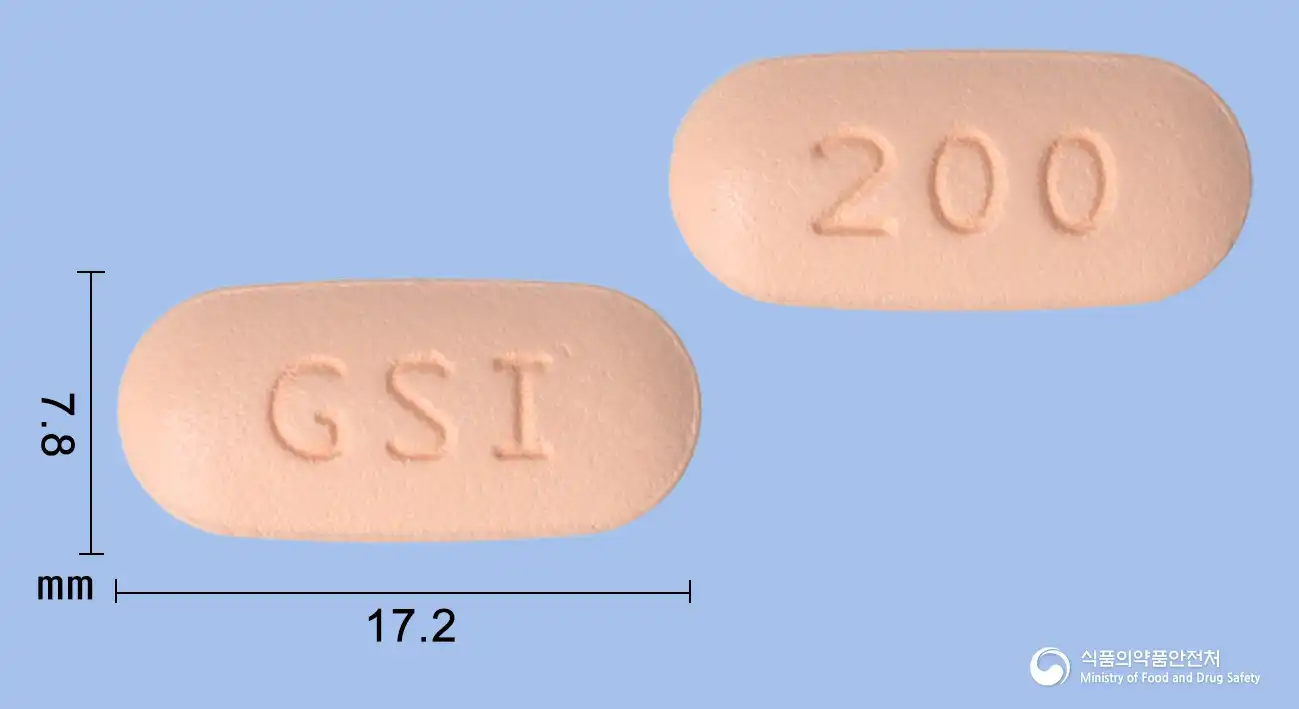
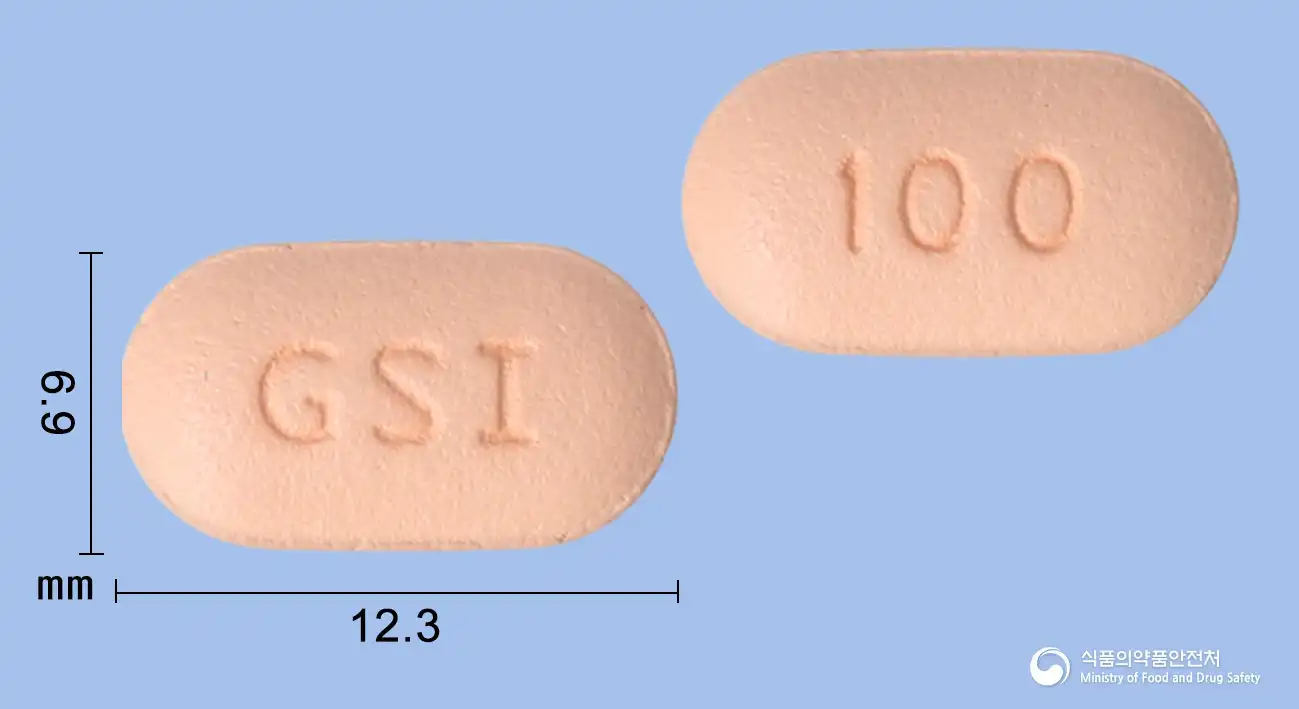
Beige film-coated tablet, oblong, with “GSI” engraved on one side and “100” engraved on the other side.
30 tablets/bottle, 14 tablets/box [(14 tablets/blister x 1)]
Even with the same ingredient, strength, dosage form and how it is taken can differ.
Even with the same ingredient, the dose and directions can differ by strength and dosage form. Talk to a doctor or pharmacist before switching from a medication you are already taking.
No questions yet.
For anything that needs medical judgment, consult a doctor or pharmacist.
This drug information is based on data provided by the Korea Ministry of Food and Drug Safety.
Consult a doctor or pharmacist for accurate dosage, administration, and usage instructions.