
 한국어
 English
 日本語
 中文(简体)
 Viewing now
Onyurek 200 mg (Azacitidine)
Azacitidine 200mg
Tablet · Prescription medication
(Yoo) Han-Kuk BMS Pharmaceuticals Co., Ltd.
MFDS item code 202201163 · Approved 2022.03.23 · Insurance code 658700720
Maintenance treatment after remission of acute myeloid leukemia in adults ineligible for transplantation
This drug is used for maintenance therapy in adult patients with acute myeloid leukemia who are not suitable for hematopoietic stem cell transplantation and who have achieved complete remission (CR) or complete remission with incomplete hematological recovery (CRi) following induction therapy, regardless of consolidation therapy.
1. Method of administration This medicine should be swallowed whole with water at approximately the same time each day. The tablets must not be split, crushed, dissolved, or chewed. This medicine may be taken with or without food (see “14. Precautions for storage and handling”). 2. Recommended dose and dosing schedule Patients should receive an antiemetic 30 minutes before taking this medicine during the first 2 cycles. If no nausea or vomiting occurs during the first 2 cycles, antiemetic prophylaxis may be omitted thereafter (see “5. General precautions”). The recommended dose is azacitidine 300 mg orally once daily. Each repeated cycle consists of a 14-day treatment period followed by a 14-day rest period (28-day treatment cycle). Treatment with this medicine should continue until 15% or fewer blasts are observed in peripheral blood or bone marrow, or unacceptable toxicity occurs. 3. Laboratory tests A complete blood count should be performed before starting treatment. Monitoring should be performed every 2 weeks during the first 2 cycles (56 days) after starting treatment and after dose adjustment, and monthly thereafter (before the start of each subsequent treatment cycle) (see “5. General precautions”). Do not administer this medicine if the absolute neutrophil count on Day 1 of a cycle is less than 0.5 × 10⁹/L. Delay the start of the cycle until the absolute neutrophil count is at least 0.5 × 10⁹/L. 4. Dose schedule adjustment for relapse of acute myeloid leukemia In the event of disease relapse, with 5%~15% blasts in peripheral blood or bone marrow, based on clinical evaluation, extending the dosing schedule from 14 days to 21 days during repeated 28-day cycles should be considered. Treatment should not exceed 21 days in a 28-day period. This medicine should be discontinued if 15% or more blasts are observed in peripheral blood or bone marrow, or if the physician considers discontinuation necessary. 5. Dose modifications for adverse reactions Dose modification guidelines for hematologic and nonhematologic adverse reactions are recommended based on clinical and laboratory findings (see Table 1). Table 1. Dose modifications for hematologic and nonhematologic adverse reactions Criteria* Recommended action Grade 4 neutropenia or Grade 3 neutropenia accompanied by fever First occurrence • Discontinue this medicine. When neutropenia recovers to Grade 2 or lower, resume the treatment cycle at the same dose. • If clinically necessary, use supportive care such as granulocyte colony-stimulating factor (GCSF) (see “5. General precautions”). Occurrence in 2 consecutive cycles • Discontinue this medicine. When neutropenia recovers to Grade 2 or lower, resume the treatment cycle at the reduced dose of 200 mg. • If the patient continues to experience toxicity after dose reduction, shorten the treatment duration to 7 days. • If toxicity persists or recurs after dose reduction and schedule shortening, discontinue this medicine. • If clinically necessary, use supportive care such as granulocyte colony-stimulating factor (GCSF) (see “5. General precautions”). Grade 4 thrombocytopenia or Grade 3 thrombocytopenia accompanied by bleeding First occurrence • Discontinue this medicine. When thrombocytopenia recovers to Grade 2 or lower, resume the treatment cycle at the same dose. Occurrence in 2 consecutive cycles • Discontinue this medicine. When thrombocytopenia recovers to Grade 2 or lower, resume the treatment cycle at the reduced dose of 200 mg. • If the patient continues to experience toxicity after dose reduction, shorten the treatment duration to 7 days. • If toxicity persists or recurs after dose reduction and schedule shortening, discontinue this medicine. Grade 3 or higher nausea, vomiting, or diarrhea • Discontinue this medicine. When the toxicity recovers to Grade 1 or lower, resume the treatment cycle at the same dose. • If symptoms occur, use supportive care such as antiemetics and antidiarrheal agents (see “5. General precautions”). • If symptoms recur, interrupt treatment until recovery to Grade 1 or lower, then resume at a dose of 200 mg. • If the patient continues to experience toxicity after dose reduction, shorten the treatment duration to 7 days. • If toxicity persists or recurs after dose reduction and schedule shortening, discontinue this medicine. Other Grade 3 or higher nonhematologic events • Discontinue this medicine and provide medical support in accordance with local recommendations. When the toxicity recovers to Grade 1 or lower, resume the treatment cycle at the same dose. • If the toxicity recurs, discontinue this medicine until recovery to Grade 1 or lower, then resume at the reduced dose of 200 mg. • If the patient continues to experience toxicity after dose reduction, shorten the treatment duration to 7 days. • If toxicity persists or recurs after dose reduction and schedule shortening, discontinue this medicine. * Grade 1 is mild, Grade 2 is moderate, Grade 3 is severe, and Grade 4 is life-threatening. Toxicity grades are based on the National Cancer Institute Common Terminology Criteria for Adverse Events Version 4.3 (NCI-CTCAE v4.3) 6. Missed or delayed doses If a dose of this medicine is missed or is not taken at the usual time, take it as soon as possible on the same day. Then take the next scheduled dose at the original time the following day. Do not take 2 doses on the same day. If the medicine is vomited, do not take another dose of this medicine on the same day. Instead, take it at the original time the following day.
This drug can pose serious risks to the fetus if taken during pregnancy, so women of childbearing potential must use effective contraception during and at least 6 months after treatment. Men must also ensure that their partner does not become pregnant during treatment and for at least 3 months after. This drug should not be used by individuals allergic to the active ingredient or excipients, breastfeeding women, or patients with certain hereditary lactose intolerance diseases. Patients with poor kidney or liver function should exercise caution when using this drug, and dosage adjustment or monitoring of side effects may be necessary. This drug may reduce blood cell counts and increase the risk of infection, so if fever or bleeding symptoms occur, the healthcare provider should be notified immediately. Common gastrointestinal side effects include nausea, vomiting, and diarrhea; if these symptoms occur, prompt treatment and dose adjustment may be required. This drug may weaken the immune system and increase the risk of infections such as pneumonia. If symptoms of infection occur, consult a healthcare provider immediately. Fatigue or dizziness may occur when taking this drug, so caution is needed when driving or operating machinery. In the case of overdose, regular blood tests and supportive therapy are important; there is no specific antidote. This drug is cytotoxic, so care should be taken to avoid contact with skin or mucous membranes when handling it, and if contact occurs, wash the area immediately with soap and water.
Not everyone experiences these, and they can vary from person to person.
This drug should be stored in an airtight container to prevent air exposure, and it is best kept at room temperature between 1°C and 30°C. Proper storage will help maintain the drug's efficacy for a longer time.
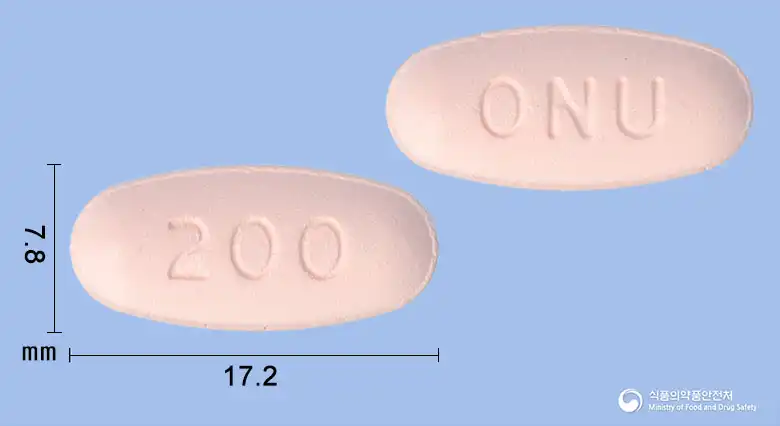
Pink oval film-coated tablet with '200' on one side and 'ONU' embossed on the other side
7 tablets/box [7 tablets/blister X 1]
Even with the same ingredient, strength, dosage form and how it is taken can differ.
Viewing nowAzacitidine 200mg
Tablet · Prescription medication
(Yoo) Han-Kuk BMS Pharmaceuticals Co., Ltd.
Azacitidine 100mg
Prescription medication
(Yoo) Korea BMS Pharmaceuticals Co., Ltd.
Azacitidine 100mg
Injections · Prescription medication
Boryung Pharmaceutical Co., Ltd.
Azacitidine 150mg
Injections · Prescription medication
Samyang BioPharm Co., Ltd.
Azacitidine 100mg
Injections · Prescription medication
Samhyang Biopharm Co., Ltd.
Azacitidine 300mg
Tablet · Prescription medication
Korean BMS Pharmaceutical Co., Ltd.
Even with the same ingredient, the dose and directions can differ by strength and dosage form. Talk to a doctor or pharmacist before switching from a medication you are already taking.
No questions yet.
For anything that needs medical judgment, consult a doctor or pharmacist.
This drug information is based on data provided by the Korea Ministry of Food and Drug Safety.
Consult a doctor or pharmacist for accurate dosage, administration, and usage instructions.