
 한국어
 English
 日本語
 中文(简体)
 Viewing now
Linvak Extended Release Tablet 30 mg (Upadacitinib Hydrate)
Upadacitinib Hemihydrate 15.4mg
Tablet · Prescription medication
AbbVie Korea Co., Ltd.
MFDS item code 202201070 · Approved 2022.03.15 · Insurance code 624900380
Treatment of ulcerative colitis, Crohn's disease, and atopic dermatitis
This medication is used in patients over 65 years of age, in high-risk cardiovascular groups, and in patients with malignancy risk who do not sufficiently respond to or tolerate conventional therapies. It is primarily used for adults and adolescents over 12 years of age with moderate to severe atopic dermatitis requiring systemic therapy. It is also used for patients with moderate to severe active ulcerative colitis and Crohn's disease who do not respond to or tolerate conventional treatments or biological agents. This medication is cautiously selected for patients with complex immune-related disorders, helping to improve symptoms.
Atopic dermatitis The recommended dose for patients 65 years and older is 15 mg once daily. Ulcerative colitis Induction therapy: Administer 45mg once daily for 8 weeks. For patients who do not achieve an adequate therapeutic benefit after 8 weeks of treatment, this drug 45mg may be continued once daily for an additional 8 weeks. Discontinue this drug in these patients if no therapeutic benefit is observed after 16 weeks of treatment. Maintenance therapy: Administer 15mg or 30mg once daily. The recommended dose for patients 65 years and older is 15mg once daily. Crohn's disease Induction therapy: Administer 45mg once daily for 12 weeks. For patients who do not achieve sufficient therapeutic benefit after the first 12 weeks of induction therapy, an additional 12-week course of 30mg once daily may be considered. Discontinue this drug in these patients if no therapeutic benefit is observed after 24 weeks of treatment. Maintenance therapy: Administer 15mg or 30mg once daily. For patients 65 years and older, the recommended maintenance dose is 15 mg once daily. If you miss a dose and there are 10 hours or more until your next dose, take it as soon as possible. Take subsequent doses regularly at the scheduled time. If you miss a dose and there are less than 10 hours until your next dose, skip the missed dose and take your usual dose the following day. Do not take two doses at once to make up for a missed dose. Do not initiate treatment in patients with an absolute lymphocyte count (ALC) less than 500 cells/mm3, an absolute neutrophil count (ANC) less than 1000 cells/mm3, or a hemoglobin level less than 8 g/dL. If ANC is <1000 cells/mm3, treatment should be interrupted and may be resumed when ANC recovers to at least this level. If ALC is <500 cells/mm3, treatment should be interrupted and may be resumed when ALC recovers to at least this level. If Hb is <8 g/dL, treatment should be interrupted and may be resumed when Hb recovers to at least this level. If drug-induced liver injury is suspected, treatment should be temporarily interrupted. If a serious infection occurs, treatment with this drug should be interrupted until the infection is controlled. Patients 75 years and older have not been studied. Patients 75 years and older have not been studied. No dose adjustment is necessary in patients with mild or moderate renal impairment. Use of this drug in patients with end-stage renal disease has not been studied. Severe renal impairment: Atopic dermatitis 15mg; ulcerative colitis and Crohn's disease induction therapy: 30mg, maintenance therapy: 15mg. No dose adjustment is necessary in patients with mild (Child Pugh A) or moderate (Child Pugh B) hepatic impairment. Use of this drug is not recommended in patients with severe hepatic impairment (Child-Pugh C).
Atopic dermatitis, adults (18 years and older) and adolescents weighing 40kg or more (12 years and older): Administer 15 mg once daily. Based on the individual patient's symptoms, 30 mg may be administered once daily. Atopic dermatitis, adolescents weighing less than 40kg: This drug has not been studied in adolescents weighing less than 40kg. Atopic dermatitis, adolescents weighing less than 40kg: The safety and efficacy of this drug have not been established. No data are available. Atopic dermatitis, children under 12 years of age: The safety and efficacy of this drug have not been established. No data are available. Ulcerative colitis, Crohn's disease, children under 18 years of age: The safety and efficacy of this drug have not been established. No data are available.
This medication may affect immune function, increasing the risk of serious infections. Serious infections such as pneumonia or soft tissue infections have been reported, so if there are any infection symptoms, immediate consultation with a healthcare professional is necessary. Patients with active infections or tuberculosis should not use this medication, and those at high risk for infections should be carefully evaluated before administration. This medication may increase the risk of cardiovascular mortality in patients over 50 years of age, so caution should be exercised in those with cardiovascular disease risk factors. Additionally, there may be an increased risk of malignancies, so those with a history of cancer or smoking should be particularly cautious. Due to the risk of thrombosis, patients at risk for thromboembolism should avoid using this medication, and if symptoms of thrombosis occur, immediate treatment should be sought. Before administration, tuberculosis screening must be conducted, and appropriate treatment should be initiated if latent tuberculosis is confirmed. There is a risk of viral infection reactivation, especially herpes zoster, so if symptoms occur, consideration should be given to discontinuing the medication. Live vaccinations should be avoided during the use of this medication, and necessary vaccinations should be completed prior to administration. Hypersensitivity reactions may occur, so if allergic symptoms develop, discontinue the medication immediately and inform healthcare professionals. Due to the risk of gastrointestinal perforation, patients with a history of gastrointestinal diseases should be monitored closely, and if there are symptoms such as abdominal pain, swift evaluation is necessary. Careful monitoring is needed for initiation or continuation of treatment if blood tests show low levels of neutrophils, lymphocytes, or hemoglobin. It is safer not to use this medication in combination with other immunosuppressants, and since drug residues may be excreted in feces, healthcare professionals should be informed if there are any abnormalities. Pregnant women or women of childbearing potential, as well as breastfeeding mothers, should not use this medication, and effective contraception is needed during treatment. Caution is advised when driving or operating machinery as dizziness or lightheadedness may occur.
Not everyone experiences these, and they can vary from person to person.
This medication should be stored in a tightly closed container to protect it from air and moisture. The suitable storage temperature is a cool place between 1 degree and 25 degrees. Caution should be taken as storing it in excessively hot or cold places may reduce its efficacy.
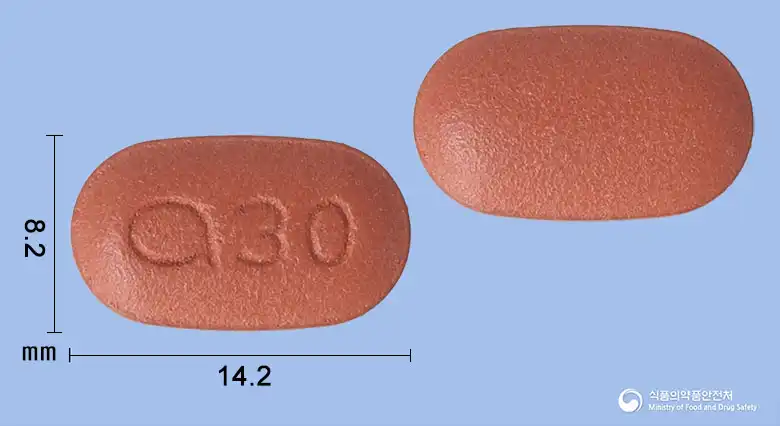
A red, bi-convex, rectangular extended-release film-coated tablet engraved with "a30" on one side.
28 tablets/box [7 tablets/PPT*4]
Even with the same ingredient, strength, dosage form and how it is taken can differ.
Viewing nowUpadacitinib Hemihydrate 15.4mg
Tablet · Prescription medication
AbbVie Korea Co., Ltd.
Upadacitinib Hemihydrate 15.4mg
Tablet · Prescription medication
AbbVie Korea Co., Ltd.
Even with the same ingredient, the dose and directions can differ by strength and dosage form. Talk to a doctor or pharmacist before switching from a medication you are already taking.
No questions yet.
For anything that needs medical judgment, consult a doctor or pharmacist.
This drug information is based on data provided by the Korea Ministry of Food and Drug Safety.
Consult a doctor or pharmacist for accurate dosage, administration, and usage instructions.