한국어
 English
 日本語
 中文(简体)
 Viewing now
Letevmo Capsule 80 mg (Selpercatinib)
Selpercatinib 80mg
Hard capsule · Prescription medication
Eli Lilly Korea, Inc.
MFDS item code 202200999 · Approved 2022.03.11
Treatment of RET fusion-positive thyroid cancer and non-small cell lung cancer, and RET-mutant medullary thyroid cancer
This medication is used for the treatment of locally advanced or metastatic non-small cell lung cancer and medullary thyroid cancer with RET gene fusion or mutation, as well as for patients with progressive or metastatic thyroid cancer who have previously received specific treatments. Patients should be aware that this drug has been approved based on overall response rates, and clinical benefits such as an increase in survival duration have not yet been proven. This drug plays a crucial role in treating cancer patients with RET gene mutations and is used appropriately depending on the patient’s condition. In summary, it is used for the treatment of RET fusion-positive non-small cell lung cancer and RET mutation thyroid cancer.
Administer this drug orally twice daily (approximately every 12 hours) until disease progression or unacceptable toxicity occurs. Swallow the capsules whole. Do not crush or chew the capsules. Do not take a missed dose unless at least 6 hours remain before the next scheduled dose. If vomiting occurs after taking this drug, do not take an additional dose; take the next dose at the next scheduled time. Avoid concomitant use of this drug with proton pump inhibitors, histamine-2 (H2) receptor antagonists, or locally acting antacids. If concomitant use cannot be avoided: • Administer this drug with food when used concomitantly with a proton pump inhibitor. • Administer this drug 2 hours before or 10 hours after an H2 receptor antagonist. • Administer this drug 2 hours before or 2 hours after a locally acting antacid. Permanently discontinue this drug in patients who do not tolerate 3 dose reductions. Avoid concomitant use of this drug with strong and moderate CYP3A inhibitors. If concomitant use with a strong or moderate CYP3A inhibitor cannot be avoided, reduce the dose of this drug according to Table 3. After discontinuing the inhibitor for 3~5 times its elimination half-life, resume this drug at the dose administered before starting the CYP3A inhibitor. Concomitant use with a moderate CYP3A inhibitor: Current dose of this drug: 120mg orally twice daily → Recommended dose of this drug: 80mg orally twice daily Current dose of this drug: 160mg orally twice daily → Recommended dose of this drug: 120mg orally twice daily Concomitant use with a strong CYP3A inhibitor: Current dose of this drug: 120mg orally twice daily → Recommended dose of this drug: 40mg orally twice daily Current dose of this drug: 160mg orally twice daily → Recommended dose of this drug: 80mg orally twice daily For patients with severe hepatic impairment, reduce the recommended dose of this drug according to the recommendations in Table 4. Current dose of this drug: 120mg orally twice daily → Recommended dose of this drug: 80mg orally twice daily Current dose of this drug: 160mg orally twice daily → Recommended dose of this drug: 80mg orally twice daily
Less than 50kg: 120mg 50kg or more: 160mg Patients weighing less than 50kg, first-line: 80mg orally twice daily Patients weighing 50kg or more, first-line: 120mg orally twice daily Patients weighing less than 50kg, second-line: 40mg orally twice daily Patients weighing 50kg or more, second-line: 80mg orally twice daily Patients weighing less than 50kg, third-line: 40mg orally once daily Patients weighing 50kg or more, third-line: 40mg orally twice daily
This medication should not be used in patients who are allergic to this medication or its components. Patients with liver dysfunction should use this medication with caution, and liver function tests should be performed every two weeks for the first three months after starting treatment, and thereafter monthly. If severe liver dysfunction occurs, treatment with this drug should be discontinued or the dose should be reduced. There may be respiratory symptoms or pulmonary disease symptoms, so if symptoms such as difficulty breathing, cough, or fever occur, you should be examined immediately and stop medication if necessary. Hypertension may occur frequently, so blood pressure should be well-controlled before administration and measured regularly after administration, with adjustment of antihypertensive medication if necessary. This medication may affect cardiac electrical activity, so patients with heart disease or a risk of QT interval prolongation should undergo cardiac examinations periodically. There is a risk of bleeding, so if bleeding symptoms appear, the medication should be stopped immediately and treatment should be initiated. Allergic reactions may occur, so if symptoms such as rash, fever, or joint pain appear, the use of this medication should be stopped and medical treatment should be administered as directed by a physician. Tumor lysis syndrome may occur, so high-risk patients should implement preventive measures such as hydration and be closely monitored. It may affect wound healing, so the medication should be discontinued for a certain period before and after surgery, and should not be resumed until the wound has completely healed. Hypothyroidism may occur, so regular thyroid function tests should be conducted, and thyroid hormone treatment should be administered if necessary. During pregnancy, it may be harmful to the fetus, so pregnant women or women of childbearing potential should take effective contraception while taking this medication, and males should ensure that their partners do not become pregnant. In pediatric and adolescent patients, it may affect bone growth, so monitoring of growth plate status is necessary, and treatment should be adjusted if necessary. There are many drug interactions, so caution must be taken when combined with antacids, CYP3A inhibitors or inducers, and drugs that prolong the QT interval, and should consult a doctor or pharmacist. In patients with severe renal or liver dysfunction, dose adjustment may be necessary, so follow your doctor's instructions. This medication should be kept out of the reach of children and not transferred to other containers.
Not everyone experiences these, and they can vary from person to person.
This medication must be stored in a tightly closed container to protect it from air and moisture. It is advisable to maintain the storage temperature between 1 to 30 degrees Celsius at room temperature. This will help safely preserve the efficacy of the medication.
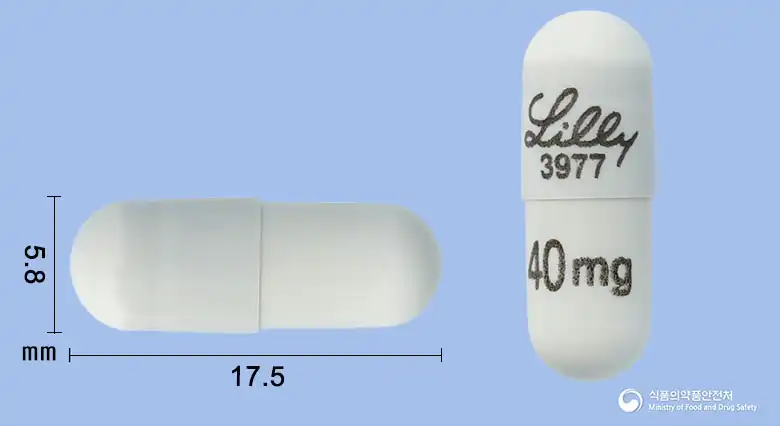
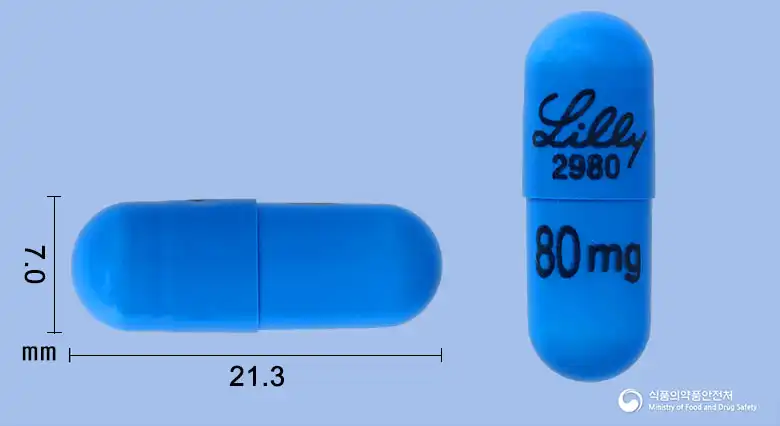
Opaque light blue hard capsule containing a white to almost white to pale yellow powder with 'Lilly', '2980', and '80 mg' printed in black ink.
Blister - 56 capsules/box [14 capsules/blister*4]
Even with the same ingredient, strength, dosage form and how it is taken can differ.
Even with the same ingredient, the dose and directions can differ by strength and dosage form. Talk to a doctor or pharmacist before switching from a medication you are already taking.
No questions yet.
For anything that needs medical judgment, consult a doctor or pharmacist.
This drug information is based on data provided by the Korea Ministry of Food and Drug Safety.
Consult a doctor or pharmacist for accurate dosage, administration, and usage instructions.