
 한국어
 English
 日本語
 中文(简体)
Summary
- Main use
- Treatment of lymphoma, chronic lymphocytic leukemia, and Waldenström macroglobulinemia
- Who takes it
- Adults
- Adult dose
- This medicine may be taken with or without food. Swallow the capsule whole with water; do not open, crush, or chew it. Do not take this medicine with grapefruit juice. Take this medicine orally until the disease progresses or the patient can no longer tolerate treatment. 1. Recommended dose The recommended total daily dose of this medicine is 320 mg (four 80 mg capsules) once daily, or 160 mg (two 80 mg capsules) twice daily, approximately 12 hours apart. 2. Missed dose If a dose is missed at the scheduled time, take the missed dose as soon as possible on the same day and resume the regular dosing schedule the following day. Do not take an extra dose of this medicine to make up for a missed dose. 3. Dose adjustment 1) Dose adjustment for adverse reactions The recommended dose adjustments for this medicine in response to Grade 3 or higher adverse reactions are shown in the table below. Table 1. Dose adjustment for adverse reactions Adverse drug reactions <Hematologic toxicity> ‧Grade 3 or higher febrile neutropenia ‧Grade 3 thrombocytopenia with significant bleeding ‧Grade 4 neutropenia (lasting more than 10 consecutive days) ‧Grade 4 thrombocytopenia (lasting more than 10 consecutive days) <Nonhematologic toxicity> ‧Grade 3 or higher nonhematologic toxicity* First occurrence of an adverse reaction: Temporarily withhold this medicine. After the adverse reaction resolves to Grade 1 or lower or to baseline, resume at 160 mg twice daily or 320 mg once daily. Second occurrence of an adverse reaction: Temporarily withhold this medicine. After the adverse reaction resolves to Grade 1 or lower or to baseline, resume at 80 mg twice daily or 160 mg once daily. Third occurrence of an adverse reaction: Temporarily withhold this medicine. After the adverse reaction resolves to Grade 1 or lower or to baseline, resume at 80 mg once daily. Fourth occurrence of an adverse reaction: Discontinue this medicine. * For patients who develop Grade 4 nonhematologic toxicity, carefully assess the benefits and risks before deciding whether to resume at the same dose. Asymptomatic lymphocytosis should not be considered an adverse reaction, and this medicine should be continued in this case. 2) Dose adjustment for drug interactions Concomitant use with CYP3A inhibitors may increase exposure to this medicine, so dose reduction is necessary. Concomitant use with CYP3A inducers may reduce the efficacy of this medicine by decreasing exposure; therefore, consider using an alternative medicine that is unlikely to induce CYP3A. Table 2. Dose adjustment in consideration of concomitant medicines Strong CYP3A inhibitors (posaconazole, voriconazole, ketoconazole, itraconazole, clarithromycin, indinavir, lopinavir, ritonavir, telaprevir, etc.): 80mg once daily Moderate CYP3A inhibitors (erythromycin, ciprofloxacin, diltiazem, dronedarone, fluconazole, verapamil, aprepitant, imatinib, grapefruit juice, Seville oranges, etc.): 80mg twice daily Strong CYP3A inducers (carbamazepine, phenytoin, rifampicin, St. John’s wort, etc.): Avoid concomitant use. Moderate CYP3A inducers (bosentan, efavirenz, etravirine, modafinil, nafcillin, rifabutin, etc.): Avoid concomitant use. If administration of a moderate CYP3A inducer is unavoidable, increase the dose of this medicine to a maximum of 320 mg twice daily. (See “5. Interactions” under Precautions for Use.) 4. Administration to patients with hepatic impairment The recommended dose of this medicine for patients with severe hepatic impairment is 80 mg twice daily; monitor adverse reactions closely (see “9. Patients with hepatic impairment” under Precautions for Use).
Ingredients
- Importer
- BeOne Medicines Korea Y.H.
Efficacy & effects
Treatment of lymphoma, chronic lymphocytic leukemia, and Waldenström macroglobulinemia
- Mantle cell lymphoma
- Waldenström macroglobulinemia
- marginal zone lymphoma
- chronic lymphocytic leukemia
- small lymphocytic lymphoma
- follicular lymphoma
View approved original textHide original text
This drug is used to treat various forms of adult lymphoma and blood cancers. It is indicated as monotherapy for patients with previous treatment experience in diseases such as mantle cell lymphoma (MCL), Waldenström macroglobulinemia (WM), marginal zone lymphoma (MZL), chronic lymphocytic leukemia (CLL), or small lymphocytic lymphoma (SLL). Additionally, for patients with follicular lymphoma (FL) who are relapsed or not responding to treatment, it is used in combination with obinutuzumab. This drug induces effective responses in each disease and helps improve patient symptoms and disease management. Therefore, this drug plays an important role in the treatment of complicated lymphomas and blood disorders.
How to take
Adult dose
This medicine may be taken with or without food. Swallow the capsule whole with water; do not open, crush, or chew it. Do not take this medicine with grapefruit juice. Take this medicine orally until the disease progresses or the patient can no longer tolerate treatment. 1. Recommended dose The recommended total daily dose of this medicine is 320 mg (four 80 mg capsules) once daily, or 160 mg (two 80 mg capsules) twice daily, approximately 12 hours apart. 2. Missed dose If a dose is missed at the scheduled time, take the missed dose as soon as possible on the same day and resume the regular dosing schedule the following day. Do not take an extra dose of this medicine to make up for a missed dose. 3. Dose adjustment 1) Dose adjustment for adverse reactions The recommended dose adjustments for this medicine in response to Grade 3 or higher adverse reactions are shown in the table below. Table 1. Dose adjustment for adverse reactions Adverse drug reactions <Hematologic toxicity> ‧Grade 3 or higher febrile neutropenia ‧Grade 3 thrombocytopenia with significant bleeding ‧Grade 4 neutropenia (lasting more than 10 consecutive days) ‧Grade 4 thrombocytopenia (lasting more than 10 consecutive days) <Nonhematologic toxicity> ‧Grade 3 or higher nonhematologic toxicity* First occurrence of an adverse reaction: Temporarily withhold this medicine. After the adverse reaction resolves to Grade 1 or lower or to baseline, resume at 160 mg twice daily or 320 mg once daily. Second occurrence of an adverse reaction: Temporarily withhold this medicine. After the adverse reaction resolves to Grade 1 or lower or to baseline, resume at 80 mg twice daily or 160 mg once daily. Third occurrence of an adverse reaction: Temporarily withhold this medicine. After the adverse reaction resolves to Grade 1 or lower or to baseline, resume at 80 mg once daily. Fourth occurrence of an adverse reaction: Discontinue this medicine. * For patients who develop Grade 4 nonhematologic toxicity, carefully assess the benefits and risks before deciding whether to resume at the same dose. Asymptomatic lymphocytosis should not be considered an adverse reaction, and this medicine should be continued in this case. 2) Dose adjustment for drug interactions Concomitant use with CYP3A inhibitors may increase exposure to this medicine, so dose reduction is necessary. Concomitant use with CYP3A inducers may reduce the efficacy of this medicine by decreasing exposure; therefore, consider using an alternative medicine that is unlikely to induce CYP3A. Table 2. Dose adjustment in consideration of concomitant medicines Strong CYP3A inhibitors (posaconazole, voriconazole, ketoconazole, itraconazole, clarithromycin, indinavir, lopinavir, ritonavir, telaprevir, etc.): 80mg once daily Moderate CYP3A inhibitors (erythromycin, ciprofloxacin, diltiazem, dronedarone, fluconazole, verapamil, aprepitant, imatinib, grapefruit juice, Seville oranges, etc.): 80mg twice daily Strong CYP3A inducers (carbamazepine, phenytoin, rifampicin, St. John’s wort, etc.): Avoid concomitant use. Moderate CYP3A inducers (bosentan, efavirenz, etravirine, modafinil, nafcillin, rifabutin, etc.): Avoid concomitant use. If administration of a moderate CYP3A inducer is unavoidable, increase the dose of this medicine to a maximum of 320 mg twice daily. (See “5. Interactions” under Precautions for Use.) 4. Administration to patients with hepatic impairment The recommended dose of this medicine for patients with severe hepatic impairment is 80 mg twice daily; monitor adverse reactions closely (see “9. Patients with hepatic impairment” under Precautions for Use).
Precautions
This drug should not be administered to patients with allergies to the active ingredient or any of the components. Careful administration is required for patients at high risk for infections, hepatitis B virus carriers, or patients with severely impaired liver or kidney function. While taking this drug, the risk of bleeding may increase; therefore, any bleeding symptoms should be reported to medical staff immediately. Additionally, caution is needed when taking this drug with anticoagulants or antiplatelet agents, as the risk of bleeding may be further elevated. Because infections may occur, vigilant observation is needed, especially for severe infections such as pneumonia. Regular blood tests are necessary as blood levels of white blood cells, platelets, and red blood cells may decrease. There is a potential for secondary primary cancer to occur while taking this drug, thus attention to sun protection is essential to prevent skin cancer. Cardiac rhythm abnormalities, particularly atrial fibrillation and atrial flutter, may occur, requiring monitoring of cardiac symptoms. Tumor lysis syndrome may occur, so especially for patients with chronic lymphocytic leukemia, an assessment of treatment risk and preventive measures should be made prior to treatment. This drug is mainly metabolized in the liver, so dosage adjustments may be needed in patients with impaired liver function. It is not recommended for use during pregnancy, and women of childbearing age should employ effective contraception during and for some time after treatment. Breastfeeding women are advised to avoid nursing during treatment and for 2 weeks afterward. This drug is metabolized by the CYP3A enzyme, therefore, caution should be exercised when taken with CYP3A inhibitors or inducers, as this may alter drug concentrations. Fatigue, dizziness, and malaise may occur during treatment, so caution is needed when driving or operating machinery. In cases of overdose, there is no specific antidote, so the patient’s condition should be closely monitored and general supportive care should be provided. Keep this medication out of the reach of children, do not use expired products, and dispose of it according to regulations.
Storage
This drug is sensitive to air and moisture, so it should be stored in a tightly sealed container. It is important to maintain a storage temperature between 1 and 30 degrees Celsius to safely preserve the effectiveness of the medication.
Appearance and packaging
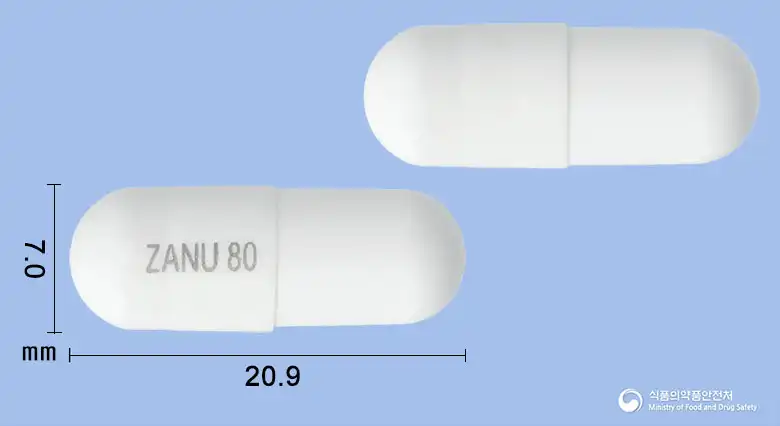
Appearance
White to off-white powder in white to off-white opaque hard capsules
Package unit
120 capsules/bottle
Questions about this medicine
No questions yet.
For anything that needs medical judgment, consult a doctor or pharmacist.