
 한국어
 English
 日本語
 中文(简体)
 Viewing now
JEBINIX 800 mg Tablets (Eslicarbazepine Acetate (Unformulated))
Eslicarbazepine Acetate(micronized) 800mg
Tablet · Prescription medication
Hwanin Pharmaceutical Co., Ltd.
MFDS item code 202007718 · Approved 2020.11.10 · Insurance code 657203720
Treatment of partial-onset seizures in epilepsy
This medication is used alone to treat partial seizures and secondary generalized seizures in adults newly diagnosed with epilepsy. It is also used as an adjunct therapy for the treatment of partial seizures and secondary generalized seizures occurring in children over 6 years of age and adults. In other words, it helps to effectively treat partial and generalized seizures across various age groups.
1. Adults This medicine may be administered as monotherapy or as adjunctive therapy with other antiepileptic drugs. The recommended initial dose is 400 mg once daily, increased to 800 mg once daily after 1 or 2 weeks. The usual maintenance dose is 800 mg once daily, and the dose may be increased to 1,200 mg once daily according to individual response. Some patients receiving monotherapy may benefit from a dose of 1,600 mg once daily. 3. Older adults (aged 65 years or over) No dose adjustment is required in older adults with normal renal function. Use of 1,600 mg as monotherapy is not recommended because clinical experience in older adults is very limited. 4. Patients with renal impairment Caution should be exercised when treating adults and pediatric patients aged 6 years or over with renal impairment, and the dose should be adjusted according to creatinine clearance (CLCR) as follows: - CLCR >60 ml/min: No dose adjustment is required. - CLCR 30-60 ml/min: Administer an initial dose of 200 mg once daily or 400 mg every 2 days for 2 weeks, then administer 400 mg once daily. The dose may be adjusted according to individual response. - CLCR <30 ml/min: Use is not recommended in patients with severe renal impairment. 5. Patients with hepatic impairment No dose adjustment is required in patients with mild to moderate hepatic impairment. Use of this medicine is not recommended in patients with severe hepatic impairment because it has not been evaluated in this population.
2. Pediatric patients (aged 6 years or over) Pediatric patients weighing less than 60 kg: The recommended initial dose is 10 mg/kg once daily. Depending on individual response, the dose may be increased by 10 mg/kg once daily at 1- or 2-week intervals, up to a maximum of 30 mg/kg. The maximum dose is 1,200 mg once daily. Pediatric patients weighing 60 kg or more: Administer the same dose as for adults. 4. Patients with renal impairment CLCR >60 ml/min, pediatric patients aged 6 years or over: No dose adjustment is required. CLCR 30-60 ml/min, pediatric patients aged 6 years or over: Administer an initial dose of 5 mg/kg once daily or 10 mg/kg every 2 days for 2 weeks, then administer 10 mg/kg once daily. The dose may be adjusted according to individual response. CLCR <30 ml/min, pediatric patients aged 6 years or over: Use is not recommended in patients with severe renal impairment.
This medication may increase the risk of suicidal thoughts or behaviors, so it is essential to closely monitor for mood changes or unusual behavior during treatment. Severe adverse reactions may occur on the skin; if skin rashes, red spots, blisters, etc., develop, the medication should be stopped immediately and medical advice sought. It should not be taken if there are allergies to this medication or similar ingredients, and patients with certain heart diseases should avoid using it. Women who are pregnant or planning to become pregnant should consult a specialist as this medication may affect the fetus. This medication can cause neurological symptoms such as drowsiness, dizziness, and motor coordination impairments; caution is required when driving or operating machinery. Drug interactions may occur, so it is essential to inform healthcare providers of any other medications being taken; especially, it can decrease the effectiveness of oral contraceptives necessitating additional contraceptive methods. Sodium levels and liver function should be regularly checked through blood tests, and any abnormal symptoms should be reported to medical personnel immediately. Children, the elderly, and patients with compromised kidney or liver function require special caution when taking this medication. In case of overdose, symptoms such as dizziness and gait instability may occur, requiring immediate medical treatment. This medication should be stored out of reach of children and should not be transferred to another container for safety.
suicidal thoughts, suicidal behavior, depression, abnormal changes in mood and behavior, Stevens-Johnson syndrome, toxic epidermal necrolysis, drug reaction with eosinophilia and systemic symptoms, severe skin adverse reactions, skin reactions, rash, hives, angioedema, laryngeal edema, hyponatremia, exacerbation of seizures, confusion, decreased consciousness, somnolence, nausea, dizziness, decreased serum osmolality, vomiting, headache, altered mental status, neurological signs and symptoms, prolonged PR interval, elevated transaminases, increased total bilirubin, jaundice, thyroid dysfunction, pancytopenia, agranulocytosis, leukopenia, dizziness, drowsiness, headache, ataxia, balance disorders, tremors, stuttering, memory impairment, nystagmus, asthenia, gait disturbance, rash, urinary tract infection, falls, nausea, vomiting, diarrhea, constipation, abdominal pain, gastritis, hypertension, diplopia, blurred vision, visual impairment, abnormal coordination, anxiety, abdominal pain, seizures
Not everyone experiences these, and they can vary from person to person.
This medication should be stored in a tightly sealed container to prevent exposure to air or moisture. It is recommended to maintain a storage temperature between 1 degree and 30 degrees Celsius at room temperature.
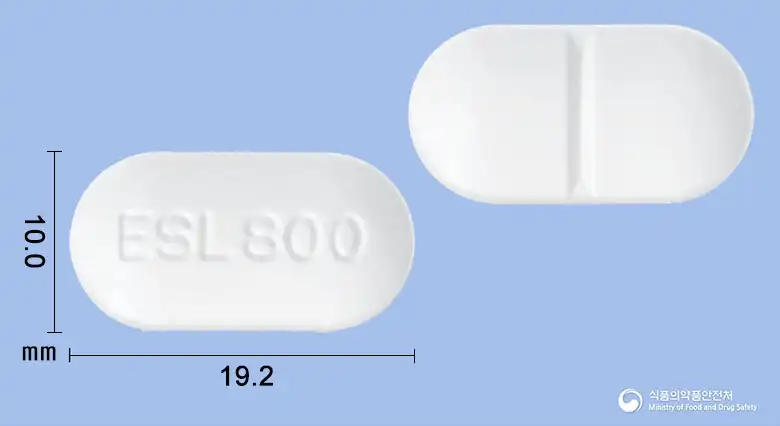
White rectangular tablets
30 tablets/bottle, 90 tablets/bottle, 20 tablets/PTP (10 tablets/PTP x 2)
Even with the same ingredient, strength, dosage form and how it is taken can differ.
Viewing nowEslicarbazepine Acetate(micronized) 800mg
Tablet · Prescription medication
Hwanin Pharmaceutical Co., Ltd.
Eslicarbazepine Acetate(micronized) 200mg
Tablet · Prescription medication
Hanmi Pharmaceutical Co., Ltd.
Eslicarbazepine Acetate(micronized) 400mg
Tablet · Prescription medication
Hanin Pharmaceutical Co., Ltd.
Eslicarbazepine Acetate(micronized) 600mg
Tablet · Prescription medication
Hanmi Pharmaceutical Co., Ltd.
Even with the same ingredient, the dose and directions can differ by strength and dosage form. Talk to a doctor or pharmacist before switching from a medication you are already taking.
No questions yet.
For anything that needs medical judgment, consult a doctor or pharmacist.
This drug information is based on data provided by the Korea Ministry of Food and Drug Safety.
Consult a doctor or pharmacist for accurate dosage, administration, and usage instructions.