
 한국어
 English
 日本語
 中文(简体)
 Viewing now
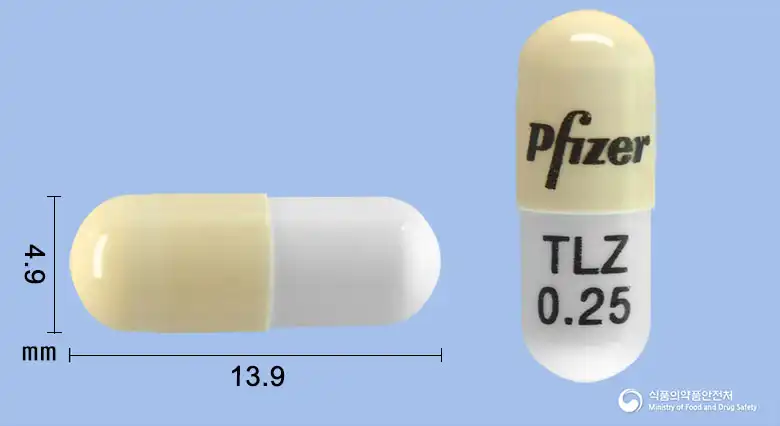
Talzenna Capsule 0.25 mg (Talazoparib tosylate)
Talazoparib Tosylate
Hard capsule · Prescription medication
Pfizer Pharmaceuticals Korea Co., Ltd.
MFDS item code 202005547 · Approved 2020.07.30
Treatment of gBRCA-mutated breast cancer and HRR-mutated prostate cancer
This medication is used for the treatment of breast cancer and prostate cancer. In breast cancer patients, it is given as monotherapy to adults with locally advanced or metastatic breast cancer who are gBRCA mutation positive and HER2 negative, and who have previously received chemotherapy. These patients may have undergone chemotherapy during preoperative or postoperative adjuvant therapy or in locally advanced or metastatic stages. For prostate cancer, it is administered in combination with enzalutamide to adult patients with metastatic castration-resistant prostate cancer who have no prior chemotherapy experience but have homologous recombination repair (HRR) mutations. This medication effectively improves the treatment of patients with specific conditions of breast cancer and prostate cancer.
Treatment with this drug should be initiated and supervised by a physician experienced in the use of anticancer agents. This drug is for oral use. The capsules must be swallowed whole to avoid contact with the capsule contents; they must not be opened or dissolved. This drug may be taken with or without food. This drug is administered orally at a dose of 1 mg once daily. Patients should continue treatment until disease progression or unacceptable toxicity occurs. The recommended dose of this drug is 0.5 mg, administered orally once daily with enzalutamide 160mg. Patients should continue treatment until disease progression or unacceptable toxicity occurs. Medical castration with a luteinizing hormone-releasing hormone (LHRH) analog should be continued during treatment in patients who have not undergone surgical castration. Refer to the prescribing information for enzalutamide for information on its recommended dosage. If a patient vomits or misses a dose, an additional dose should not be taken. The next prescribed dose should be taken at the scheduled time. To manage adverse drug reactions, consider temporarily interrupting treatment or reducing the dose according to severity and clinical presentation (Table 1). The recommended dose reductions for this drug as monotherapy (breast cancer) and in combination with enzalutamide (prostate cancer) are described in Tables 2 and 3, respectively. A complete blood count should be obtained before starting treatment with this drug and monitored monthly and according to clinical status (see Table 1 and ‘4. General precautions’). Hemoglobin < 8 g/dL: Interrupt treatment with this drug until recovery to the following level. ≥ 9 g/dL: Resume treatment with this drug at a reduced dose. Platelet count < 50,000/μL: Interrupt treatment with this drug until recovery to the following level. ≥ 75,000/μL: Resume treatment with this drug at a reduced dose. Neutrophil count < 1,000/μL: Interrupt treatment with this drug until recovery to the following level. ≥ 1,500/µL: Resume treatment with this drug at a reduced dose. Grade 3 or 4 nonhematologic adverse reactions: Interrupt treatment with this drug until recovery to the following level. ≤ Grade 1: Resume treatment with this drug at a reduced dose or discontinue treatment. Dose reductions when this drug is used as monotherapy (breast cancer): Recommended starting dose 1 mg once daily; first dose reduction 0.75 mg once daily; second dose reduction 0.5 mg once daily; third dose reduction 0.25 mg once daily. Dose reductions when this drug is administered in combination with enzalutamide (prostate cancer): Recommended starting dose 0.5 mg once daily; first dose reduction 0.35 mg once daily; second dose reduction 0.25 mg once daily; third dose reduction 0.1 mg once daily. Refer to the prescribing information for enzalutamide for dose adjustments due to enzalutamide-related adverse reactions. Strong P-gp inhibitors may increase exposure to this drug. Concomitant use of strong P-gp inhibitors should be avoided during treatment with this drug. Concomitant administration should be considered only after careful evaluation of the potential benefits and risks. If concomitant administration of a strong P-gp inhibitor is unavoidable, reduce the dose of this drug by one dose level. If treatment with the strong P-gp inhibitor is discontinued, increase the dose of this drug to the dose used before administration of the strong P-gp inhibitor after 3-5 half-lives of the P-gp inhibitor. The effect of P-gp inhibitor administration on exposure to this drug during concomitant administration of enzalutamide and this drug has not been studied. Therefore, administration of P-gp inhibitors during concomitant treatment with this drug should be avoided (see 5. Interactions). No dose adjustment is necessary in patients with mild renal impairment (60 mL/min≤creatinine clearance [CrCl]<90 mL/min). The recommended starting dose of this drug in patients with moderate renal impairment (30 mL/min≤CrCl<60 mL/min) is 0.75 mg once daily. The recommended starting dose of this drug in patients with severe renal impairment (15 mL/min<CrCl<30 mL/min) is 0.5 mg once daily. This drug has not been studied in patients with CrCl<15 mL/min or in patients requiring hemodialysis (see Pharmacokinetic properties). No dose adjustment is necessary in patients with mild renal impairment (60 mL/min≤creatinine clearance [CrCL]<90 mL/min). The recommended starting dose in patients with moderate renal impairment (30 mL/min≤CrCL<60 mL/min) is 0.35mg of this drug orally once daily in combination with enzalutamide. The recommended starting dose in patients with severe renal impairment (15mL/min≤CrCL<30mL/min) is 0.25mg of this drug once daily in combination with enzalutamide. This drug has not been studied in patients with CrCL <15 mL/min or in patients requiring hemodialysis (see Pharmacokinetic properties). No dose adjustment is necessary in patients with mild hepatic impairment (total bilirubin≤1×upper limit of normal [ULN] and aspartate aminotransferase (AST)>ULN, or total bilirubin>1.0-1.5×ULN and any AST), moderate hepatic impairment (total bilirubin>1.5-3.0×ULN and any AST), or severe hepatic impairment (total bilirubin>3.0×ULN and any AST) (see Pharmacokinetic properties).
This medication may lead to serious blood disorders such as myelodysplastic syndrome or acute myeloid leukemia, so blood tests should be thoroughly conducted before and during administration to monitor blood condition. Women of childbearing age should not become pregnant while taking this medication and must confirm pregnancy status before starting treatment. Additionally, highly effective contraception must be used during treatment and for at least 7 months after discontinuation. Male patients should use contraception during treatment and for at least 4 months after stopping if their partner is of childbearing potential or pregnant. This medication should not be administered to patients with hypersensitivity to the active ingredients or excipients, or to nursing mothers. Common side effects during treatment include fatigue, anemia, nausea, neutropenia, and thrombocytopenia, so any occurrence of these symptoms must be reported to healthcare providers immediately. In the event of severe bone marrow suppression symptoms, dose adjustment or discontinuation may be necessary. This medication should be used under the supervision of a specialist and is appropriately used in patients who have previously received platinum-based chemotherapy or who are positive for specific genetic mutations. Caution is advised while driving or operating machinery as fatigue or dizziness may occur after taking this medication. Additionally, this medication may interact with other drugs, so consultation with healthcare providers is necessary, especially when used in conjunction with specific drug transport inhibitors or inducers. Women who are pregnant or breastfeeding should avoid taking this medication, and breastfeeding should be discontinued for at least one month during and after treatment. In case of overdose, immediate medical attention is required, and it should be stored out of reach of children.
Not everyone experiences these, and they can vary from person to person.
This medication may be sensitive to air or moisture, and should be stored in a sealed container. It is important to maintain a storage temperature between 1 and 30 degrees Celsius to preserve the drug's efficacy and safety over time.
A yellowish-white to off-white powder contained in an opaque hard capsule with beige upper and white lower parts.
30 capsules per bottle
Even with the same ingredient, strength, dosage form and how it is taken can differ.
Viewing nowTalazoparib Tosylate
Hard capsule · Prescription medication
Pfizer Pharmaceuticals Korea Co., Ltd.
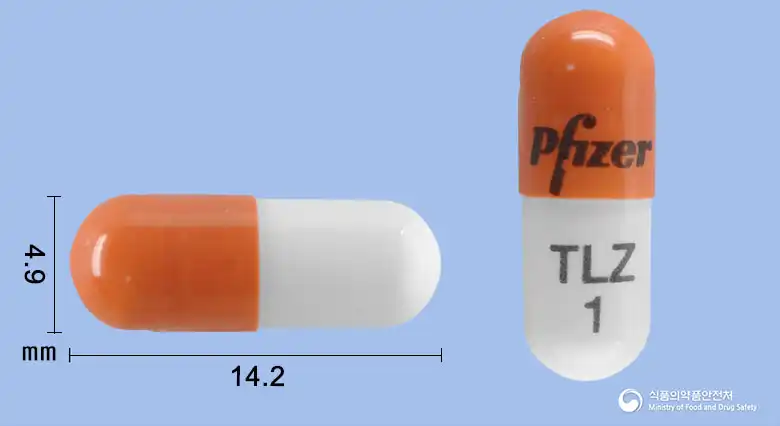
Talazoparib Tosylate
Prescription medication
Pfizer Korea Co., Ltd.
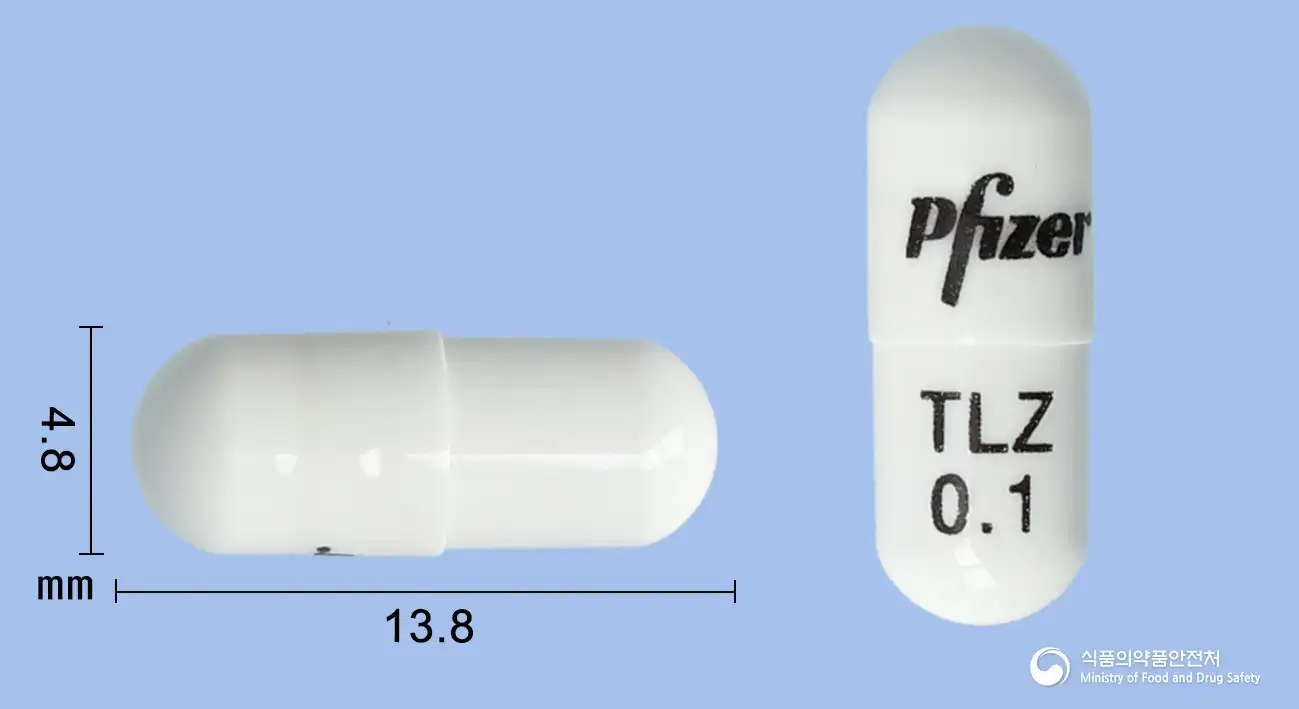
Talazoparib Tosylate
Hard capsule · Prescription medication
Pfizer Pharmaceuticals Korea Co., Ltd.
Even with the same ingredient, the dose and directions can differ by strength and dosage form. Talk to a doctor or pharmacist before switching from a medication you are already taking.
No questions yet.
For anything that needs medical judgment, consult a doctor or pharmacist.
This drug information is based on data provided by the Korea Ministry of Food and Drug Safety.
Consult a doctor or pharmacist for accurate dosage, administration, and usage instructions.