
 한국어
 English
 日本語
 中文(简体)
 Viewing now
Linburk Sustained Release Tablet 15 mg (Upadacitinib Monohydrate)
Upadacitinib Hemihydrate 15.4mg
Tablet · Prescription medication
AbbVie Korea Co., Ltd.
MFDS item code 202004222 · Approved 2020.06.04 · Insurance code 624900370
Treatment of arthritis and spondyloarthritis, atopic dermatitis, and inflammatory bowel disease
This medication is used for adult patients who have inadequate responses to or intolerance of previously used therapies, and is indicated for various autoimmune and inflammatory diseases. Major indications include moderate to severe rheumatoid arthritis, psoriatic arthritis, axial spondyloarthritis including ankylosing spondylitis, and atopic dermatitis. Additionally, it is used for patients with moderate to severe active ulcerative colitis and Crohn's disease. This medication should be used with caution in patients over 65 years of age, those with high cardiovascular risk, or those at risk of malignancies. This medication can be administered alone or in combination with certain non-biological disease-modifying antirheumatic drugs, but should not be used in combination with biological products or other Janus kinase inhibitors. It aids in effectively improving the symptoms of patients who do not respond to existing treatments.
Rheumatoid arthritis, psoriatic arthritis, ankylosing spondylitis, and non-radiographic axial spondyloarthritis: Administer 15 mg once daily. Atopic dermatitis (adults 18 years of age and older and adolescents weighing 40kg or more): Administer 15 mg once daily; depending on symptoms, 30 mg may be administered once daily. Ulcerative colitis - Induction therapy: Administer 45 mg once daily for 8 weeks. Treatment may be extended for an additional 8 weeks if needed. - Maintenance therapy: Administer 15 mg or 30 mg once daily, depending on symptoms. Crohn's disease - Induction therapy: Administer 45 mg once daily for 12 weeks. If the response is inadequate, treatment may be extended with 30 mg once daily for 12 weeks. - Maintenance therapy: Administer 15 mg or 30 mg once daily, depending on symptoms. For most patients 65 years of age and older, 15 mg once daily is recommended. Take this tablet orally by swallowing it whole, with or without food. Do not split, crush, or chew it.
The safety and efficacy have not been established in adolescents 12 years of age and older who weigh less than 40kg or in children under 12 years of age. The safety and efficacy have not been established in children under 18 years of age.
This medication poses a significant risk of severe infections and should not be used in patients with active infections or those at high risk of infection. During treatment, it is essential to closely monitor for signs of infection, and if an infection occurs, discontinue the medication immediately and seek appropriate treatment. Caution is required as this medication may increase the risk of cardiovascular disease or malignancy, particularly in patients aged 65 years or older or those with cardiovascular risk factors. Due to a risk of thrombosis, administration should be avoided in patients with a history of thrombosis or risk factors for thrombosis, and if thrombosis symptoms appear, treatment should be stopped and evaluated immediately. Tuberculosis screening should be performed before administration, and if latent tuberculosis is present, appropriate treatment should be completed before starting therapy. There is a risk of viral reactivation; therefore, if symptoms of conditions such as herpes zoster occur, consider temporarily stopping the medication. Live vaccination is not recommended during the use of this medication, and necessary vaccinations should be completed before therapy initiation. Hypersensitivity reactions may occur; if such symptoms appear, discontinue the medication immediately and seek appropriate treatment. There is a risk of gastrointestinal perforation; therefore, patients with a history of gastrointestinal disease or new abdominal symptoms should be evaluated promptly. Regular blood tests to monitor neutrophil, lymphocyte, and hemoglobin levels should be performed, and treatment should be adjusted or stopped if levels fall below specified thresholds. This medication may elevate liver enzymes and lipid levels, so it is essential to monitor liver function and lipid profiles periodically. Caution is advised when used in conjunction with other immunosuppressants due to potential additional risks; co-administration is generally discouraged. The drug may persist in feces; therefore, patients undergoing gastrointestinal surgery or with gastrointestinal dysfunction should inform their healthcare provider and closely monitor therapeutic effects. Pregnant or potentially pregnant women and nursing mothers should not use this medication, and effective contraception is necessary during use. This drug is affected by the CYP3A4 enzyme, so caution is needed when used with certain medications, and grapefruit intake should be avoided. Dizziness or vertigo may occur; therefore, caution is advised when driving or operating machinery. When stored, keep this medication out of reach of children, away from moisture and direct sunlight, and maintain at a temperature below 25 degrees Celsius.
Not everyone experiences these, and they can vary from person to person.
This medication should be stored in a tightly closed container to protect it from air and moisture. An appropriate storage temperature is cool, between 1 and 25 degrees Celsius.
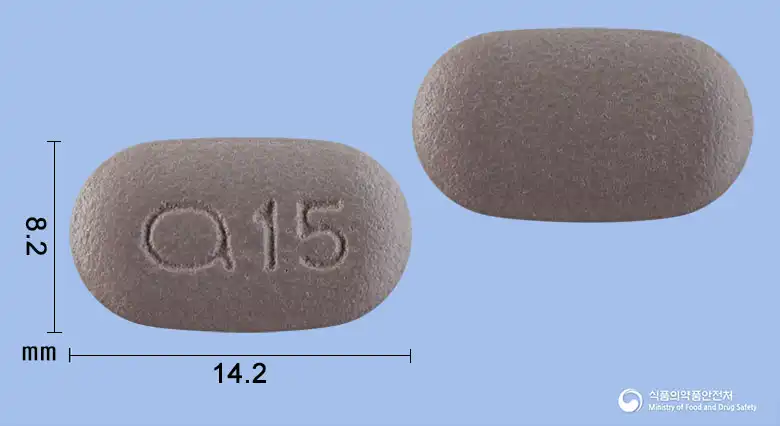
A purple, bilaterally convex, rectangular sustained-release film-coated tablet imprinted with "a15" on one side
28 tablets/box [7 tablets/PTP*4]
Even with the same ingredient, strength, dosage form and how it is taken can differ.
Viewing nowUpadacitinib Hemihydrate 15.4mg
Tablet · Prescription medication
AbbVie Korea Co., Ltd.
Upadacitinib Hemihydrate 15.4mg
Tablet · Prescription medication
AbbVie Korea Co., Ltd.
Even with the same ingredient, the dose and directions can differ by strength and dosage form. Talk to a doctor or pharmacist before switching from a medication you are already taking.
No questions yet.
For anything that needs medical judgment, consult a doctor or pharmacist.
This drug information is based on data provided by the Korea Ministry of Food and Drug Safety.
Consult a doctor or pharmacist for accurate dosage, administration, and usage instructions.