
 한국어
 English
 日本語
 中文(简体)
 Viewing now
Bitrakbi Capsule 100 mg (Larotrectinib Sulfate)
Larotrectinib sulfate 122.9mg
Hard capsule · Prescription medication
Bayer Korea Co., Ltd.
MFDS item code 202003384 · Approved 2020.05.11 · Insurance code 641106130
Treatment of NTRK gene fusion-positive solid tumors without acquired resistance mutations
This drug is used for the treatment of adult and pediatric patients with NTRK gene fusions. It is particularly applicable for patients with locally advanced, metastatic, or surgically unresectable solid tumors, especially when existing therapies are ineffective or when there are no suitable treatment options. This drug was approved based on overall response rate, but clinical benefits such as prolongation of survival have not yet been proven. Thus, this drug helps in treating cancer targeting specific gene mutations.
(Adults) The recommended adult dose of this drug (oral) is 100 mg twice daily and should be continued until there is no longer a clinical benefit or unacceptable toxicity occurs. Table 1. Recommended dose modifications for adverse reactions Adults First dose modification: 75 mg twice daily Second dose modification: 50 mg twice daily Third dose modification: 100 mg once daily If the dose is still not tolerated after the third dose modification, permanently discontinue treatment. Patients with hepatic impairment Reduce the starting dose of this drug by 50% in patients with moderate (Child-Pugh B) to severe (Child-Pugh C) hepatic impairment. No dose adjustment is required for patients with mild (Child-Pugh A) hepatic impairment. Concomitant use with strong CYP3A4 inhibitors: Avoid concomitant use of this drug with strong CYP3A4 inhibitors. If concomitant use with a strong CYP3A4 inhibitor is unavoidable, reduce the dose of this drug by 50%. After discontinuing the inhibitor for a period of 3~5 times its elimination half-life, resume this drug at the dose used before concomitant administration of the CYP3A4 inhibitor (see Precautions for Use, 5. Drug Interactions). Concomitant use with strong or moderate CYP3A4 inducers: Avoid concomitant use of this drug with strong CYP3A4 inducers. If concomitant use with a strong CYP3A4 inducer is unavoidable, double the dose of this drug. Also, when used concomitantly with a moderate CYP3A4 inducer, double the dose of this drug. After discontinuing the inducer for a period of 3~5 times its elimination half-life, resume this drug at the dose used before concomitant administration of the CYP3A4 inducer (see Precautions for Use, 5. Drug Interactions).
(Pediatric patients) Recommended dose based on body surface area: 100 mg/m2 (oral) twice daily, with a maximum dose of 100 mg per dose, and continued until there is no longer a clinical benefit or unacceptable toxicity occurs. Pediatric patients with a body surface area of 1.0 m2 or greater: First dose modification, 75 mg twice daily Pediatric patients with a body surface area of less than 1.0 m2: First dose modification, 75 mg/m2 twice daily Pediatric patients with a body surface area of 1.0 m2 or greater: Second dose modification, 50 mg twice daily Pediatric patients with a body surface area of less than 1.0 m2: Second dose modification, 50 mg/m2 twice daily Pediatric patients with a body surface area of 1.0 m2 or greater: Third dose modification, 100 mg once daily Pediatric patients with a body surface area of less than 1.0 m2: Third dose modification, 25 mg/m2 twice dailya a Pediatric patients receiving 25 mg/m2 twice daily should remain on this dose even if their body surface area increases to greater than 1.0 m2 during treatment. At the third dose modification, the maximum dose should be 25 mg/m2 twice daily. If the dose is still not tolerated after the third dose modification, permanently discontinue treatment.
This medication may affect the nervous system, leading to symptoms such as dizziness, gait disturbance, and sensory abnormalities. These symptoms primarily occur within 3 months after the initiation of treatment, and if symptoms are severe or persist, discontinuation or dose adjustment may be necessary. This drug may affect liver function, leading to elevated liver enzyme levels, thus regular liver function tests should be performed before and during treatment. It should not be administered if there is an allergy to the active ingredient or excipients. Various side effects such as anemia, vomiting, constipation, diarrhea, fatigue, and dizziness are common, and some may be severe. Neurological adverse reactions and hepatotoxicity should be monitored closely, and treatment may need to be discontinued in severe cases. This drug is metabolized by specific enzymes and proteins, so interactions may occur with other medications altering drug concentrations. Careful dose adjustment is necessary, especially when taken with CYP3A inhibitors or inducers, and grapefruit or grapefruit juice should be avoided. It is advisable to avoid use during pregnancy, and breastfeeding should cease for 3 days after the last dose if taking this medication. Women of childbearing potential and men of reproductive capacity should use effective contraception during and for a certain period after treatment. It can be used in pediatric and elderly patients, but caution is advised as the frequency and severity of side effects may vary by age. In patients with severely impaired renal function, dose adjustment is not required. No known antidote exists for overdose, and general supportive treatment should be provided based on symptoms. This medication can cause dizziness and fatigue, so it is safer to avoid driving or operating machinery during the initial 3 months of treatment.
Not everyone experiences these, and they can vary from person to person.
This medication may be sensitive to air or moisture, thus it is important to store it in a tightly closed container. The storage temperature should be maintained between 1 and 30 degrees Celsius, avoiding excessively hot or cold places.
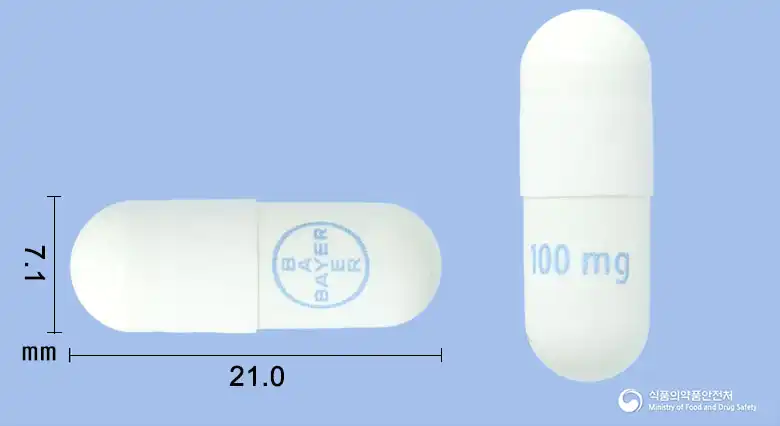
A white opaque hard capsule containing a yellow solid with shades of pale yellow - yellow - pink, printed with "Bayer cross" and "100 mg" in blue ink.
1 bottle - 56 capsules/bottle
Even with the same ingredient, strength, dosage form and how it is taken can differ.
Viewing nowLarotrectinib sulfate 122.9mg
Hard capsule · Prescription medication
Bayer Korea Co., Ltd.
Larotrectinib sulfate 30.7mg
Hard capsule · Prescription medication
Bayer Korea Co., Ltd.
Larotrectinib sulfate 2.46g
Solution · Prescription medication
Bayer Korea Co., Ltd.
Even with the same ingredient, the dose and directions can differ by strength and dosage form. Talk to a doctor or pharmacist before switching from a medication you are already taking.
No questions yet.
For anything that needs medical judgment, consult a doctor or pharmacist.
This drug information is based on data provided by the Korea Ministry of Food and Drug Safety.
Consult a doctor or pharmacist for accurate dosage, administration, and usage instructions.