
 한국어
 English
 日本語
 中文(简体)
 Viewing now
Bitrack B capsule 25 mg (Larotrectinib sulfate)
Larotrectinib sulfate 30.7mg
Hard capsule · Prescription medication
Bayer Korea Co., Ltd.
MFDS item code 202003383 · Approved 2020.05.11 · Insurance code 641106120
Treatment of NTRK gene fusion-positive solid tumors
This medication is used for the treatment of adult and pediatric patients with NTRK gene fusion. It is specifically indicated for patients with locally advanced or metastatic solid tumors that have a high chance of severe morbidity after surgical resection or for those whose disease has progressed after existing therapies. This medication may serve as an alternative when no appropriate treatments are available. The efficacy of this medication is approved based on overall response rates, and clinical evidence for increased survival is not yet available. It is suggested for patients to understand that this medication is an important option with expected therapeutic effects.
The recommended adult dose (oral) is 100 mg twice daily. Continue treatment until there is no further clinical benefit or unacceptable toxicity occurs. For all Grade 3 or 4 adverse reactions that do not involve abnormal liver function tests: - Withhold this medicine until the adverse reaction resolves or improves to baseline or Grade 1. If the adverse reaction resolves within 4 weeks, resume treatment at the next dose level. - If the adverse reaction does not resolve within 4 weeks, permanently discontinue this medicine. First dose reduction (adults): 75 mg twice daily Second dose reduction (adults): 50 mg twice daily Third dose reduction (adults): 100 mg once daily If the patient cannot tolerate treatment after the third dose reduction, permanently discontinue treatment. Grade 2 ALT and/or AST (greater than 3 times and up to 5 times ULN): After Grade 2 toxicity is observed, perform frequent serial laboratory evaluations until resolution to determine whether dose interruption or reduction is necessary. Grade 3 ALT and/or AST (greater than 5 times and up to 20 times ULN) or Grade 4 ALT and/or AST (greater than 20 times ULN), and bilirubin ≤2 times ULN: - Withhold this medicine until the adverse reaction resolves or improves to baseline. Monitor liver function frequently until the adverse reaction resolves or returns to baseline. If the adverse reaction does not resolve, permanently discontinue this medicine. - If the adverse reaction resolves, resume treatment at the next dose level. Resume treatment only if the benefit outweighs the risk. - If Grade 4 ALT and/or AST elevations occur after resuming treatment, permanently discontinue treatment. ALT and/or AST ≥3 times ULN, and bilirubin ≥2 times ULN: - Withhold treatment and monitor liver function frequently until the adverse reaction resolves or returns to baseline. - Consider permanently discontinuing this medicine. - Resume treatment only if the benefit outweighs the risk. - If treatment is resumed, restart at the next lower dose. Monitor liver function frequently after resuming treatment. - If the adverse reaction recurs after resuming treatment, permanently discontinue treatment. In patients with moderate (Child-Pugh B) to severe (Child-Pugh C) hepatic impairment, reduce the starting dose of this medicine by 50%. No dose adjustment is necessary in patients with mild (Child-Pugh A) hepatic impairment. Avoid concomitant use of this medicine with strong CYP3A4 inhibitors. If concomitant use with a strong CYP3A4 inhibitor is unavoidable, reduce the dose of this medicine by 50%. After discontinuing the inhibitor for a period of 3~5 times its elimination half-life, resume this medicine at the dose used before concomitant administration of the CYP3A4 inhibitor. Avoid concomitant use of this medicine with strong CYP3A4 inducers. If concomitant use with a strong CYP3A4 inducer is unavoidable, double the dose of this medicine. Also double the dose of this medicine when used concomitantly with a moderate CYP3A4 inducer. After discontinuing the inducer for a period of 3~5 times its elimination half-life, resume this medicine at the dose used before concomitant administration of the CYP3A4 inducer.
The dose for pediatric patients is based on body surface area (BSA). The recommended pediatric dose of this medicine is 100 mg/m2 orally twice daily, with a maximum dose of 100 mg per dose. Continue treatment until there is no further clinical benefit or unacceptable toxicity occurs. Pediatric patients with a body surface area of 1.0 m2 or more: First dose reduction, 75 mg per dose twice daily Pediatric patients with a body surface area of 1.0 m2 or more: Second dose reduction, 50 mg per dose twice daily Pediatric patients with a body surface area of 1.0 m2 or more: Third dose reduction, 100 mg per dose once daily Pediatric patients with a body surface area of less than 1.0 m2: First dose reduction, 75 mg/m2 per dose twice daily Pediatric patients with a body surface area of less than 1.0 m2: Second dose reduction, 50 mg/m2 per dose twice daily Pediatric patients with a body surface area of less than 1.0 m2: Third dose reduction, 25 mg/m2 per dose twice daily a a Pediatric patients receiving 25 mg/m2 per dose twice daily should maintain this dose during treatment even if their body surface area increases to more than 1.0 m2. At the third dose reduction, the maximum dose should be 25 mg/m2 per dose twice daily.
This drug can affect the nervous system, leading to symptoms such as dizziness, gait disturbances, and sensory abnormalities. These symptoms are mainly observed within three months after treatment initiation, and if the symptoms are severe or persist for a long time, the drug administration may need to be temporarily suspended or the dosage reduced. It may also affect liver function, potentially leading to elevated liver enzyme levels or liver function abnormalities. Liver function tests should be conducted every two weeks for the first month after treatment initiation, and then monthly for the following six months. If liver enzyme levels increase, it may be necessary to interrupt or reduce the dosage. This medication should not be used if you are allergic to its components or excipients. The most common side effects include increased liver enzymes, vomiting, anemia, constipation, diarrhea, nausea, fatigue, and dizziness, which mostly show moderate severity. This drug can interact with other medications, so caution is necessary, especially when taken with drugs that inhibit or activate enzymes (CYP3A4) responsible for drug metabolism in the liver. Grapefruit or grapefruit juice may also increase the concentration of this drug, so it is advisable to avoid them. Women who are pregnant or may become pregnant should take a pregnancy test before taking this medication, and effective contraception should be used during treatment and for one month post-treatment. If breast-feeding, it is safe to stop breast-feeding during the treatment period and for three days after the last dose, as this medication may pass into breast milk. It can also be given to children or the elderly, but careful observation is needed as the frequency of side effects may differ. Patients with end-stage renal impairment may use it without dosage adjustment, but in case of overdose, no specific antidote is available, and general emergency measures are required. This medication can cause dizziness and fatigue, so it is advisable to refrain from driving or operating machinery during the first three months of treatment, and to use caution until feeling sufficiently safe.
Not everyone experiences these, and they can vary from person to person.
This medication should be stored in a tightly sealed container to protect it from air and moisture. It is preferable to maintain storage temperatures between 1 and 30 degrees Celsius at room temperature. Proper storage will help preserve the medication's efficacy and safety for a longer duration.
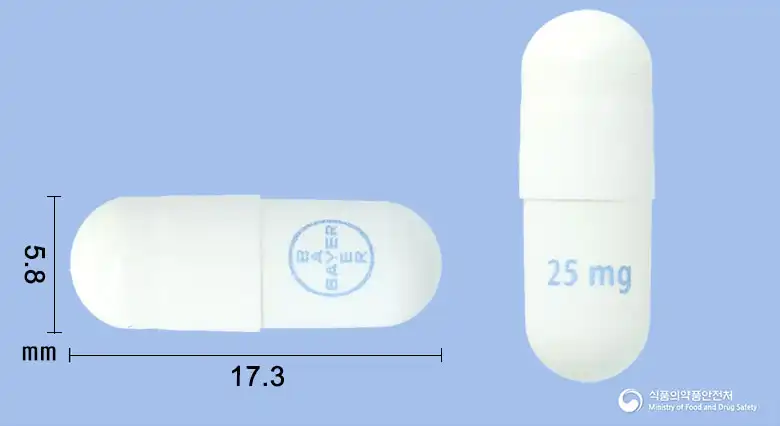
An opaque white hard capsule containing a buff - yellow - pink solid printed with a blue ink on 'Bayer cross' and '25 mg'.
1 bottle - 56 capsules/bottle
Even with the same ingredient, strength, dosage form and how it is taken can differ.
Viewing nowLarotrectinib sulfate 30.7mg
Hard capsule · Prescription medication
Bayer Korea Co., Ltd.
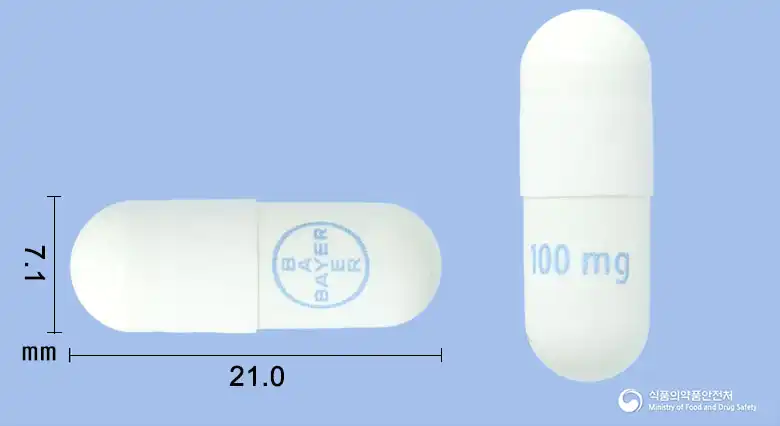
Larotrectinib sulfate 122.9mg
Hard capsule · Prescription medication
Bayer Korea Co., Ltd.
Larotrectinib sulfate 2.46g
Solution · Prescription medication
Bayer Korea Co., Ltd.
Even with the same ingredient, the dose and directions can differ by strength and dosage form. Talk to a doctor or pharmacist before switching from a medication you are already taking.
No questions yet.
For anything that needs medical judgment, consult a doctor or pharmacist.
This drug information is based on data provided by the Korea Ministry of Food and Drug Safety.
Consult a doctor or pharmacist for accurate dosage, administration, and usage instructions.