
 한국어
 English
 日本語
 中文(简体)
 Viewing now
Bizem Pro Tablets 15 mg (Dacomitinib Hydrate)
Dacomitinib Hydrate 15.576mg
Tablet · Prescription medication
Pfizer Korea Ltd.
MFDS item code 202000971 · Approved 2020.02.14 · Insurance code 648903460
First-line treatment of EGFR-mutated locally advanced or metastatic non-small cell lung cancer
This medication is used for the first-line treatment of locally advanced or metastatic non-small cell lung cancer (NSCLC) in patients with epidermal growth factor receptor (EGFR) exon 19 deletions or exon 21 L858R substitution mutations.
Administer this medicine orally at the recommended dose of 45 mg once daily until disease progression or unacceptable toxicity occurs. Advise patients to take this medicine at the same time each day. If a patient vomits or misses a dose, do not administer an additional dose; the prescribed dose should be taken at the scheduled time the following day. Recommended starting dose: 45 mg, first dose reduction: 30 mg, second dose reduction: 15 mg (once daily) Temporarily withhold this medicine during diagnostic evaluation for interstitial lung disease/interstitial pneumonia. Permanently discontinue this medicine if interstitial lung disease/interstitial pneumonia is confirmed. For Grade 1 diarrhea, no dose adjustment is required. Start antidiarrheal treatment (e.g., loperamide) at the first occurrence of diarrhea. Maintain adequate oral fluid intake during diarrhea. For Grade 2 diarrhea, if it does not improve to Grade 1 or lower within 24 hours despite administration of an antidiarrheal (e.g., loperamide) and adequate oral fluid intake, temporarily withhold this medicine. Once it resolves to Grade 1 or lower, resume this medicine at the same dose or consider reducing the dose by one level. For Grade 3 or higher diarrhea, temporarily withhold this medicine. Administer an antidiarrheal (e.g., loperamide) and ensure adequate oral fluid intake, or administer intravenous fluids or electrolytes as needed. Once it resolves to Grade 1 or lower, resume this medicine with the dose reduced by one level. For Grade 1 rash or erythematous skin, no dose adjustment is required. Initiate treatment (e.g., antibiotics, topical corticosteroids, and emollients). For Grade 1 exfoliative skin reactions, no dose adjustment is required. Initiate treatment (e.g., oral antibiotics and topical corticosteroids). For Grade 2 rash or erythematous or exfoliative skin reactions, no dose adjustment is required. Initiate or add treatment (e.g., oral antibiotics and topical corticosteroids). If Grade 2 rash or erythematous or exfoliative skin reactions persist for 72 hours despite treatment, temporarily withhold this medicine. Once they resolve to Grade 1 or lower, resume this medicine at the same dose or consider reducing the dose by one level. For Grade 3 or higher rash or erythematous or exfoliative skin reactions, temporarily withhold this medicine. Initiate or continue treatment and/or provide additional treatment (e.g., broad-spectrum oral or intravenous antibiotics and topical corticosteroids). Once they resolve to Grade 1 or lower, resume this medicine with the dose reduced by one level. For Grade 1 or 2 toxicity, no dose adjustment is required. For Grade 3 or higher toxicity, temporarily withhold this medicine until symptoms resolve to Grade 2 or lower. Once recovered, resume this medicine with the dose reduced by one level. This medicine is for oral use. Swallow the tablet with water; it may be taken with or without food. No adjustment of the starting dose is required when administering this medicine to patients with mild (Child-Pugh class A) or moderate (Child-Pugh class B) hepatic impairment. For patients with severe (Child-Pugh class C) hepatic impairment, adjust the starting dose to 30mg once daily. After at least 4 weeks of treatment, the dose may be increased to 45mg once daily based on the individual's safety and tolerability. No adjustment of the starting dose is required when administering this medicine to patients with mild or moderate renal impairment (creatinine clearance [CrCl] ≥30 mL/min). Data are limited for patients with severe renal impairment (CrCl <30 mL/min), and no data are available for patients requiring hemodialysis. Therefore, recommended doses for these two patient groups are unknown.
This drug can cause serious pulmonary-related conditions such as interstitial lung disease or interstitial pneumonia; therefore, patients with a history of lung issues should exercise particular caution. If sudden symptoms or worsening occurs in the lungs, the use of this medication should be immediately discontinued and medical attention sought. Patients allergic to the active ingredient or excipients of this medication should not use it, as well as those with lactose intolerance or certain genetic metabolic disorders. Common side effects include diarrhea, skin rash, oral inflammation, nail problems, dry skin, loss of appetite, eye congestion, weight loss, hair loss, itching, increased liver enzyme levels, and nausea. Some of these side effects can be serious, so if symptoms worsen, consultation with healthcare staff is necessary. Diarrhea, in particular, occurs very frequently and can lead to dehydration; thus, it is important to manage it early by taking antidiarrheal medication and ensuring adequate fluid intake. If rashes or erythema develop on the skin, moisturizers should be used and, if necessary, local steroid or antibiotic treatment should be applied. Sun exposure may worsen symptoms, so UV protection and protective clothing are recommended. Liver function abnormalities have been reported, requiring regular liver function tests, and if liver enzyme levels significantly increase, the medication should be discontinued. This drug is metabolized by a specific enzyme (CYP2D6) in the liver, so caution is needed when taken with other medications that affect this enzyme, and co-administration with proton pump inhibitors should be avoided. If fatigue or visual disturbances occur during treatment, caution should be exercised when driving or operating machinery. Women who are pregnant or planning to become pregnant should avoid pregnancy while taking this medication and maintain contraception for a certain period after discontinuation. If breast-feeding, it is safest to discontinue breast-feeding as this medication may pass into breast milk. Safety in children has not been established, and no dose adjustment is required for elderly patients. Since there is no specific antidote for overdose, treatment and supportive care should be based on symptoms when an overdose occurs. This medication should be kept out of reach of children and stored in its original container to prevent misuse or degradation in quality.
Not everyone experiences these, and they can vary from person to person.
This medication should be stored in a tightly closed container to prevent air or moisture from entering and kept at a temperature between 1 and 30 degrees Celsius. Proper storage will help maintain the medication's effectiveness safely.
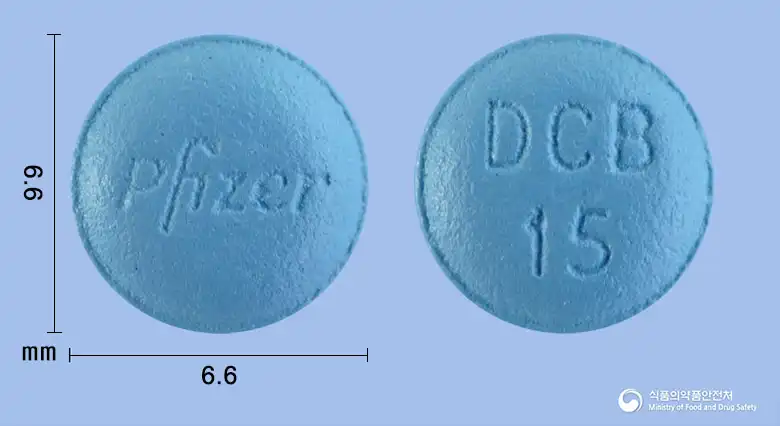
Blue, bilaterally convex, round film-coated tablets
For domestic use - 30 tablets/blister
Even with the same ingredient, strength, dosage form and how it is taken can differ.
Viewing nowDacomitinib Hydrate 15.576mg
Tablet · Prescription medication
Pfizer Korea Ltd.
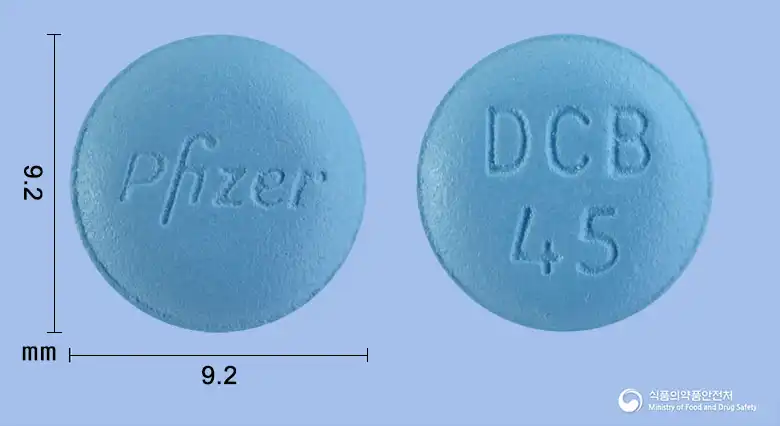
Dacomitinib Hydrate 46.729mg
Tablet · Prescription medication
Pfizer Korea Co., Ltd.
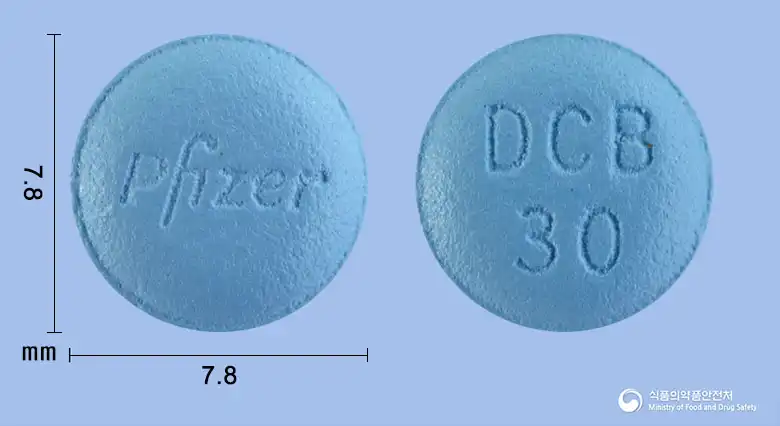
Dacomitinib Hydrate 31.153mg
Tablet · Prescription medication
Pfizer Pharmaceuticals Korea Co., Ltd.
Even with the same ingredient, the dose and directions can differ by strength and dosage form. Talk to a doctor or pharmacist before switching from a medication you are already taking.
No questions yet.
For anything that needs medical judgment, consult a doctor or pharmacist.
This drug information is based on data provided by the Korea Ministry of Food and Drug Safety.
Consult a doctor or pharmacist for accurate dosage, administration, and usage instructions.