
 한국어
 English
 日本語
 中文(简体)
 Viewing now
Lynparza 100 mg Tablets (Olaparib)
Olaparib 100mg
Tablet · Prescription medication
AstraZeneca Korea Co., Ltd.
MFDS item code 201907537 · Approved 2019.10.29 · Insurance code 650701120
Treatment of gynecologic cancers (ovarian, endometrial, etc.) and other cancers (breast, pancreatic, and prostate cancer)
This medication is used for treating various cancers. For ovarian cancer, it is used as maintenance therapy in patients with high-grade epithelial ovarian cancer, fallopian tube cancer, or primary peritoneal cancer with BRCA mutations who have responded to platinum-based chemotherapy, whether first-line or recurrent. In breast cancer, it is applicable for post-surgical adjuvant therapy and treatment of patients with gBRCA mutation HER2-negative high-risk early breast cancer and metastatic breast cancer. For pancreatic cancer, it is used as maintenance therapy after platinum-based chemotherapy in metastatic pancreatic cancer patients with gBRCA mutations. In prostate cancer, it is administered for the treatment of metastatic castration-resistant prostate cancer patients with BRCA mutations, including those with no prior experience of chemotherapy. Lastly, for endometrial cancer, it is used as first-line treatment and maintenance therapy in patients with progressive or recurrent endometrial cancer who do not have mismatch repair deficiency. This medication is mainly effective in treating ovarian, breast, pancreatic, prostate cancers, and endometrial cancer associated with BRCA mutations.
Take 300 mg (2 tablets of 150 mg) orally twice daily (total daily dose of 600 mg). Monotherapy maintenance treatment for advanced BRCA-mutated high-grade epithelial ovarian cancer (including fallopian tube cancer or primary peritoneal cancer): Treatment may be continued for 2 years or until disease progression or unacceptable toxicity occurs. Patients who achieve a complete response (no radiologic evidence of disease) in the second year should discontinue treatment. Patients who have evidence of disease in the second year but, in the opinion of their treating physician, may derive additional benefit from continuing treatment may continue treatment beyond 2 years. Platinum-sensitive recurrent high-grade epithelial ovarian cancer (including fallopian tube cancer or primary peritoneal cancer): It is recommended that treatment be continued until progression of the underlying disease or unacceptable toxicity occurs. Maintenance treatment in combination with bevacizumab: Treatment may be continued for 2 years or until disease progression or unacceptable toxicity occurs. Patients who achieve a complete response (no radiologic evidence of disease) in the second year should discontinue treatment. Patients who have evidence of disease in the second year but, in the opinion of their treating physician, may derive additional benefit from continuing treatment may continue treatment beyond 2 years. (Refer to the prescribing information for bevacizumab.) Adjuvant treatment after surgery in patients with gBRCA-mutated, HER2-negative, high-risk early breast cancer: It is recommended that patients continue treatment for up to 1 year or until disease recurrence or unacceptable toxicity occurs. Patients who are hormone receptor-positive should continue concomitant endocrine therapy. HER2-negative metastatic breast cancer: It is recommended that treatment be continued until progression of the underlying disease or unacceptable toxicity occurs. Maintenance treatment after first-line treatment of metastatic pancreatic cancer: It is recommended that treatment be continued until progression of the underlying disease or unacceptable toxicity occurs. BRCA-mutated metastatic castration-resistant prostate cancer: It is recommended that treatment be continued until progression of the underlying disease or unacceptable toxicity occurs. Combination therapy with abiraterone and prednisolone for the treatment of metastatic castration-resistant prostate cancer: It is recommended that treatment be continued until progression of the underlying disease or unacceptable toxicity occurs. When Lynparza is used in combination with abiraterone, refer to the prescribing information for the recommended dosage of abiraterone (see section 12, Information for Healthcare Professionals, under Precautions for Use). First-line maintenance treatment in combination with durvalumab for advanced or recurrent endometrial cancer: It is recommended that treatment be continued until progression of the underlying disease or unacceptable toxicity occurs. When this medicine is administered in combination with durvalumab, refer to the prescribing information for the recommended dosage of durvalumab (see section 12, Information for Healthcare Professionals, under Precautions for Use). If a patient misses a dose of this medicine, the patient should take the next normal dose at the scheduled time. Treatment may be interrupted to manage adverse reactions, and dose reduction may be considered. The recommended dose reduction is 250 mg (one 150mg tablet and one 100mg tablet) twice daily (equivalent to a total daily dose of 500mg). If further dose reduction is required, a reduction to 200mg (two 100mg tablets) twice daily (equivalent to a total daily dose of 400mg) is recommended. Concomitant administration with strong or moderate CYP3A inhibitors is not recommended; consider alternative treatment. If concomitant administration with a strong CYP3A inhibitor is necessary, it is recommended that the dose of this medicine be reduced to 100mg (one 100mg tablet) twice daily (equivalent to a total daily dose of 200mg). If concomitant administration with a moderate CYP3A inhibitor is necessary, it is recommended that the dose of this medicine be reduced to 150mg (one 150mg tablet) twice daily (equivalent to a total daily dose of 300mg) (see section 4, Interactions). This medicine must be swallowed whole and must not be chewed, crushed, dissolved, or divided. This medicine may be taken with or without food.
Rarely, serious blood disorders such as myelodysplastic syndrome or acute myeloid leukemia can occur with long-term use of this medication. The risk of these conditions may be higher in patients who have previously undergone multiple courses of platinum-based chemotherapy, so caution is advised. During the course of this medication, venous thrombosis, which occurs when blood clots form and travel to the lungs resulting in pulmonary embolism, may occur; patients should notify healthcare professionals immediately if any related symptoms arise. If new or worsening symptoms such as shortness of breath, cough, or fever appear, pneumonia may be suspected, and the use of this medication should be stopped and an immediate examination should be conducted. Use of this medication during pregnancy can cause serious harm to the fetus, thus it must not be taken during pregnancy. Women of childbearing potential should use effective contraception during treatment and for 6 months after completing the treatment. Male patients are also advised to use condoms during sexual intercourse and provide contraception for their partners during the treatment period and for 3 months after discontinuation. Hematological side effects such as reduced levels of red blood cells, white blood cells, and platelets are common, so regular blood tests should be conducted to monitor these conditions. Liver function abnormalities can occur, and if any hepatic toxicity symptoms appear, immediate medical attention is necessary, and discontinuation of the medication should be considered. Fatigue, weakness, and dizziness may occur during treatment, so caution is required when driving or operating machinery. Since this medication has many drug interactions, dosage adjustments or discontinuation may be necessary when co-administered with certain antibiotics, antifungals, or medications affecting liver metabolism, so it is essential to consult healthcare professionals. This medication is not recommended for patients with severely impaired kidney or liver function, and dosage adjustments are required for moderately impaired patients. There is no specific antidote for overdose; general supportive measures should be taken under the guidance of healthcare professionals. This medication should be kept out of the reach of children for safety, and should be stored in its original container, avoiding moisture and direct sunlight.
Not everyone experiences these, and they can vary from person to person.
This medication may be sensitive to air or moisture, so it should be stored in a tightly closed container. It is best to maintain a storage temperature between 1 degree and 30 degrees Celsius at room temperature. By doing so, the efficacy of the medicine can be safely preserved.
Yellow to dark yellow, bilaterally convex, oval-shaped film-coated tablet
56 tablets (8 tablets/PTPx7)
Even with the same ingredient, strength, dosage form and how it is taken can differ.
Viewing nowOlaparib 100mg
Tablet · Prescription medication
AstraZeneca Korea Co., Ltd.
Olaparib 50mg
Hard capsule · Prescription medication
AstraZeneca Korea Co., Ltd.
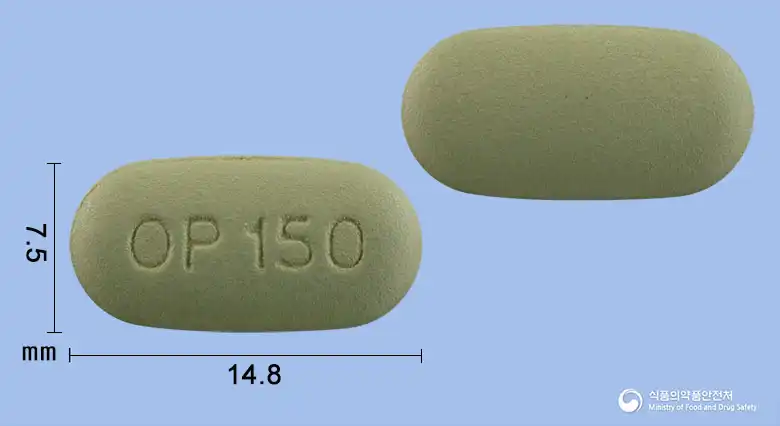
Olaparib 150mg
Tablet · Prescription medication
AstraZeneca Korea Co., Ltd.
Even with the same ingredient, the dose and directions can differ by strength and dosage form. Talk to a doctor or pharmacist before switching from a medication you are already taking.
No questions yet.
For anything that needs medical judgment, consult a doctor or pharmacist.
This drug information is based on data provided by the Korea Ministry of Food and Drug Safety.
Consult a doctor or pharmacist for accurate dosage, administration, and usage instructions.