
 한국어
 English
 日本語
 中文(简体)
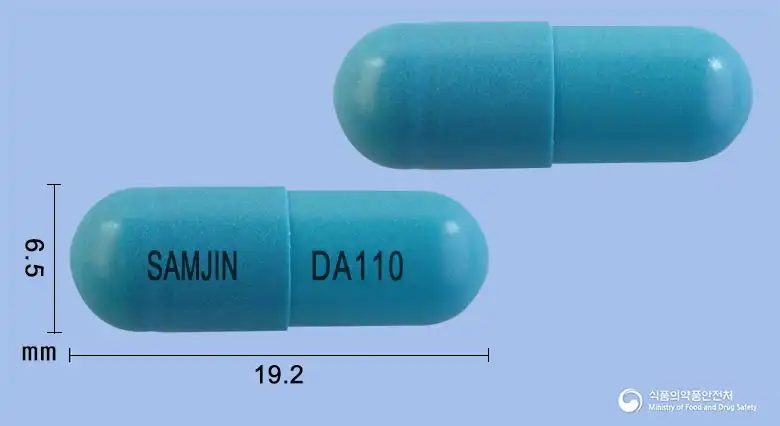 Viewing now
Dabiran Capsule 110mg (Dabigatran etexilate)
Dabigatran Etexilate 110mg
Hard capsule · Prescription medication
Samjin Pharmaceutical Co., Ltd.
MFDS item code 201804540 · Approved 2018.11.15
Prevention of stroke and embolism; treatment and prevention of recurrence of venous thrombosis; prevention of thrombosis after joint replacement
This medication helps to reduce the risk of stroke and systemic embolism in patients with non-valvular atrial fibrillation. It also treats venous thromboembolism and pulmonary embolism and reduces the risk of recurrence. It is also used for the prevention of venous thromboembolism in patients undergoing hip or knee replacement surgery. Therefore, it is effective for the prevention and treatment of thrombotic diseases.
This medicine should be taken with water, with or without food. 1. Adults (1) Reduction in the risk of stroke and systemic embolism in patients with non-valvular atrial fibrillation Take 150 mg orally twice daily. (2) Treatment of deep vein thrombosis and pulmonary embolism/reduction in the risk of recurrent deep vein thrombosis and pulmonary embolism After at least 5 days of parenteral anticoagulant therapy, take 150mg orally twice daily. (3) For patients who may be at increased risk of bleeding in the three indications above (see “3. Patients who should use this medicine with caution” under Precautions for Use), administration of 110 mg orally twice daily may be considered. These patients should be monitored closely for clinical signs of bleeding or anemia, and coagulation tests such as aPTT should be used to assess whether excessive exposure to this medicine may increase the risk. (4) Prevention of venous thromboembolism in patients who have undergone hip or knee replacement surgery ① Patients who have undergone knee replacement surgery Take 220mg (2 capsules of 110mg) orally once daily. Start treatment with 1 capsule of 110mg of this medicine within 1~4 hours after completion of surgery, then administer 220mg (2 capsules of 110mg) once daily for a total of 10 days. ② Patients who have undergone hip replacement surgery Take 220mg (2 capsules of 110mg) orally once daily. Start treatment with 1 capsule of 110mg of this medicine within 1~4 hours after completion of surgery, then administer 220mg (2 capsules of 110mg) once daily for a total of 28~35 days. ③ For patients who may be at increased risk of bleeding (see “3. Patients who should use this medicine with caution” under Precautions for Use), administration of 150 mg (2 capsules of 75mg) orally twice daily may be considered. Start treatment with 1 capsule of 75mg of this medicine within 1~4 hours after completion of surgery, then administer 150mg (2 capsules of 75mg) once daily for a total of 10 days (for knee replacement surgery) or 28~35 days (for hip replacement surgery). ④ Bioequivalence has not been established between concomitant administration of 2 capsules of 75mg of this medicine and administration of 1 capsule of 150mg of this medicine; therefore, when administering 150mg of this medicine, 2 capsules of 75mg must be administered. ⑤ For both types of surgery, if hemostasis has not been reliably achieved, initiation of treatment with this medicine should be delayed. If treatment cannot be started on the day of surgery, start with 2 capsules once daily. 2. Switching medications (1) Switching from this medicine to a parenteral anticoagulant ① Reduction in the risk of stroke and systemic embolism in patients with non-valvular atrial fibrillation, treatment of deep vein thrombosis and pulmonary embolism/reduction in the risk of recurrent deep vein thrombosis and pulmonary embolism Start administration of the parenteral anticoagulant 12 hours after taking the last dose of this medicine. ② Prevention of venous thromboembolism in patients who have undergone hip or knee replacement surgery Start administration of the parenteral anticoagulant 24 hours after taking the last dose of this medicine. (2) Switching from a parenteral anticoagulant to this medicine For patients currently receiving a parenteral anticoagulant, administer this medicine 0~2 hours before the next scheduled dose of the parenteral anticoagulant, or at the time of discontinuation if it is being administered continuously (e.g., intravenous administration of unfractionated heparin). (3) Switching from this medicine to a vitamin K antagonist ① Reduction in the risk of stroke and systemic embolism in patients with non-valvular atrial fibrillation, treatment of deep vein thrombosis and pulmonary embolism/reduction in the risk of recurrent deep vein thrombosis and pulmonary embolism Adjust the time of initiation of the vitamin K antagonist according to creatinine clearance (Creatinine Clearance, CrCl), as follows. • CrCl 50 mL/min or greater: Start the vitamin K antagonist 3 days before discontinuing this medicine. • CrCl ≥ 30~<50 mL/min: Start the vitamin K antagonist 2 days before discontinuing this medicine. This medicine may increase INR. Since INR testing at least 2 days after discontinuing this medicine better reflects the effect of the vitamin K antagonist, INR values should be interpreted with caution until then. (4) Switching from a vitamin K antagonist to this medicine ① Reduction in the risk of stroke and systemic embolism in patients with non-valvular atrial fibrillation, treatment of deep vein thrombosis and pulmonary embolism/reduction in the risk of recurrent deep vein thrombosis and pulmonary embolism Discontinue the vitamin K antagonist; this medicine may be administered immediately when the INR is below 2.0. 3. Patients with renal impairment (1) Reduction in the risk of stroke and systemic embolism in patients with non-valvular atrial fibrillation, treatment of deep vein thrombosis and pulmonary embolism/reduction in the risk of recurrent deep vein thrombosis and pulmonary embolism No dose adjustment is necessary in patients with mild renal impairment (50 ≤ CrCL ≤ 80 mL/min). In patients with moderate renal impairment (30 ≤ CrCL < 50 mL/min), administration of 110 mg twice daily may be considered because the risk of bleeding may be increased. Administration of this medicine is contraindicated in patients with severe renal impairment (CrCL < 30 mL/min). (2) Prevention of venous thromboembolism in patients who have undergone hip or knee replacement surgery In patients with moderate renal impairment (30 ≤ CrCL < 50 mL/min), administration of 150mg (2 capsules of 75mg) once daily may be considered because the risk of bleeding may be increased. For patients with moderate renal impairment who are taking this medicine concomitantly with verapamil, administration of 75mg once daily may be considered. Administration of this medicine is contraindicated in patients with severe renal impairment (CrCL < 30 mL/min). 4. Elderly patients aged 75 years or older (1) Reduction in the risk of stroke and systemic embolism in patients with non-valvular atrial fibrillation, treatment of deep vein thrombosis and pulmonary embolism/reduction in the risk of recurrent deep vein thrombosis and pulmonary embolism Administration of 110 mg twice daily may be considered because the risk of bleeding may be increased. (2) Prevention of venous thromboembolism in patients who have undergone hip or knee replacement surgery Administration of 150mg (2 capsules of 75mg) once daily may be considered because the risk of bleeding may be increased. 5. If you forget to take this medicine (1) Reduction in the risk of stroke and systemic embolism in patients with non-valvular atrial fibrillation, treatment of deep vein thrombosis and pulmonary embolism/reduction in the risk of recurrent deep vein thrombosis and pulmonary embolism If you forget to take this medicine, take it as soon as possible on the same day, but no later than 6 hours before the next scheduled dose. Do not take twice the recommended daily dose to make up for a missed dose. (2) Prevention of venous thromboembolism in patients who have undergone hip or knee replacement surgery Take the recommended daily dose of this medicine at the same time the following day. Do not take twice the recommended daily dose to make up for a missed dose.
This medication is used to prevent or treat thrombus formation by stopping the blood from clotting. However, due to the risk of bleeding, it should be used with caution in patients at high risk of bleeding. If bleeding is suspected or blood pressure drops, inform healthcare staff immediately, and if severe bleeding occurs, administration of this medication should be stopped. Patients with rapidly deteriorating renal function should also discontinue this medication, and it should not be administered to patients with severe renal impairment. Patients allergic to any component of this medication and those with gastrointestinal ulcers, intracranial hemorrhage, or who have recently undergone brain or spinal surgery should also not receive this medication. Additionally, concurrent use with other anticoagulants increases the risk of bleeding and should be avoided. Care should be taken when administering this medication with platelet inhibitors or specific medications, as it may further increase the risk of bleeding. During the treatment with this medication, bleeding symptoms and signs of anemia should be monitored closely, especially in elderly or underweight patients and those with impaired renal function. The medication may be temporarily discontinued before and after surgery due to the risk of bleeding, and caution is needed during high-risk invasive procedures. Overdosing this medication greatly increases the risk of bleeding, so the dosage must be strictly adhered to. Pregnant women are advised not to use this medication, and breastfeeding women should discontinue breastfeeding while using it. The safety and efficacy of this medication in children have not been established, and therefore it is not recommended. Moreover, this medication has many drug interactions, particularly when taken with certain antibiotics, cardiac medication, antiplatelet agents, and anticoagulants, which may increase the risk of bleeding, so consultation with a doctor or pharmacist is essential. Finally, this medication is provided in capsule form, and capsules should not be opened or broken, and it should be stored in a cool, dry place away from children's reach.
Not everyone experiences these, and they can vary from person to person.
This medication should be stored at room temperature between 1 to 30 degrees Celsius in a tightly sealed container. It is important to keep it in a dry place, avoiding humid areas.
A hard capsule with a bright blue top and a bright blue bottom, filled with pale yellow pellets
60 capsules (10 capsules/PTP x 6)
Even with the same ingredient, strength, dosage form and how it is taken can differ.
Viewing nowDabigatran Etexilate 110mg
Hard capsule · Prescription medication
Samjin Pharmaceutical Co., Ltd.
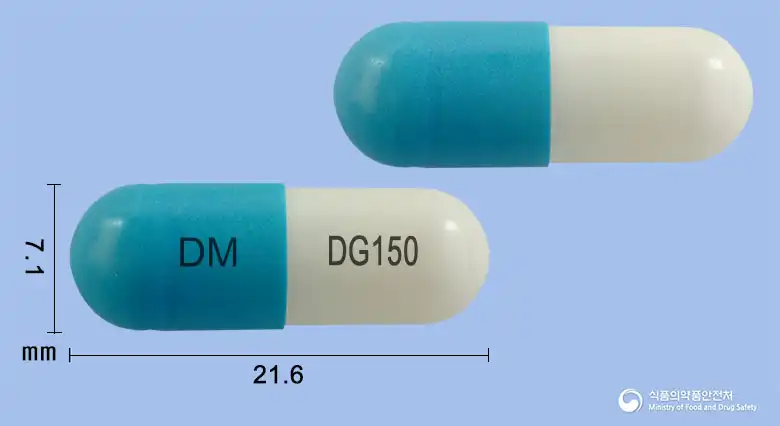
Dabigatran Etexilate 150mg
Hard capsule · Prescription medication
Dasan Pharmaceutical Co., Ltd.
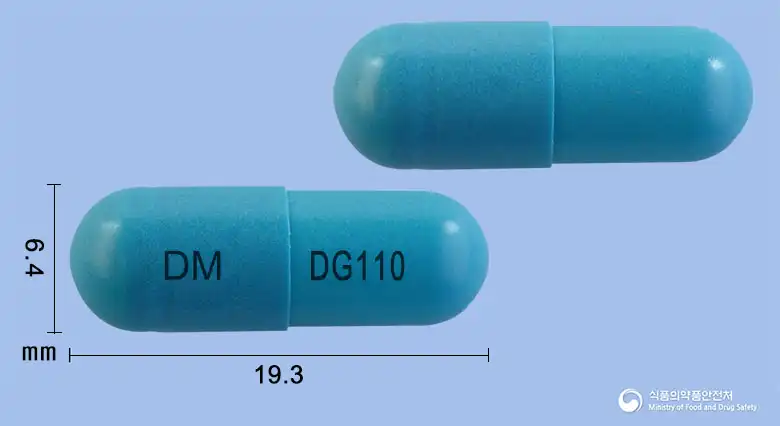
Dabigatran Etexilate 110mg
Hard capsule · Prescription medication
Dasan Pharmaceutical Co., Ltd.
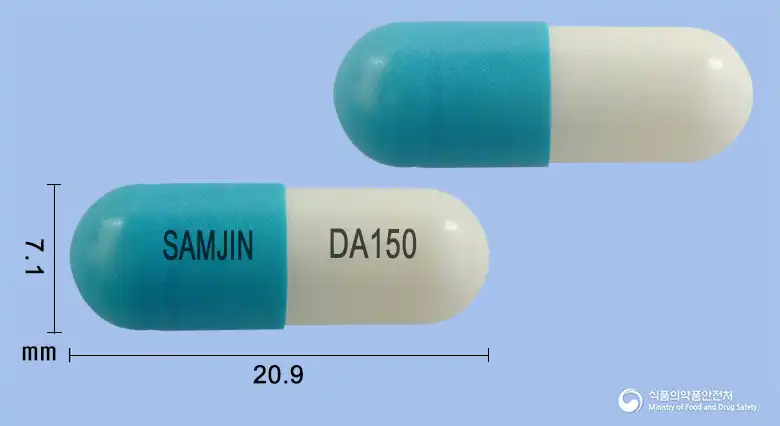
Dabigatran Etexilate 150mg
Hard capsule · Prescription medication
Samjin Pharmaceutical Co., Ltd.
Dabigatran Etexilate 110mg
Prescription medication
Boryeong (Co., Ltd.)
Dabigatran Etexilate 150mg
Prescription medication
Boryung Pharmaceutical Co., Ltd.
Dabigatran Etexilate 150mg
Prescription medication
Daiwon Pharmaceutical Co., Ltd.
Dabigatran Etexilate 110mg
Prescription medication
Daewon Pharmaceutical Co., Ltd.
Even with the same ingredient, the dose and directions can differ by strength and dosage form. Talk to a doctor or pharmacist before switching from a medication you are already taking.
No questions yet.
For anything that needs medical judgment, consult a doctor or pharmacist.
This drug information is based on data provided by the Korea Ministry of Food and Drug Safety.
Consult a doctor or pharmacist for accurate dosage, administration, and usage instructions.