한국어
 English
 日本語
 中文(简体)
 Viewing now
Lafinna Capsule 50 mg (Dabrafenib Mesilate)
Dabrafenib Mesylate Micronized 59.25mg
Soft capsule · Prescription medication
Novartis Korea Co., Ltd.
MFDS item code 201404384 · Approved 2014.09.25 · Insurance code 653602650
Treatment of BRAF-mutant melanoma (including adjuvant therapy), non-small cell lung cancer, and solid tumors
This medication is primarily used for the treatment of patients with inoperable or metastatic melanoma with confirmed BRAF V600E or V600K mutations, as well as for adjuvant treatment in melanoma patients post-surgery, and for metastatic non-small cell lung cancer patients. It is also used in combination with Trametinib for the treatment of inoperable or metastatic solid tumor patients after disease progression following conventional therapy. This drug effectively helps treat cancer and improve symptoms in patients with specific gene mutations.
The recommended dose of this drug in adult patients is 150mg twice daily, regardless of body weight, for both monotherapy and combination therapy (equivalent to a total daily dose of 300mg). Dose reductions below 50mg twice daily are not recommended for monotherapy or combination therapy with this drug. Starting dose: 150mg twice daily First dose reduction: 100mg twice daily Second dose reduction: 75mg twice daily Third dose reduction: 50mg twice daily Further dose reduction: Permanently discontinue treatment if 50mg twice daily is not tolerated It is recommended that treatment be continued unless the patient no longer benefits or unacceptable toxicity occurs. For adjuvant treatment of melanoma, treatment duration is limited to a maximum of 1 year. If you forget to take a dose and it is less than 6 hours until the next dose, do not take the missed dose. Dabrafenib should be taken at least 1 hour before a meal or at least 2 hours after a meal, with doses approximately 12 hours apart. This drug should be taken at about the same time each day to improve patient adherence. If vomiting occurs after taking this drug, do not take another dose; take the next dose according to the regular schedule. Swallow the capsules whole with water. Do not chew or crush the capsules, and do not mix them with food or liquids because dabrafenib is chemically unstable. When this drug is used in combination with trametinib, administer trametinib once daily at the same time as the morning or evening dose of this drug. Treatment interruption, dose reduction, or discontinuation may be necessary to manage adverse reactions. Dose modification or treatment interruption is not recommended for cutaneous squamous cell carcinoma (cuSCC) or new primary melanoma adverse reactions. Febrile drug reaction: fever of 38℃~40℃ (at the first symptom in the event of recurrence)—Interrupt treatment with this drug until the fever resolves. Then resume treatment at the same or a lower dose. Fever above 40℃, or fever accompanied by complications such as rigors, hypotension, dehydration, or renal failure—Interrupt treatment with this drug until the fever resolves. Then resume treatment at a lower dose, or permanently discontinue treatment with this drug. Intolerable Grade 2 skin toxicity, Grade 3 or 4 skin toxicity—Interrupt treatment with this drug for up to 3 weeks. If the condition improves, resume treatment at a lower dose. If it does not improve, permanently discontinue treatment. Symptomatic congestive heart failure, LVEF with an absolute decrease of 20% or more from baseline and below the institutional LLN—Interrupt treatment with this drug; if the condition improves, resume treatment at the same dose. Life-threatening pulmonary embolism—Permanently discontinue treatment with this drug. Uveitis, including iritis and iridocyclitis—For mild or moderate uveitis that does not respond to ocular treatment, or for severe uveitis, interrupt dabrafenib treatment for up to 6 weeks. If the condition improves to Grade 0~1, resume treatment at the same or a lower dose. If it does not improve, permanently discontinue treatment. Intolerable Grade 2 adverse reactions, any Grade 3 adverse reaction—Interrupt treatment with this drug. If the condition improves to Grade 0~1, resume treatment at a lower dose. If it does not improve, permanently discontinue treatment. First occurrence of a Grade 4 adverse reaction—Interrupt treatment with this drug until the adverse reaction improves to Grade 0~1. Then resume treatment at a lower dose, or permanently discontinue treatment. Recurrence of any Grade 4 adverse reaction—Permanently discontinue treatment with this drug. If the patient's adverse reactions are effectively managed, consider re-escalating the dose according to the same dose levels used for dose reduction. The dose must not exceed 150mg twice daily. When adjusting the dose of concomitant trametinib for the following adverse reactions, dose adjustment of this drug is not recommended: retinal pigment epithelial detachment, retinal vein occlusion, interstitial lung disease/pneumonitis, uncomplicated deep vein thrombosis, or pulmonary embolism Continue treatment when adverse reactions are Grade 1 or 2 (tolerable) and monitor as clinically indicated. If a RAS mutation-positive noncutaneous malignancy adverse reaction occurs, dabrafenib treatment should be permanently discontinued. If the patient's body temperature is 38℃ or higher, interrupt treatment with this drug (both this drug and trametinib in combination therapy). In the event of recurrence, treatment may be interrupted at the first symptom of fever. Treatment with an antipyretic such as ibuprofen or acetaminophen (paracetamol) should be initiated. If antipyretics are inadequate, consider administering an oral corticosteroid. Assess the patient for signs and symptoms of infection. When the patient has been symptom-free for at least 24 hours, resume treatment with this drug (both this drug and trametinib in combination therapy) as follows. (1) Resume at the same dose (2) Or, if fever recurs or is accompanied by other severe symptoms, including dehydration, hypotension, or renal failure, resume at a dose reduced by one dose level according to Tables 1, 3, and 4
26 – 37kg: 75mg orally twice daily 38 – 50kg: 100mg orally twice daily 51kg or more: 150mg orally twice daily 26 – 37kg: First dose reduction: 50mg orally twice daily; second and third dose reductions: - 38 – 50kg: First dose reduction: 75mg orally twice daily; second dose reduction: 50mg orally twice daily; third dose reduction: - 51kg or more: First dose reduction: 100mg orally twice daily; second dose reduction: 75mg orally twice daily; third dose reduction: 50mg orally twice daily The recommended dose has not been established for patients weighing less than 26kg. Permanently discontinue treatment if the patient cannot tolerate the third reduced dose or administration of this drug at 50mg twice daily.
This medication should not be used in patients with an allergy to the active ingredient or any other components. Side effects such as fever, headache, joint pain, fatigue, skin rash, hair loss, and indigestion may frequently occur during treatment with this medication. In particular, fever may occur frequently, and if the body temperature exceeds 38 degrees, the medication should be discontinued, and a doctor should be consulted. Any abnormal changes in the skin or the development of new skin lesions should be reported immediately to a physician, as serious skin problems such as skin cancer may occur, necessitating regular skin examinations. This medication may affect cardiac function and symptoms such as decreased cardiac output or cardiomyopathy may appear, so it is important to undergo cardiac testing before and during treatment. Additionally, various side effects such as liver dysfunction, renal impairment, pancreatitis, bleeding, and hypertension may occur, so regular blood tests and health monitoring are necessary. Inflammation in the eyes or changes in vision may occur, so if any ocular abnormalities occur, immediate consultation with healthcare professionals is necessary. This medication may interact with other drugs, so it is crucial to inform your physician of any other medications you are taking, particularly when combined with drugs that are metabolized in the liver. When taking this medication, caution should be exercised as fatigue and dizziness may occur while driving or operating machinery. If you are pregnant, planning to become pregnant, or breastfeeding, a consultation with healthcare providers is essential before using this medication. During treatment, it is important to inform healthcare professionals immediately of any adverse reactions and through regular exams and monitoring to detect and manage side effects early.
This medication should be stored in a tightly sealed container to avoid exposure to air or moisture, and should be kept at room temperature between 1°C and 30°C. This will maintain the medication's effectiveness and ensure safe use.
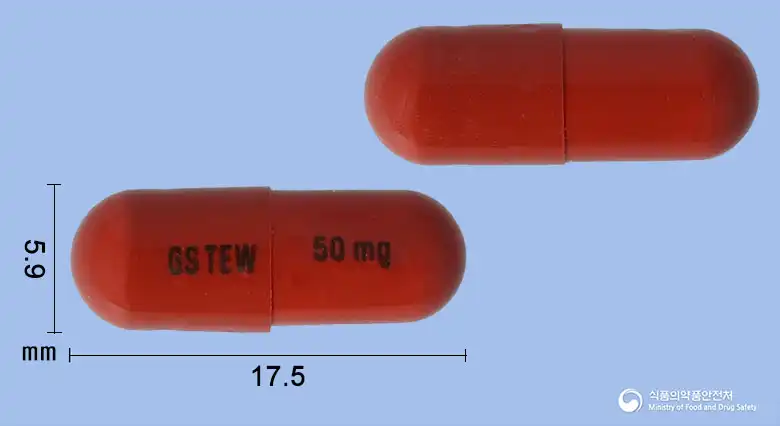
Opaque capsule of dark red color
120 capsules (120 capsules/bottle packaging x 1)
Even with the same ingredient, strength, dosage form and how it is taken can differ.
Even with the same ingredient, the dose and directions can differ by strength and dosage form. Talk to a doctor or pharmacist before switching from a medication you are already taking.
No questions yet.
For anything that needs medical judgment, consult a doctor or pharmacist.
This drug information is based on data provided by the Korea Ministry of Food and Drug Safety.
Consult a doctor or pharmacist for accurate dosage, administration, and usage instructions.