
 한국어
 English
 日本語
 中文(简体)
Dosage form image
Viewing nowVfend Oral Suspension (Voriconazole)
Voriconazole
Prescription medication
Pfizer Korea Co., Ltd.
MFDS item code 200806353 · Approved 2008.06.09
This product's status changed to Expired on 2023.04.01. It may no longer be sold, so consult a doctor or pharmacist before taking it.
Treatment of fungal infections (e.g., Aspergillus and Candida infections); prevention of invasive fungal infections
This medication is used to treat invasive Aspergillus infections, particularly infections caused by most Aspergillus fumigatus. It also treats Candida bacteremia and Candida infections of the skin, abdomen, kidneys, bladder wall, and wound sites in patients without neutropenia. It is effective for esophageal candidiasis and is applicable for patients with severe fungal infections due to Scedosporium apiospermum and Fusarium species who are resistant to or do not respond to other treatments. Additionally, it is used for the prevention of invasive fungal infections after hematopoietic stem cell transplantation in patients with acute leukemia, treatment failure of lymphoma, or chronic myeloid leukemia. This drug helps improve various invasive and severe fungal infections.
Vfend Dry Syrup should be taken at least 1 hour before or 1 hour after a meal. Adults (18 years and older) and adolescents (adolescents aged 12 to under 15 years weighing at least 50 kg, and adolescents aged 15 to under 18 years of any weight) should be dosed as follows. - Severe fungal infections, including invasive Aspergillus infections: loading dose of 6 mg/kg every 12 hours (4 mg/kg every 12 hours during the first 24 hours); maintenance dose of 4 mg/kg every 12 hours - Candidemia and Candida infections in patients without neutropenia: loading dose of 6 mg/kg every 12 hours (during the first 24 hours); maintenance dose of 3~4 mg/kg every 12 hours - Esophageal candidiasis: 200 mg (5mL) every 12 hours - Prevention of invasive fungal infections in hematopoietic stem cell transplant patients: loading dose of 6 mg/kg every 12 hours (during the first 24 hours); maintenance dose of 4 mg/kg every 12 hours Patients weighing at least 40 kg should receive 200 mg (5mL) every 12 hours, and patients weighing less than 40 kg should receive 100 mg (2.5mL) every 12 hours. If the treatment response is insufficient, the maintenance dose may be increased or decreased. Elderly patients and patients with hepatic or renal impairment may also receive this medicine without dose adjustment.
Children (2 to under 12 years) and adolescents (adolescents aged 12 to under 15 years weighing less than 50 kg) should be dosed as follows. - Loading dose (during the first 24 hours): 9 mg/kg every 12 hours by injection (the dry syrup formulation is not recommended). - Maintenance dose (after the first 24 hours): 8 mg/kg twice daily for the injectable formulation; 9 mg/kg twice daily for the dry syrup formulation, up to a maximum of 350 mg twice daily. It is recommended that treatment be initiated with the injectable formulation; the oral formulation should be considered only if there is clinical improvement. Use is not recommended in children under 2 years of age because safety and efficacy have not been established. If treatment is inadequate, the dose may be increased or decreased by 1 mg/kg.
This medication contains voriconazole, an antifungal agent, and should not be administered to certain patients. First of all, patients allergic to voriconazole or other components of this medication should not take it. Moreover, this drug contains sucrose and should not be used in patients with rare genetic disorders such as fructose intolerance, sucrose-isomaltase deficiency, or glucose-galactose malabsorption. It is also prohibited to take this medication in combination with certain drugs. For example, concomitant use with St John's Wort, rifabutin, rifampicin, carbamazepine, or phenobarbital may reduce the effectiveness of this medication. When taken together with high doses of ritonavir, the blood concentration of this drug may significantly decrease, so concomitant use is prohibited. Taking this medication with drugs that can affect the heart can increase the risk of arrhythmia, so it should not be used with terfenadine, astemizole, cisapride, pimodivir, or quinidine. Furthermore, combining it with sirolimus, ergot alkaloids, or efavirenz is also prohibited. This medication should be administered cautiously to patients with hypersensitivity to other azole medications or underlying heart conditions and electrolyte imbalances, and blood concentration changes due to drug interactions must be monitored closely. During treatment, liver, kidney, and pancreatic functions should be regularly assessed to check for any signs of abnormality, and side effects such as skin reactions or visual disturbances should also be monitored carefully. In particular, this medication may commonly cause visual disturbances, fever, rashes, vomiting, diarrhea, and headaches, so if symptoms are severe, it is essential to consult medical personnel. During pregnancy, as the safety for the fetus has not been established, it should only be used when the risks to the fetus outweigh the benefits, and women under treatment should use effective contraceptive measures. If nursing, it is recommended to discontinue breastfeeding during the administration of this drug. This medication can cause visual changes such as blurred vision or photophobia, so caution is required when driving or operating machinery. In the case of overdose, there is no specific antidote, but blood dialysis may be performed to remove the drug if necessary. Store in a sealed container to protect from air and moisture and keep refrigerated between 2°C and 8°C to maintain freshness and efficacy. The suspension should be used within 14 days and should not be mixed with other medications. Before taking this medication, it is crucial to consult medical personnel to thoroughly consider potential drug interactions and individual health conditions, and strictly adhere to the prescribed dosage and administration guidelines.
Not everyone experiences these, and they can vary from person to person.
This medication should be stored in a tightly closed container to protect it from air and moisture and should be kept refrigerated between 2°C and 8°C to maintain freshness and efficacy.
White to grayish white powder
Manufacturer packaging unit
Even with the same ingredient, strength, dosage form and how it is taken can differ.
Voriconazole
Prescription medication
Pfizer Korea Co., Ltd.
Voriconazole
Prescription medication
Pfizer Korea Co., Ltd.
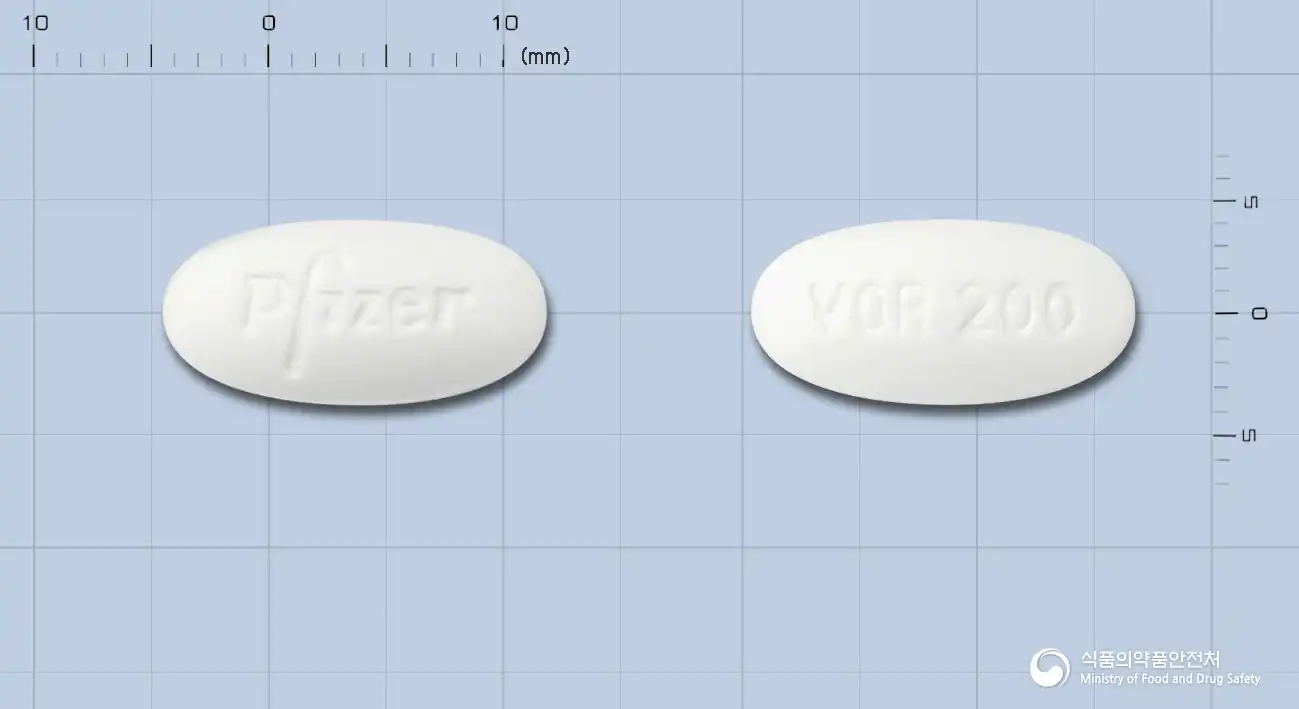
Voriconazole 200mg
Tablet · Prescription medication
Pfizer Korea Co., Ltd.
Voriconazole 200mg
Prescription medication
Pfizer Korea Ltd.
Voriconazole 200mg
Prescription medication
Jongkundang Co., Ltd.
Even with the same ingredient, the dose and directions can differ by strength and dosage form. Talk to a doctor or pharmacist before switching from a medication you are already taking.
No questions yet.
For anything that needs medical judgment, consult a doctor or pharmacist.
This drug information is based on data provided by the Korea Ministry of Food and Drug Safety.
Consult a doctor or pharmacist for accurate dosage, administration, and usage instructions.