
 한국어
 English
 日本語
 中文(简体)
 Viewing now
Aqipta Tablets 60 mg (Atozepant Dihydrate)
Atogepant Monohydrate 61.8mg
Tablet · Prescription medication
AbbVie Korea Co., Ltd.
MFDS item code 202303151 · Approved 2023.11.15
Prevention of migraine in adults
This medicine is used for the prevention of recurrent migraines in adults. If individuals with frequent migraines take this medication, it can help reduce the frequency of attacks and alleviate the severity of symptoms. Regular intake can help reduce discomfort caused by migraines in daily life. It is used to improve quality of life by preventing migraines in advance.
○ Adults The recommended dose of this medicine is 60 mg of atogepant, taken orally once daily. This medicine may be taken with or without food. Swallow the tablet whole; do not crush or cut it. If a dose is missed, take it as soon as possible. However, if it is nearly time for the next dose, skip the missed dose and take the prescribed dose at the scheduled time the following day. The efficacy of this medicine for the acute treatment of migraine has not been established. ○ Dose adjustment 1) When this medicine is coadministered with other medicines, adjust the dose of this medicine as follows. (See Precautions for Use, ‘5. Interactions.’) Concomitant medication class Recommended dose of this medicine (atogepant) once daily Strong CYP3A4 inhibitors 10mg OATP inhibitors 10mg 2) Patients with renal impairment The recommended dose of this medicine in patients with severe renal impairment (creatinine clearance [CLcr] 15-29 mL/min) and end-stage renal disease (ESRD) (CLcr<15 mL/min) is 10mg once daily. Patients with ESRD receiving intermittent dialysis should take this medicine after dialysis whenever possible. Dose adjustment is not recommended in patients with mild or moderate renal impairment. 3) Patients with hepatic impairment Do not administer this medicine to patients with severe hepatic impairment (Child-Pugh Class C). Dose adjustment is not recommended in patients with mild (Child-Pugh Class A) or moderate hepatic impairment (Child-Pugh Class B).
This medication should not be used by individuals who are allergic to its active ingredients or additives, as it may cause serious allergic reactions such as anaphylaxis or respiratory distress. Also, it is not safe for patients with severely impaired liver function. Caution should be exercised while using this medication due to the potential for hypersensitivity reactions, which may manifest as rashes, itching, hives, or facial swelling. If such symptoms occur, it is essential to stop using the medication immediately and seek medical attention. Patients with severely impaired kidney function or end-stage renal disease should also use this medication cautiously. Common side effects of this medication include nausea, constipation, fatigue, and drowsiness, which are mostly mild. Rarely, there may be an elevation in liver enzyme levels, necessitating regular monitoring. This medication is only for use in migraine patients and should not be taken in excess of the prescribed dose. Those with liver or kidney dysfunction may have abnormal drug metabolism and excretion and should use the medication cautiously. Initial use may cause drowsiness or fatigue; therefore, it is advisable to avoid driving or operating machinery. This medication may interact with certain other drugs, particularly strong liver enzyme inhibitors or inducers, possibly requiring dose adjustments. Women who are pregnant are advised not to use this medication, and breastfeeding women should consult with a physician as it may be excreted in breast milk. Its safety and efficacy for children under 18 have not been established, and it is not recommended for use in this population. The elderly should exercise increased caution due to a higher likelihood of impaired liver, kidney, or heart function. In case of overdose, as no specific antidote is available, visit a hospital immediately for vital sign monitoring and necessary treatment. This medication should be kept out of reach of children and stored in its original container at room temperature, avoiding transfer to other containers.
Not everyone experiences these, and they can vary from person to person.
This medication should be stored in a tightly closed container to protect it from air and moisture. It is advisable to maintain storage temperatures between 1 and 30 degrees Celsius.
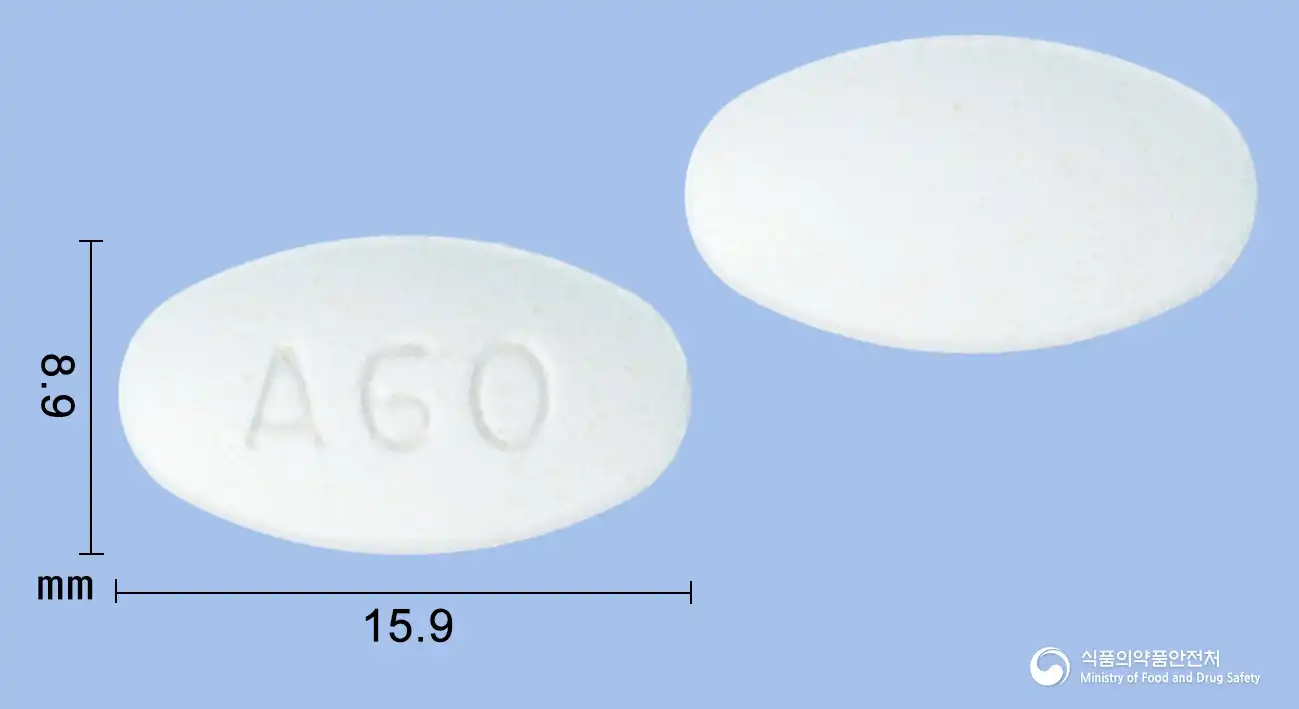
Biconvex oval tablets that are white to off-white with “A60” engraved on one side.
28 tablets/box [(7 tablets/PTP X 4)]
Even with the same ingredient, strength, dosage form and how it is taken can differ.
Even with the same ingredient, the dose and directions can differ by strength and dosage form. Talk to a doctor or pharmacist before switching from a medication you are already taking.
No questions yet.
For anything that needs medical judgment, consult a doctor or pharmacist.
This drug information is based on data provided by the Korea Ministry of Food and Drug Safety.
Consult a doctor or pharmacist for accurate dosage, administration, and usage instructions.