
 한국어
 English
 日本語
 中文(简体)
Dosage form image
Viewing nowPacpent Nasal Spray 100 Micrograms (Fentanyl Citrate)
Fentanyl Citrate 1.57mg
Nasal spray · Prescription medication
Korea Menarini Co., Ltd.
MFDS item code 202000148 · Approved 2020.01.09 · Insurance code 674900551
Relief of breakthrough pain in adult cancer patients who are opioid-tolerant
This medication is used to relieve breakthrough pain in cancer patients who are 18 years and older, currently receiving treatment with opioid analgesics for chronic pain, and have developed tolerance to that treatment. This helps patients manage their pain and improve their quality of life.
This medicine must be administered under the supervision of a clinician with specialized knowledge and skills in opioid analgesic therapy for the treatment of pain in patients with cancer. Clinicians should be alert to the potential for fentanyl abuse. Before starting treatment with this medicine, the long-acting opioid analgesic therapy used to treat the patient's persistent pain should be stabilized. When treating breakthrough pain episodes with this medicine, the dose should be titrated over 2 consecutive episodes to the effective dose that provides adequate analgesia and minimizes pain without excessive (or intolerable) adverse drug reactions. The efficacy of the administered dose should be assessed over 30 minutes. Patients should be carefully monitored until an effective dose is reached. This medicine is available in two strengths: 100 µg/spray and 400 µg/spray. A single dose of this medicine consists of 1 spray (100 µg or 400 µg dose) or 2 sprays (200 µg or 800 µg dose) of the same strength (100 µg or 400 µg strength). Patients should not take more than 4 doses per day. After the first dose of this medicine, at least 4 hours must elapse before treating another breakthrough pain episode with this medicine. This medicine can deliver doses of 100, 200, 400 and 800 µg as follows; Required dose (µg) Product strength (µg) Amount 100 100 1 spray into one nostril 200 100 1 spray into each nostril 400 400 1 spray into one nostril 800 400 1 spray into each nostril (1) Initial dose The initial dose of this medicine for treating a breakthrough pain episode is always 100 µg (1 spray), including for patients switched to this medicine from another fentanyl-containing product for the treatment of breakthrough pain. Before treating another breakthrough pain episode with this medicine, the patient must wait at least 4 hours. (2) Dose titration The initial dose is 100 µg. For patients who require titration to a higher dose because of inadequate efficacy, 200 μg (1 spray of 100 μg into each nostril) may be administered for the next breakthrough pain episode. If this dose is insufficient, prescribe the patient one bottle of this medicine at 400 μg/spray and instruct them to administer 1 spray of 400 μg/spray for the next pain episode. If this dose is insufficient, the dose may be increased to 800 μg (1 spray of 400 μg into each nostril). Patients should be closely monitored from the start of treatment, and the dose should be titrated until an effective dose is reached and confirmed over 2 consecutive breakthrough pain episodes. Titration when switching between immediate-release fentanyl products Pharmacokinetic profiles differ among immediate-release fentanyl products, which may result in clinical differences. Therefore, when switching between fentanyl-containing products for the treatment of breakthrough pain, including intranasal formulations, it is essential to retitrate the patient on the new product rather than switching on a dose-for-dose (µg-for-µg) basis. (3) Maintenance therapy Once an effective dose has been established during the titration period, patients should continue to take that dose up to a maximum of 4 times per day. (4) Dose readjustment In general, the maintenance dose of this medicine should be increased only if the current dose has not adequately treated several consecutive breakthrough pain episodes. If a patient consistently experiences more than 4 breakthrough pain episodes in 24 hours, the dose of the background opioid therapy may need to be reviewed. If pain is not adequately controlled, the possibility of hyperalgesia, tolerance, and progression of the underlying disease should be considered. If the patient does not tolerate this medicine or adverse reactions persist, the dose should be reduced or treatment with this medicine should be replaced with another analgesic. (5) Duration and goals of treatment Before starting treatment with this medicine, the treatment strategy, including the duration of treatment, treatment goals, and plans for ending treatment, should be agreed upon with the patient. During treatment with this medicine, the physician and patient should have frequent contact to assess the need for continued treatment, consider discontinuation, and adjust the dose if necessary. If pain is not adequately controlled, the possibility of hyperalgesia, tolerance, and progression of the underlying disease should be considered. This medicine should not be used for longer than necessary. (6) Discontinuation of treatment If the patient no longer experiences breakthrough pain episodes, this medicine should be discontinued immediately. The ongoing background pain therapy should be continued as prescribed. If discontinuation of all opioid analgesic therapy is required, the physician must closely monitor the patient because gradual downward titration of opioid analgesics is necessary to avoid the possibility of sudden withdrawal symptoms. (7) How to administer this medicine This medicine must be administered by the intranasal route only. Immediately before use, remove the bottle from the child-resistant container and remove the protective cap. Before first use, hold the bottle upright and prime it by repeatedly pressing and releasing the finger grips on both sides of the nozzle until a green bar appears in the counting window. (The green bar will appear after 4 sprays). Each bottle of this medicine contains 8 spray doses. If the opened bottle has not been used for 5 days, prime it with one spray before use.
This medication is a strong opioid analgesic used to relieve breakthrough pain in cancer patients. It should only be used in patients with tolerance to opioid analgesics and should not be used in patients who are new to opioid analgesics or for acute pain or postoperative pain management. Serious side effects such as respiratory depression can occur, so it must be administered under the supervision of qualified medical personnel. It should be stored out of reach of children, and any remaining medication after opening should be disposed of properly. Alcohol or central nervous system depressants must not be taken in conjunction with this medication, and if concomitant use cannot be avoided, it should be closely monitored. In particular, administration is not recommended for patients who have recently taken serotonergic drugs or MAO inhibitors. Patients with respiratory diseases, heart diseases, or liver or kidney dysfunction require special caution when using this medication. It is safest for pregnant or breastfeeding women not to use this medication, and elderly or frail patients should also be used with caution. This medication can cause dependence and addiction, so it must only be used according to medical instructions regarding proper dosage and duration. In case of overdose, contact a medical professional immediately for appropriate treatment, and urgent action is needed for symptoms such as respiratory distress or decreased consciousness. This medication is for intranasal use only and should not be used via any other route. During use, symptoms like drowsiness, dizziness, and blurred vision may occur, so driving or operating machinery should be avoided. When storing the medication, it should be placed in a child-resistant container, kept away from direct sunlight, and should not be frozen. Any remaining medication must be disposed of safely or returned to a healthcare institution.
Not everyone experiences these, and they can vary from person to person.
This medication is sensitive to light and should be stored in an opaque container. It is best to keep it in a cool place between 1 and 25 degrees Celsius.
A colorless and transparent nasal spray solution contained in a transparent glass bottle with a pump that indicates the number of sprays.
8 doses (1.55 mL)
Even with the same ingredient, strength, dosage form and how it is taken can differ.
Fentanyl Citrate 1.57mg
Nasal spray · Prescription medication
Korea Menarini Co., Ltd.
Fentanyl Citrate 0.0785mg
Solution · Prescription medication
Myungmoon Pharmaceutical Co., Ltd.
Fentanyl Citrate
Prescription medication
DaeWon Pharmaceutical Co., Ltd.
Fentanyl Citrate 78.5μg
Injections · Prescription medication
BC World Pharmaceutical Co., Ltd.
Fentanyl Citrate 0.0785mg
Prescription medication
Gujoo Pharmaceutical Co., Ltd.
Fentanyl Citrate 0.0785mg
Injections · Prescription medication
Hana Pharmaceutical Co., Ltd.
Fentanyl Citrate 78.5μg
Injections · Prescription medication
Halim Pharmaceuticals Co., Ltd.
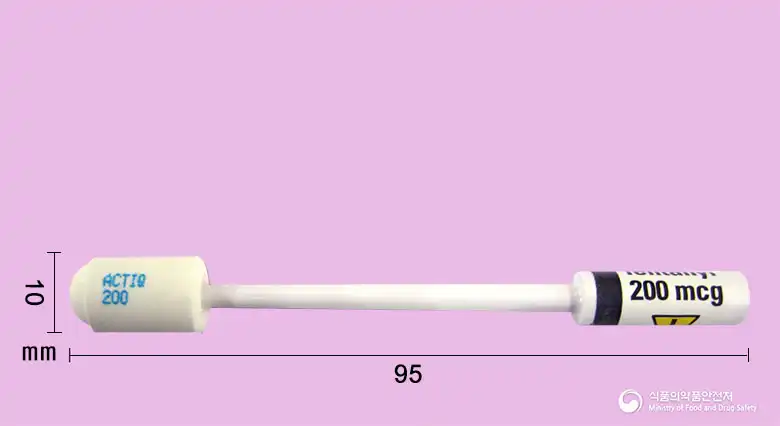
Fentanyl Citrate 0.3142mg
Prescription medication
Hyundai Pharmaceutical Co., Ltd.
Even with the same ingredient, the dose and directions can differ by strength and dosage form. Talk to a doctor or pharmacist before switching from a medication you are already taking.
No questions yet.
For anything that needs medical judgment, consult a doctor or pharmacist.
This drug information is based on data provided by the Korea Ministry of Food and Drug Safety.
Consult a doctor or pharmacist for accurate dosage, administration, and usage instructions.