
 한국어
 English
 日本語
 中文(简体)
 Viewing now
Verzenio Tablet 150 mg (Abemaciclib)
Abemaciclib 150mg
Tablet · Prescription medication
Eli Lilly Korea LLC
MFDS item code 201902827 · Approved 2019.05.01 · Insurance code 670801160
Combination treatment for advanced or metastatic breast cancer and high-risk early breast cancer
This medication is used for the treatment of early breast cancer and advanced or metastatic breast cancer. It is particularly effective in patients who are hormone receptor-positive and HER2-negative. For early breast cancer patients, it is used as an adjuvant treatment in combination with endocrine therapy when there is a high risk of recurrence due to positive lymph nodes. Premenopausal or perimenopausal women should use it in conjunction with an aromatase inhibitor and a luteinizing hormone-releasing hormone (LHRH) agonist. For patients with advanced or metastatic breast cancer, it is administered as first-line therapy in combination with an aromatase inhibitor and endocrine-based therapy. If the disease progresses after endocrine therapy, treatment continues in combination with fulvestrant. These treatment methods effectively improve the risk of progression and recurrence of breast cancer.
When used in combination with endocrine therapy, administer 150 mg orally twice daily. For early breast cancer, administer for 2 years or until disease recurrence or toxicity occurs; for advanced or metastatic breast cancer, administer until disease progression or toxicity occurs. Administer at approximately the same time each day, regardless of food intake, and swallow the tablets whole. Dose adjustment is required if adverse reactions occur. The first dose reduction is to 100 mg twice daily, and the second dose reduction is to 50 mg twice daily. When coadministered with a strong CYP3A inhibitor, reduce the dose to 100 mg twice daily and, if necessary, reduce it to 50 mg twice daily. In patients with severe hepatic impairment, reduce the dosing frequency to once daily.
This drug may reduce the number of neutrophils in the blood, increasing the risk of infection. Therefore, it is important to have regular blood tests while taking this drug, especially during the first 2 months when tests should be conducted every 2 weeks. If severe neutropenia occurs, it may be necessary to temporarily discontinue or adjust the dosage of this drug. Additionally, this medication can harm the fetus if administered to pregnant women; therefore, women of childbearing age should use effective contraception for at least 3 weeks during and after treatment. This drug can cause serious pulmonary diseases such as interstitial lung disease or pneumonia, so symptoms like cough, shortness of breath, or hypoxia should be reported to a healthcare provider immediately. Patients with certain genetic disorders such as lactose intolerance should not be given this drug. Diarrhea may occur frequently, so appropriate measures such as sufficient fluid intake and anti-diarrheal medication should be taken if symptoms appear; in severe cases, medication should be discontinued and healthcare advice obtained. Liver dysfunction may occur, so regular liver function tests should be conducted, and if liver enzymes are elevated, dosage adjustment or discontinuation may be necessary. Blood clotting-related problems such as venous thromboembolism may occur, so symptoms like leg swelling, pain, or shortness of breath should prompt an immediate visit to the hospital. This drug may interact with other medications that inhibit or induce certain liver enzymes (CYP3A), so it is essential to inform healthcare providers about any other medications being taken. Pregnant or breastfeeding women should not use this drug, and those breastfeeding should discontinue for at least 3 weeks after taking it. Caution is also required in elderly patients or those with impaired renal and liver function, and dosage adjustments may be necessary. There is no specific antidote for overdose, so immediate supportive treatment at a medical facility is required. This drug should be kept out of the reach of children and should not be transferred to another container.
Not everyone experiences these, and they can vary from person to person.
This medication may be sensitive to air or moisture, so it should be stored in a tightly closed container. The storage temperature should be maintained at room temperature between 1 and 30 degrees Celsius. Proper storage can help retain the medication’s effectiveness for a prolonged period.
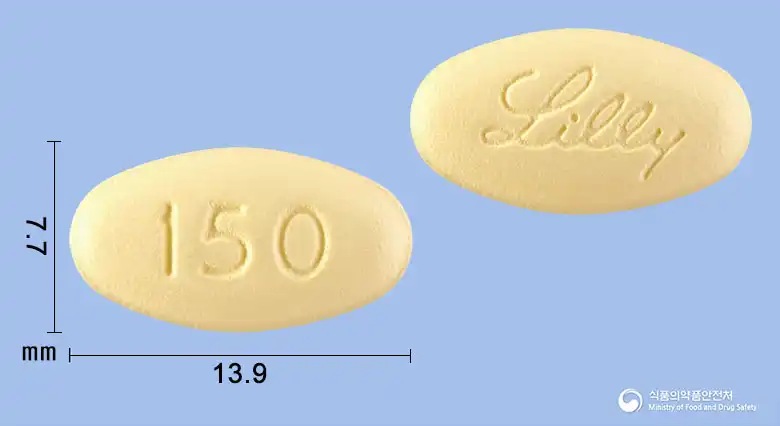
A yellow, oval-shaped film-coated tablet with 'Lilly' embossed on one side and '150' embossed on the other side.
70 tablets/box [(14 tablets/blister*5)]
Even with the same ingredient, strength, dosage form and how it is taken can differ.
Viewing nowAbemaciclib 150mg
Tablet · Prescription medication
Eli Lilly Korea LLC
Abemaciclib 50mg
Tablet · Prescription medication
Korea Lilly Co., Ltd.

Abemaciclib 100mg
Tablet · Prescription medication
Eli Lilly Korea, Co., Ltd.
Abemaciclib 200mg
Tablet · Prescription medication
Eli Lilly Korea, Ltd.
Even with the same ingredient, the dose and directions can differ by strength and dosage form. Talk to a doctor or pharmacist before switching from a medication you are already taking.
No questions yet.
For anything that needs medical judgment, consult a doctor or pharmacist.
This drug information is based on data provided by the Korea Ministry of Food and Drug Safety.
Consult a doctor or pharmacist for accurate dosage, administration, and usage instructions.