
 한국어
한국어 English
 日本語
日本語 中文(简体)
 Viewing now
Silvercept 23 mg (Donepezil Hydrochloride Hydrate)
Donepezil Hydrochloride Hydrate 24mg
Tablet · Prescription medication
Myongin Pharmaceutical Co., Ltd.
MFDS item code 201600568 · Approved 2016.01.28 · Insurance code 651904330
Treatment of moderate to severe symptoms of Alzheimer's disease
This medication is used to treat moderate to severe symptoms of Alzheimer's disease. It helps alleviate memory decline and cognitive impairment, enhancing the patient's daily living abilities. Additionally, it delays the deterioration of behavioral and psychiatric symptoms, improving the quality of life for both patients and families. When taken consistently, it is expected to slow the progression of symptoms. The dosage and administration may be adjusted according to each patient's condition, so it is important to closely follow the instructions of healthcare professionals. For these reasons, it is used in the treatment of symptoms of Alzheimer's disease.
This medication is taken once daily just before bedtime and can be taken regardless of meals. The initial recommended dose of Donepezil Hydrochloride is 5 mg taken once daily. After 15 days, a steady state is reached, and after administering 5 mg for 4 to 6 weeks, clinical response evaluation will be done to increase the dosage up to 10 mg. When increasing to 10 mg daily, attention should be paid to gastrointestinal adverse reactions. Take at least one dose of 10 mg daily for 3 months.
This medication is used for the treatment of symptoms of Alzheimer's disease, with Donepezil Hydrochloride Hydrate as the main ingredient. However, it should not be administered to certain patients. For example, it should not be used in individuals allergic to this drug or its components, pregnant women, breastfeeding women, and patients with genetic lactose intolerance issues. Patients with heart disease, history of peptic ulcers, asthma, chronic obstructive pulmonary disease, and extrapyramidal disorders like Parkinson's disease should use this medication with caution. In particular, patients with heart-related conditions may experience bradycardia or arrhythmias, necessitating careful attention. This medication can cause various side effects, which can be severe, including syncope, heart block, gastrointestinal bleeding, liver dysfunction, seizures, and movement disorders. Additionally, it may commonly cause mild side effects such as nausea, vomiting, diarrhea, dizziness, insomnia, headache, fatigue, skin rash, among others. In particular, when taken at high doses, nausea and vomiting may occur more frequently, and side effects often appear within one month of starting treatment, so patients should be closely monitored. This medication affects the cardiovascular system and can induce disturbances in heart rhythm, so patients with a history of heart disease or those at risk of QT interval prolongation need regular monitoring, including electrocardiograms. Additionally, since this medication is metabolized by CYP3A4 and CYP2D6 enzymes, care should be taken when taken with drugs that inhibit or induce these enzymes, as the drug's effects may change. It is advisable for pregnant or breastfeeding women not to use this medication, and it should only be used after careful consultation with specialists if absolutely necessary. Its safety in children has not been established, so it should not be used in this population. In case of overdose, symptoms may include nausea, vomiting, bradycardia, and respiratory depression, and immediate medical treatment is required. Antidotes such as atropine may be used. While this drug is effective for dementia treatment, always consult with a doctor beforehand, and periodically check for side effects and the patient's condition during treatment. Finally, this medication should be stored out of the reach of children, and transferring it to another container is not advisable to maintain quality and safety.
Hives, severe swelling (edema), chest tightness, difficulty breathing, cold sweat, paleness, severe rash with high fever, blisters, skin peeling, oral/ocular mucosal pain, difficulty breathing or shortness of breath, asthma attack, respiratory irregularities with coughing and fever, yellowing of skin or eyes (jaundice), profound lethargy, sudden and severe headache, lightning-like headache, seizures, altered consciousness, visual disturbances, paralysis, urination
Not everyone experiences these, and they can vary from person to person.
This medication should be stored in a tightly sealed container to prevent air or moisture from entering and ideally kept at a temperature between 1 and 30 degrees Celsius. Storing it this way helps maintain the drug's efficacy and prevents degradation.
Red, bi-convex, round film-coated tablet
30 tablets/bottle
Even with the same ingredient, strength, dosage form and how it is taken can differ.
Viewing nowDonepezil Hydrochloride Hydrate 24mg
Tablet · Prescription medication
Myongin Pharmaceutical Co., Ltd.

Donepezil Hydrochloride 5mg
Tablet · Prescription medication
HanDoc Co., Ltd.

Donepezil Hydrochloride 10mg
Tablet · Prescription medication
Hanmi Pharmaceutical Co., Ltd.

Donepezil Hydrochloride Hydrate 10.43mg
Tablet · Prescription medication
IYun Pharmaceuticals Co., Ltd.

Donepezil Hydrochloride Hydrate 10.43mg
Tablet · Prescription medication
Yuhan Corporation
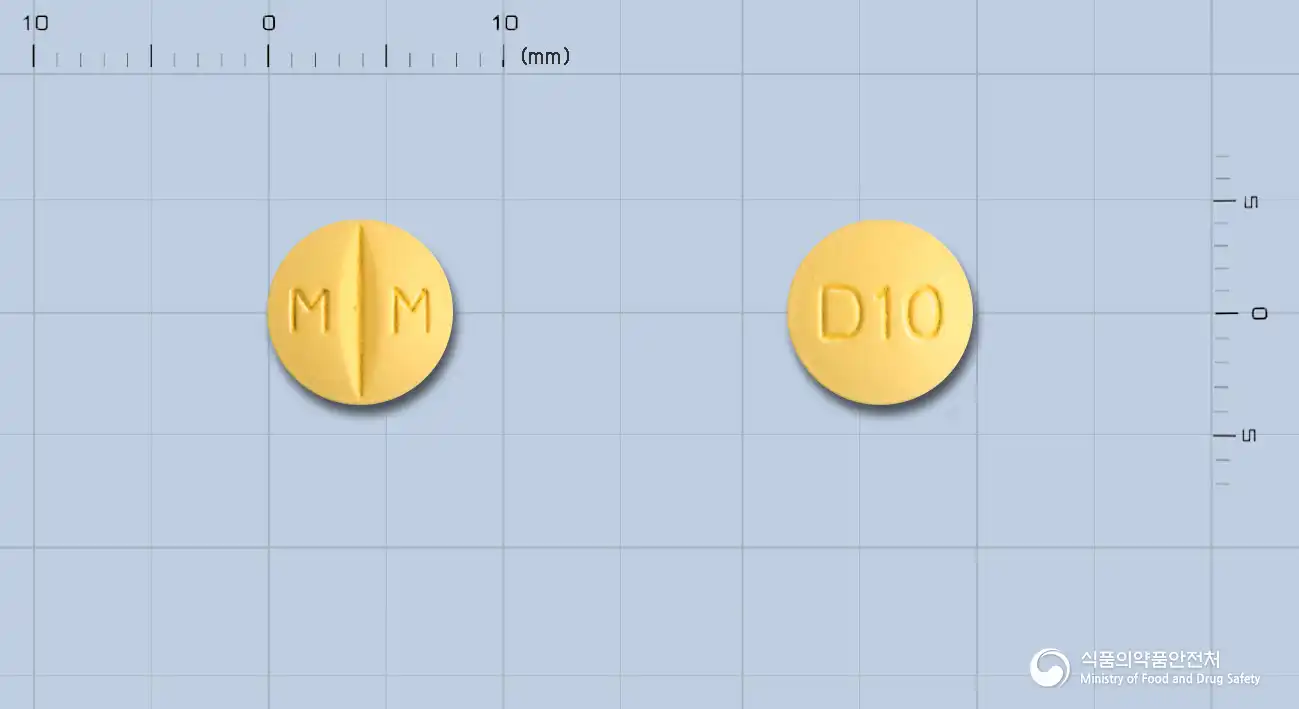
Donepezil Hydrochloride Hydrate 10.43mg
Tablet · Prescription medication
Myungmoon Pharmaceutical Co., Ltd.

Donepezil Hydrochloride Hydrate 10.43mg
Tablet · Prescription medication
HK inno.N Co., Ltd.
Donepezil Hydrochloride 10mg
Tablet · Prescription medication
Celltrion Pharmaceutical Co., Ltd.
Even with the same ingredient, the dose and directions can differ by strength and dosage form. Talk to a doctor or pharmacist before switching from a medication you are already taking.
No questions yet.
For anything that needs medical judgment, consult a doctor or pharmacist.
This drug information is based on data provided by the Korea Ministry of Food and Drug Safety.
Consult a doctor or pharmacist for accurate dosage, administration, and usage instructions.