
 한국어
한국어 English
 日本語
日本語 中文(简体)
 Viewing now
Minocapsule 50 mg (Minocycline Hydrochloride)
Minocycline Hydrochloride 50mg
Hard capsule · Prescription medication
(Korea Medica Co., Ltd.)
MFDS item code 202203142 · Notified 2022.08.01
Treatment of infections such as Rickettsial infections, improvement of periodontal disease symptoms
This medicine is available in various forms (capsules, granules, injections, etc.) and is effective against several types of bacteria including Rickettsia, Mycoplasma pneumoniae, Chlamydia, Vibrio cholerae, and Treponema pallidum. It is used in the treatment of various diseases including epidemic typhus, scrub typhus, mycoplasma pneumonia, lymphogranuloma venereum, cholera, plague, syphilis, pneumonia, bronchitis, gonorrhea, meningitis, and acute necrotizing ulcerative stomatitis. Additionally, in the formulation of ointment, it helps improve the symptoms of chronic marginal periodontitis caused by specific bacteria. Overall, this drug is very effective in treating infectious diseases and alleviating symptoms, thus being widely used for various infectious diseases.
(Capsules)(Granules) Initially, 200mg (potency) is administered, followed by 100mg (potency) orally every 12 hours. (Injections) Initially, 200mg (potency) is injected, followed by 100mg (potency) intravenously every 12 hours. Do not exceed 400mg (potency) per day.
(Capsules)(Granules) Initially, 4mg (potency) per kg of body weight is given, followed by 2mg (potency) per kg of body weight orally every 12 hours. (Injections) Initially, 4mg (potency) per kg of body weight is injected.
This drug should not be administered to certain patients. For example, it should not be used by individuals who are allergic to this drug, its ingredients, or tetracycline antibiotics. Pregnant or breastfeeding women, and children under the age of 12 should avoid taking this drug as it may cause permanent discoloration of teeth and abnormalities in enamel formation. Patients with severely impaired kidney or liver function or with certain skin diseases or autoimmune disorders should also avoid using this drug. Patients with weak kidney function should adjust the dosage and monitor drug concentration through blood tests due to the possibility of liver toxicity from the accumulation of this drug. This drug may cause sensitivity to sunlight, so patients who might be exposed to sunlight or ultraviolet rays should take precautions, and if any rash or erythema occurs on the skin, stop taking it immediately and consult a healthcare professional. Patients with weak liver function should regularly undergo liver function tests while taking this drug, and patients with esophageal passage difficulties may need to take precautions as esophageal inflammation or ulcers may occur. Patients with allergic tendencies, asthma, or a history of hives are at a higher risk of hypersensitivity reactions and should use this drug carefully. This drug contains certain coloring agents, so patients allergic to these substances should exercise caution. Rarely, severe allergic reactions such as anaphylactic shock may occur as a side effect of this drug; if symptoms such as breathing difficulties, widespread rashes, or swelling appear, discontinue use immediately and consult a medical professional. Various adverse reactions, including hepatitis, jaundice, dyspepsia, esophagitis, diarrhea, skin rash, hair loss, impaired kidney function, headache, dizziness, and auditory impairment, have been reported. Especially with long-term use, it is crucial to regularly monitor liver and kidney conditions as well as blood for any signs of abnormalities. Pregnant women should avoid taking this drug as it may affect fetal skeletal and dental development, and breastfeeding women should also either avoid this drug or discontinue breastfeeding as it may be transmitted through breast milk. Children are at risk for tooth discoloration and growth retardation, so it is not used for those under 12 years of age. Elderly individuals, possibly having diminished kidney and liver function, should start with lower doses and carefully monitor for any adverse reactions. This drug has many interactions with other medications; thus, particularly when taking anticoagulants, oral contraceptives, antacids, anticonvulsants, and immunosuppressants, proper dosage adjustments and monitoring are necessary in consultation with healthcare professionals. In case of overdose, symptoms such as vomiting, nausea, esophageal damage, liver and kidney damage, and severe allergic reactions may occur, necessitating immediate medical attention. When taking this medication, it should be taken upright or sitting with plenty of water to prevent esophageal injury, especially avoiding taking it right before bedtime. This drug should be kept out of reach of children and care should be taken not to transfer it to other containers, as this may degrade its quality. Finally, to prevent the development of resistant bacteria, it is important to take this medication only as directed for the required duration and to have regular blood tests and liver and kidney function tests during long-term use.
Hives, severe swelling (angioedema), chest tightness, difficulty breathing, cold sweat, paleness, severe rash with high fever, blisters, skin peeling, pain in oral mucosa, pain in ocular mucosa, shortness of breath or difficulty breathing, asthma attack, breathing abnormalities accompanied by cough and fever, yellowing of the skin or eyes (jaundice), drowsiness throughout the body, sudden and severe headache, thunderclap headache, seizures, confusion of consciousness.
Dyspepsia, esophagitis, esophageal ulcers, pancreatitis, pseudomembranous colitis, constipation, anal itching, loss of appetite, heartburn, nausea, vomiting, abdominal pain, abdominal bloating, diarrhea, fatty stools, glossitis, stomatitis, dysphagia, small intestine and colon inflammation, perianal dermatitis due to opportunistic Candida overgrowth, oral discoloration, hoarseness, black hairy tongue, tooth discoloration, enamel hypoplasia, hair loss, erythema multiforme, erythema nodosum, skin swelling, papilloma, blister formation.
Not everyone experiences these, and they can vary from person to person.
This drug is sensitive to air and moisture, so it must be stored in a tightly sealed container. The storage temperature should be maintained at room temperature between 1 and 30 degrees Celsius, preferably in a dry place with low humidity.
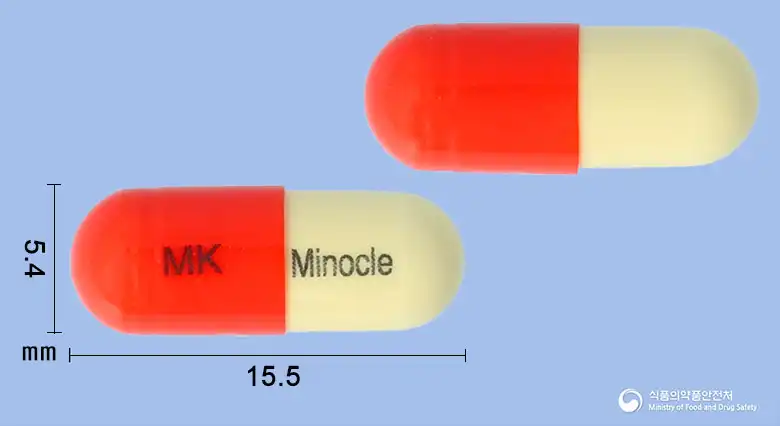
A hard capsule with a yellow powder contained in an upper red and a lower pale yellow opaque part.
30 capsules/bottle, 100 capsules/bottle, 500 capsules/bottle
Even with the same ingredient, strength, dosage form and how it is taken can differ.
Viewing nowMinocycline Hydrochloride 50mg
Hard capsule · Prescription medication
(Korea Medica Co., Ltd.)
Minocycline Hydrochloride 50mg
Hard capsule · Prescription medication
SK Chemicals Co., Ltd.
Minocycline Hydrochloride 20mg
Ointment · Prescription medication
Dongkuk Pharmaceutical Co., Ltd.
Minocycline Hydrochloride 10mg
Ointment · Prescription medication
Vimer
Minocycline Hydrochloride 20mg
Ointment · Prescription medication
Nybex Co., Ltd.
Minocycline Hydrochloride 20mg
Ointment · Prescription medication
Genewon Science Co., Ltd.
Minocycline Hydrochloride 20mg
Ointment · Prescription medication
Ostem Pharma Co., Ltd.
Minocycline Hydrochloride 50mg
Hard capsule · Prescription medication
TheU Pharmaceutical Co., Ltd.
Even with the same ingredient, the dose and directions can differ by strength and dosage form. Talk to a doctor or pharmacist before switching from a medication you are already taking.
No questions yet.
For anything that needs medical judgment, consult a doctor or pharmacist.
This drug information is based on data provided by the Korea Ministry of Food and Drug Safety.
Consult a doctor or pharmacist for accurate dosage, administration, and usage instructions.