
 한국어
 English
 日本語
 中文(简体)
 Viewing now
Pentasa Sustained Release Tablets 1g (Mesalazine)
Mesalazine 1000mg
Tablet · Prescription medication
Korea Ferring Pharmaceutical Co., Ltd.
MFDS item code 201206669 · Approved 2012.08.31 · Insurance code 652500320
Treatment of mild to moderate ulcerative colitis and Crohn's disease
This medication is used to treat mild to moderate ulcerative colitis and Crohn's disease. It helps alleviate inflammation in the intestines, improve symptoms, and restore intestinal function. Therefore, it is effectively used for treating inflammatory bowel diseases.
This drug must not be crushed or chewed. To facilitate administration, it may be divided or suspended in water or juice immediately before administration. Ulcerative colitis: For adults, during acute episodes, administer up to 4 g of mesalazine once daily or in 2~4 divided doses; for maintenance therapy, administer 2 g orally once daily. Crohn's disease: For adults, administer up to 4 g of mesalazine orally in divided doses.
Ulcerative colitis: For pediatric patients aged 6 years and older, during acute episodes, administer 30 ∼ 50 mg/kg daily orally in divided doses. The total daily dose should not exceed 4 g. Ulcerative colitis: For pediatric patients aged 6 years and older, for maintenance therapy, administer 15 ∼ 30 mg/kg daily orally in divided doses. The total daily dose should not exceed 2 g. Ulcerative colitis: As a general rule, the recommended dose for pediatric patients weighing no more than 40 kg is half the adult dose. Ulcerative colitis: The recommended dose for pediatric patients weighing 40 kg corresponds to the usual adult dose. Crohn's disease: For pediatric patients aged 6 years and older, during acute episodes, administer 30 ∼ 50 mg/kg daily orally in divided doses. Crohn's disease: For pediatric patients aged 6 years and older, for maintenance therapy, administer 15 ∼ 30 mg/kg daily orally in divided doses. Crohn's disease: As a general rule, the recommended dose for pediatric patients weighing no more than 40 kg is half the adult dose. Crohn's disease: The recommended dose for pediatric patients weighing 40 kg corresponds to the usual adult dose.
This medicine should not be used by persons who are allergic to this medicine or its components, salicylic acid, or salicylates. It should not be administered to patients with severe impairment of liver or kidney function, those with peptic ulcers, or those with bleeding disorders. Children under the age of 6 and individuals with a history of asthma or hypersensitivity reactions to salicylates or nonsteroidal anti-inflammatory drugs, patients with severe heart failure, and those undergoing high-dose methotrexate treatment should also not use this medication. Patients with bronchial asthma or allergic reactions to other drugs, those with liver or kidney problems, patients with blood disorders, pregnant or breastfeeding women, children and adolescents aged 6 to 18 years, elderly patients, and those with a history of allergic reactions to sulfasalazine-containing preparations should use this medicine with caution. Common side effects of this medication may include diarrhea, nausea, abdominal pain, headache, vomiting, and skin rash. Rarely, severe allergic reactions, high fever, and problems affecting the heart or lungs, liver, and kidneys may occur, so any symptoms should be immediately discussed with a doctor. Regular blood tests, liver function tests, and kidney function tests should be conducted before and during treatment, and if any abnormal symptoms arise, immediate testing should be done. In particular, patients with asthma or weakened kidney function require careful monitoring by a physician. This medication may interact with other medications, so it is essential to inform your doctor or pharmacist about any other medications you are currently taking. Pregnant or breastfeeding women should only use this medication when the benefits are deemed to outweigh the risks, and caution should be exercised during breastfeeding as diarrhea and other side effects may occur in infants. Special care should be taken when using this medication in children or elderly patients, with elderly patients advised to start at a lower dose due to potential liver and kidney function decline. In cases of overdose, there are no specific antidotes, and appropriate treatment should be administered according to the symptoms; inducing vomiting or treating for fluid and electrolyte balance may be necessary. This medication should be swallowed whole and should not be chewed or crushed. If swallowing is difficult, consult a doctor or pharmacist to adjust the method of administration. Keep this medication out of reach of children and do not transfer it to another container for safety and quality maintenance.
Diarrhea, nausea, abdominal pain, headache, vomiting, rash, hypersensitivity reaction, drug reaction with eosinophilia and systemic symptoms (DRESS syndrome), Stevens-Johnson syndrome (SJS), toxic epidermal necrolysis (TEN), anemia, aplastic anemia, agranulocytosis, neutropenia, leukopenia, pancytopenia, thrombocytopenia, anaphylactic reaction, dizziness, peripheral neuropathy, idiopathic intracranial hypertension, myocarditis, pericarditis, dyspnea, cough, bronchospasm, allergic alveolitis, pulmonary eosinophilia, interstitial lung disease, pulmonary infiltration, pneumonia, pleuritis, abdominal distension, amylase increase, acute pancreatitis, colitis, increased aminotransferases, increased cholestasis evaluation parameters, hepatotoxicity, rash (including urticaria and erythematous rash), photosensitivity, alopecia, allergic rash, erythema multiforme, myalgia, arthralgia, erythema nodosum syndrome, renal dysfunction, nephrolithiasis, urine discoloration, reversible sperm shortage, abdominal bloating, belching, increased methemoglobin levels, conjunctivitis, benign intracranial hypertension in adolescents, angioedema
Not everyone experiences these, and they can vary from person to person.
This medication may be sensitive to air or moisture and should therefore be stored in a tightly closed container. It is also recommended to keep it away from direct sunlight and store it at room temperature between 1°C and 30°C.
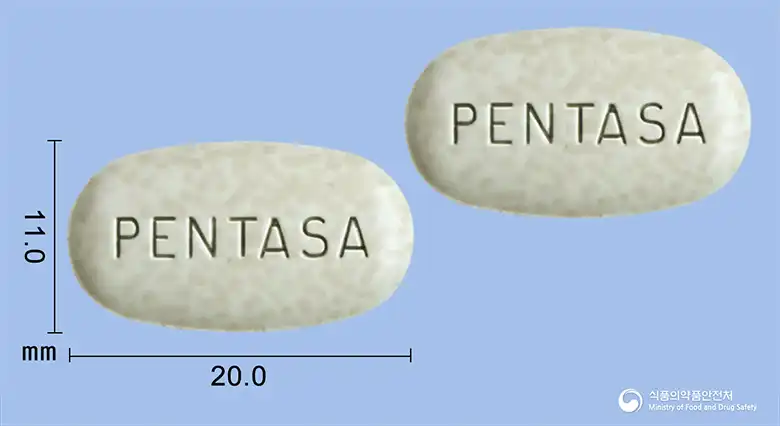
Oval tablets that are grayish-white with light brown spots
60 tablets (10 tablets/PTP pack × 6)/box
Even with the same ingredient, strength, dosage form and how it is taken can differ.
Viewing nowMesalazine 1000mg
Tablet · Prescription medication
Korea Ferring Pharmaceutical Co., Ltd.
Mesalazine 500mg
Tablet · Prescription medication
Korea Ferring Pharmaceutical Co., Ltd.
Mesalazine 1000mg
Prescription medication
Korea PhaRing Pharmaceutical Co., Ltd.
Mesalazine 4g
Suspension · Prescription medication
Daewoong Pharmaceutical Co., Ltd.
Mesalazine 500mg
Prescription medication
Daiwoong Pharmaceutical Co., Ltd.
Mesalazine 400mg
Tablet · Prescription medication
Daewoong Pharmaceutical Co., Ltd.
Mesalazine 1g
Prescription medication
Korea Ferring Pharmaceuticals Co., Ltd.
Mesalazine 2g
Prescription medication
Korea Ferring Pharmaceuticals Co., Ltd.
Even with the same ingredient, the dose and directions can differ by strength and dosage form. Talk to a doctor or pharmacist before switching from a medication you are already taking.
No questions yet.
For anything that needs medical judgment, consult a doctor or pharmacist.
This drug information is based on data provided by the Korea Ministry of Food and Drug Safety.
Consult a doctor or pharmacist for accurate dosage, administration, and usage instructions.