한국어
 English
 日本語
 中文(简体)
 Viewing now
Muno Tablet 2.5 mg (Felodipine)
Felodipine Micronized 2.5mg
Tablet · Prescription medication
Handok Co., Ltd.
MFDS item code 200200775 · Approved 2002.03.05 · Insurance code 652100350
Treatment of hypertension and stable angina
This medication is used for hypertension and stable angina.
Swallow this medicine whole with water. Do not divide, chew, or crush it. Hypertension: The initial dose of felodipine is 5㎎ once daily, and the maintenance dose is 5-10㎎ daily, taken orally in the morning. Do not exceed 20㎎ per day. This medicine may be administered concomitantly with a β-blocker or diuretic. If other antihypertensive agents are inappropriate, it may be administered as monotherapy. Adjust the dose according to the patient’s response to treatment. Stable angina: The initial dose is 5㎎ once daily and may be increased to 10㎎ if necessary. This medicine may be administered concomitantly when a β-blocker does not provide an adequate effect. Adjust the dose according to the patient’s response to treatment. Elderly patients: Administer with caution while monitoring the patient’s condition; consider an initial dose of 2.5㎎ once daily. Patients with renal impairment: Renal impairment does not affect the plasma concentration of felodipine. Dose adjustment is not required, but administer with caution to patients with severe renal impairment (GFR<30ml/min). Patients with hepatic impairment: Plasma felodipine concentrations may increase in patients with hepatic impairment, who may respond to treatment at lower doses. Therefore, administer with caution to patients with hepatic impairment; consider an initial dose of 2.5mg once daily. Do not administer to patients with severe hepatic impairment.
Safety and efficacy in children have not been established.
This medication should not be used by women who are pregnant or may become pregnant. It should also not be administered to patients with severely impaired heart function, acute myocardial infarction, or unstable angina. Patients with a history of allergy to this medication or certain heart valve diseases should avoid it. Patients with severe liver or kidney dysfunction should use this medication with caution, and so should elderly patients or those with low blood pressure. When starting this medication or increasing the dose, symptoms such as facial flushing, headache, rapid heartbeat, dizziness, and fatigue may occur. In some patients, side effects such as ankle swelling, chest tightness, nausea, constipation, and oral inflammation may occur, so caution is advised. Rarely, symptoms of liver dysfunction, blood anomalies, skin rash, muscle pain, or increased blood sugar may appear, so consult a doctor immediately if any adverse effects occur. Abruptly discontinuing this medication may worsen symptoms, so the dosage should be reduced gradually under a doctor's guidance. Since blood pressure can drop too low, it is advisable to avoid driving or operating hazardous machinery if dizziness is severe. This medication can be taken in the morning with meals or on an empty stomach. This medication can interact with other drugs, so caution is needed when taken with other antihypertensive drugs, certain antibiotics, antifungals, anticonvulsants, or grapefruit juice. Particularly, taking it with grapefruit juice can significantly increase drug concentration, so it should be avoided. It is safest for pregnant or nursing women not to use this medication; if unavoidable, they should stop breastfeeding. Safety in children has not been established, so it is advisable not to use in pediatric patients. Overdose may lead to serious symptoms such as low blood pressure, cardiac arrhythmias, coma, or seizures, necessitating immediate emergency treatment. This medication may require gastric decontamination, administration of antidotes, or assistance with heart function. Dizziness or fatigue may occur during treatment, so caution should be exercised when driving or operating machinery.
Facial flushing, headache, palpitations, dizziness, fatigue, tachycardia, feeling of breathlessness, chest tightness, ankle edema, hypotension accompanied by tachycardia causing angina, extrasystole, heaviness in the head, lightheadedness, staggering, lethargy, drowsiness, anxiety, sensory disturbances, syncope due to hypotension, nausea, constipation, discomfort in the upper abdomen, heartburn, abdominal pain, loss of appetite, diarrhea, thirst, vomiting, gingival hyperplasia, gingivitis, elevated AST, elevated ALT, elevated ALP, elevated LDH, elevated BUN, elevated creatinine, anemia, rash, itching, exfoliative dermatitis, erythema of the skin, urticaria, photosensitivity reactions, angioedema of the lips or tongue, leukoclastic vasculitis, myalgia, arthralgia, hyperglycemia, weight gain, peripheral edema, leg cramps, shoulder stiffness, weakness, digit tremor, cough, throat discomfort, sweating, tearing, conjunctival hyperemia, paresthesia, elevated CPK, elevated total cholesterol, elevated triglycerides, low serum potassium, gynecomastia, erectile dysfunction, sexual dysfunction, frequent urination, angioedema, fever, confusion, sleep disturbances, mild intoxication symptoms, marked hypotension, bradycardia, atrioventricular block I-III, atrioventricular dissociation, ventricular extrasystole, impaired contraction, consciousness impairment, coma, convulsions, respiratory distress, pulmonary edema, apnea, adult respiratory distress syndrome, acidosis, hypocalcemia, hypothermia, nausea
Not everyone experiences these, and they can vary from person to person.
This medication is sensitive to light and should be stored in a container that does not allow light in. It is also advisable to store the medication at room temperature between 1 to 30 degrees Celsius. This helps maintain the effectiveness of the medication and ensures safe usage.
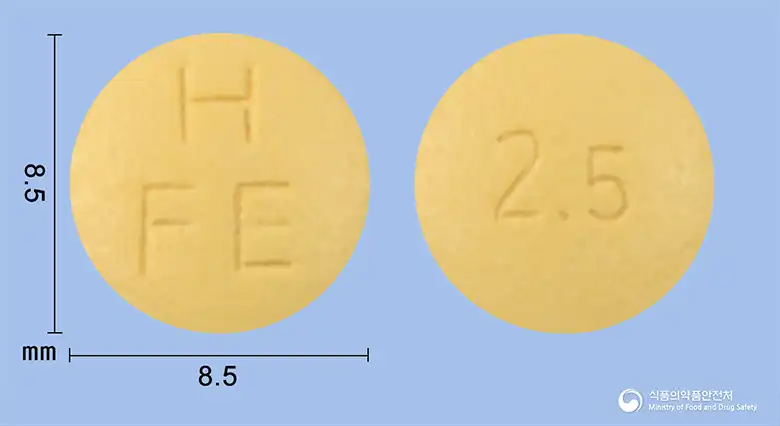
Yellow round film-coated tablet with both sides convex
30 tablets/bottle
Even with the same ingredient, strength, dosage form and how it is taken can differ.
Even with the same ingredient, the dose and directions can differ by strength and dosage form. Talk to a doctor or pharmacist before switching from a medication you are already taking.
No questions yet.
For anything that needs medical judgment, consult a doctor or pharmacist.
This drug information is based on data provided by the Korea Ministry of Food and Drug Safety.
Consult a doctor or pharmacist for accurate dosage, administration, and usage instructions.