


명잔걸

Parkinson's disease is a condition characterized by movement disorders caused by the destruction of dopamine neurons in the substantia nigra located in the center of the brainstem. Dopamine is an essential neurotransmitter that acts on the basal ganglia of the brain, enabling us to move our bodies precisely as we desire.
The symptoms of Parkinson's disease become clearly apparent after approximately 60-80% of the dopaminergic neurons in the substantia nigra of the brain are lost. Pathological examination reveals the presence of Lewy bodies, which are deposits of abnormal alpha-synuclein protein, in various regions of the brain and peripheral nerves. Parkinson's disease is the second most common degenerative brain disorder after Alzheimer's disease. It has an prevalence rate of 1% in individuals over 60 years old. The incidence increases with age.
Only 5-10% of Parkinson's disease cases occur due to genetic factors. The majority are idiopathic. Research on environmental factors related to Parkinson's disease has identified toxins such as 1-methyl-4-phenyl-1,2,3,6-tetrahydropyridine (MPTP), pesticides ( rotenone, paraquat), heavy metals (manganese, lead, copper), carbon monoxide, organic solvents, trace metal elements, and factors like head trauma as potential causes of the disease.
The exact cause of the destruction of dopamine neurons in the substantia nigra is not yet known. There are hypotheses that environmental toxins, mitochondrial dysfunction, and abnormalities in the processing of unnecessary proteins may trigger this.
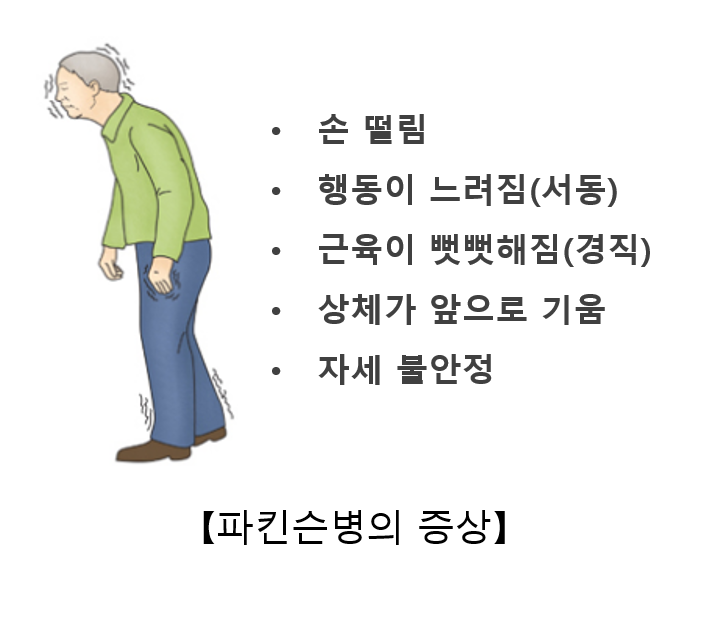
1. Exercise symptoms
1) Tremor (shaking)
The symptom of trembling is the most noticeable symptom. Tremors mainly occur when sitting or lying in a comfortable position. They disappear when moving the hands or legs. Because of this, tremors that appear in Parkinson's disease patients are called "resting tremor."
2) Rigidity
In the early stages of Parkinson's disease, stiffness symptoms such as muscle rigidity appear. It is sometimes mistaken for problems with muscles or joints. As Parkinson's disease progresses, patients may experience sensations of muscle tightening or pulling, as well as muscle pain. Depending on the area and the patient, symptoms such as lower back pain, headaches, leg pain, or leg numbness may be reported.
3) Seodong
Movements become slower. Fine motor tasks such as buttoning or writing gradually become dulled. The frequency and amplitude of actions like blinking, facial expressions, arm movements while walking, and changing posture decrease. In many cases, the patient is not aware of this themselves. They only realize it after being pointed out by those around them.
4) Postural instability
Unable to maintain posture and fall. Although it is rare in the early stages of Parkinson's disease, it appears in many patients as the disease progresses.
5) Slouched posture
The neck, lower back, elbows, and knees are in a bent and hunched posture.
6) Gait freezing
When starting to walk, during walking, or when turning, the feet do not leave the ground, preventing steps from being taken. Many patients suffer greatly. This is observed in patients with advanced Parkinson's disease.
2. Non-exercise symptoms
1) Neuropsychiatric symptoms
Neuropsychiatric symptoms such as depression, anxiety, apathy, impulse control disorders, hallucinations, and psychosis may occur. About 50% of Parkinson's disease patients experience depression. This can lead to decreased medication adherence and motivation for treatment, resulting in a decline in quality of life.
2) Cognitive decline
Approximately 40% of all patients experience cognitive decline. The dementia symptoms experienced by Parkinson's disease patients differ from those seen in Alzheimer's disease. They may experience visual hallucinations and have significant fluctuations in cognitive function. Some may also show hypersensitivity to medications. Realistically, there is no cure for cognitive impairment. However, appropriate medication therapy can provide assistance.
3) Autonomic nervous system disorder
Orthostatic hypotension, constipation, urinary disorders, sexual dysfunction, olfactory disturbances, and abnormal gastrointestinal motility may occur due to autonomic nervous system dysfunction.
4) Sleep disorder
Many Parkinson's disease patients complain of insomnia. In addition, sleep disorders such as hypersomnia, excessive daytime sleepiness, restless legs syndrome, REM sleep behavior disorder, and periodic limb movement disorder can also occur. REM sleep behavior disorder involves severe talking, flailing, and kicking during sleep. It can be observed even before the onset of motor symptoms of Parkinson's disease.
5) Urinary disorder
Frequent urination, known as pollakiuria, occurs commonly. If nocturnal urination occurs, it disrupts sleep.
6) Others
Sensory abnormalities such as pain, numbness, fatigue, and loss of smell accompany.
There is no specific test to confirm Parkinson's disease. The most important method of diagnosis is the clinical examination by a specialist. Brain magnetic resonance imaging (MRI) or brain PET scans can be helpful in diagnosis.
Parkinson's syndrome and secondary Parkinson's disease are also called "cousins" of Parkinson's disease. Parkinson's disease must be distinguished from these conditions. Parkinson's syndrome presents symptoms such as progressive supranuclear palsy, multiple system atrophy, cortical-basal degeneration, and Lewy body dementia. Secondary Parkinson's disease occurs secondarily due to causes such as drug-induced Parkinsonism, vascular Parkinsonism, normal pressure hydrocephalus, brain tumors, or toxic substances.
Treatment
The principles of treating Parkinson's disease are medication therapy and exercise therapy.
2. Exercise therapy - Parkinson's disease reduces activity levels and causes postural deformities. The head tilts forward, and the shoulders and
The back becomes rounded. Therefore, stretching exercises that straighten the body are helpful. Strengthening exercises greatly assist in maintaining mobility and function, even if the body slows down and becomes stiff.
Exercise is very important for Parkinson's disease patients to maintain physical activity functions regardless of disease progression.
You must continue exercising regularly.
Precautions
Patients with Parkinson's disease must avoid the following medications.
1. Digestive medicine
1) Metoclopramide: Macperan, Reglan
2) Levofride: Levosulpiride, Sulpiride, Levofran, etc.
'Levodipride' is a medication that stimulates gastrointestinal motility. It is a very commonly prescribed drug in our country, so special caution is required. In particular, it is often prescribed by departments other than neurology for indigestion or arthritis. Therefore, when Parkinson's disease patients visit the hospital for symptoms other than Parkinson's disease (such as gastrointestinal issues, arthritis, or back pain), it must be clearly stated in advance that medications containing levosulpiride are absolutely contraindicated.
2. Sedatives: Haloperidol, Perphenazine
--------------------------------------------------------
When I see elderly people at hospitals or parks, there are those who have difficulty moving and whose hands and feet tremble unusually...
I just casually thought that maybe somewhere was uncomfortable or hurting without any particular thought...
Everyone probably has memories of seeing many people with that illness in everyday life, even if they just passed by.
Since last year, an elderly family member has been diagnosed with Parkinson's and is receiving treatment... They have a lot of tremors in their hands and feet, and have difficulty moving around...
You've had five stent procedures, your body has become weaker, and now you're also said to have heart failure, it seems you're becoming a general hospital...

