The secret to living young is maintaining muscle mass.
Muscle exercise must be performed. Muscle mass naturally decreases after the age of 40, declining by about 1% in your 50s and losing up to 60% of total muscle mass by your 80s. Muscles burn 20 kcal per kilogram, and when muscle decreases, energy sources such as fat and carbohydrates that are not fully used remain in the body. These substances circulate through the blood vessels, increasing the risk of cardiovascular and cerebrovascular diseases, and accumulate under the skin, raising the risk of metabolic syndrome. Domestic research shows that sarcopenia increases the risk of cardiovascular disease by 3.6 times, diabetes by 3 times, and hypertension by 2 times. Additionally, bones and joints are also affected. As the muscles between bones and joints thin, external forces such as load are directly transmitted to the bones and joints, increasing the burden. Professor Lee Byeong-hoon of the Department of Orthopedics at Gachon University Gil Medical Center said, "Some people avoid strength training thinking it may strain the joints, but actually, it helps prevent joint damage."
There is no late time to start exercising. Just start right now. Especially for men, strength training becomes even more necessary starting in their 40s. Professor Byung-hoon Lee said, "Men begin to lose muscle faster than women from age 40, leading to physical changes such as thinning legs," and "Women have a somewhat slower rate of muscle loss due to female hormones." For women, the importance of muscle exercise increases from the late 40s when entering menopause. A study by a research team at Linköping University in Sweden found that menopausal women who engaged in strength training experienced about half the number of menopausal symptoms, such as hot flashes and night sweats.
<Simple and effective muscle preservation methods>
Photo = Health Chosun DB
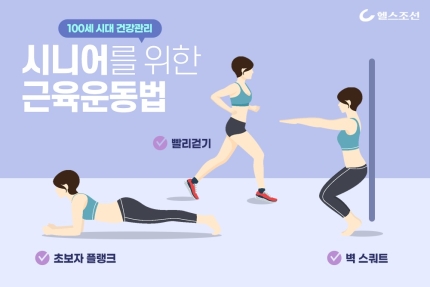
Wall Squat=
Wall squats are an easy exercise for people with low muscle mass and an effective way to properly strengthen muscles. It involves leaning your back against the wall, bending your knees until your thighs and calves form a 90-degree angle, and holding that position for a certain period. The duration of holding varies from person to person, but after four repetitions, you should feel somewhat fatigued. The goal is to hold for up to two minutes. Professor Byung-Hoon Lee said, "The part of our body with the most muscle mass is the lower body," and recommended wall squats as an effective lower body strength exercise. A research team led by Professor Jamie Odriscoll from the Department of Psychological and Life Sciences at Canterbury Christ Church University in the UK examined the effects of various exercises, from aerobic to strength training, and found that wall squats were the most effective exercise for increasing muscle strength and lowering blood pressure. The team explained, "When you tense your leg muscles and hold, the blood vessels around the muscles constrict, and when you release the tension, blood flow increases rapidly. Repeating this movement is believed to cause blood vessels to expand, which widens the space for blood flow and lowers blood pressure."
Walking at a faster pace
Even walking quickly can have the effect of strengthening muscles. Walking quickly causes muscles to rapidly relax and contract, which trains the muscles and also promotes smooth blood circulation. It also improves the elasticity of blood vessel walls. When walking quickly, do not run; just walk at a pace that makes you slightly breathless. A speed that makes it difficult to talk or sing while walking is appropriate. To avoid injuries, it is better to walk on flat ground. Walking quickly not only trains muscles but also serves as a measure to assess muscle strength. When checking for age-related muscle loss, walking speed is measured. The typical walking speed for healthy seniors aged 65 and over without health issues is usually above 1.0 m/sec. If the walking speed is 0.6 m/sec or less, it indicates that muscle strength is relatively weak, and strength training should be increased. Walking speed can be measured by timing how long it takes to walk a certain distance. A person walking at 0.6 m/sec takes 7 seconds to walk 4 meters.
Beginner's plank=
The beginner plank, which lowers the difficulty of the basic plank exercise, is a movement that reduces the risk of injury while increasing muscle strength. The basic plank position involves lying face down with your toes together and raised. The beginner plank involves extending the arms and hands and lowering the knees to the ground. Hold for 10 to 30 seconds at a time, up to 5 minutes. It helps keep the body upright and effectively trains the erector spinae muscles, which are important for maintaining balance. If the beginner plank is too easy, you can switch to the standard plank position.