


블리비
벽스쿼트 장난아니게 힘들어요 ㅎ
1분도 못 버텼어요
뭐든 그냥 주어진건 없더라구요
화이팅입니다


Install the Cashdoc app
I know I need exercise,
▲It is difficult to make time for a long time
▲Are you afraid of getting injured by exercising with the wrong posture?
▲For readers who aren't sure what exercises to do, this is the "One-Picture Exercise" method, which allows you to follow along with just one picture.
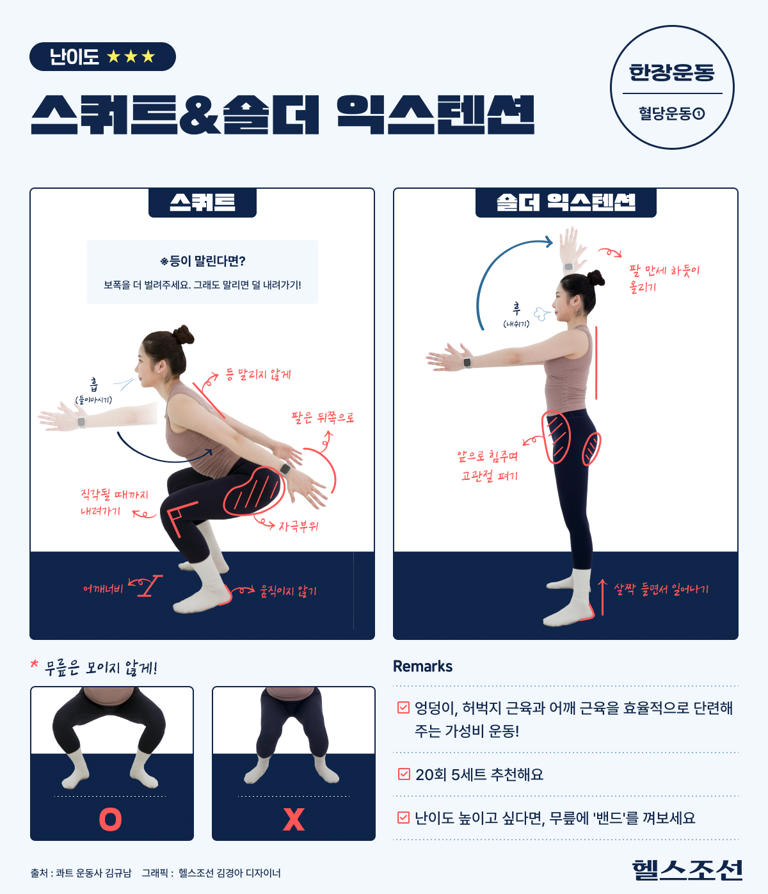
The first exercise is the "Squat & Shoulder Extension," which can help maintain stable blood sugar levels even if you just follow along during spare time. Its difficulty rating is 3 out of 5 stars, making it easy to follow. We learned about it with the help of Kim Gyu-nam, a fitness instructor at Quat, an integrated health management platform.
◇Follow the squat shoulder extension
▶Movement
First, stand with your feet shoulder-width apart. Extend your arms straight out in front of you at shoulder height. Keeping your elbows straight, pull your arms back behind you, bending your knees and hips. If your hips aren't properly bent, this can put stress on your knees, so focus on ensuring your pelvis is properly bent. The hip joint is where your pelvis meets your legs. Lower your knees until they form a right angle. Shift your weight onto your heels. You should feel the tension in your buttocks and thighs. Inhale as you squat down. Then, press the soles of your feet firmly into the floor and rise. Straighten your hips and knees, and lift your heels slightly off the floor, as if you were on tiptoe. Simultaneously, extend your arms upwards as if you were shouting "Hurrah!" You should engage your calves, thighs, buttocks, and abdominal muscles. Exhale.
▶Number of exercises and rest time
Perform five sets of 20 repetitions (100 repetitions total) daily. If you find it difficult to complete 20 repetitions in one go, lower your goal to at least 10 per set. Gradually increase the number of repetitions. After completing one set, begin the next one only when you're comfortable enough to hold a conversation with someone nearby.
▶Postures to watch out for
First, you should perform the movement with your upper body upright, avoiding forward bending of the lower back or waist. If your lower back or waist is bent forward even though your knees are not bent at a right angle, it's best not to go down further. Repeating the movement while bent can strain your lower back. In this case, perform the movement with a stride wider than shoulder width. A narrower stride can cause your hips to fall too far back, naturally lowering your upper body and rounding your lower back. When descending, avoid turning your knees inward. Proper posture requires them to spread outward. If your knees turn inward, friction between the patella (the bone in front of the knee joint) and the femur (the thigh bone) increases, increasing the risk of knee pain. Properly perform the movement while keeping the entire sole of your foot in contact with the ground.
▶Difficulty adjustment
If the difficulty is too low and does not stimulate your thighs or buttocks, wear the band on both knees and perform the movement.
◇Best value for money for maintaining blood sugar levels
▶Point 1. Compound exercises
Exercise is very effective in maintaining blood sugar levels. In fact, the American Diabetes Association and the American College of Sports Medicine have announced that regular physical activity is an important factor in preventing diabetes. Both aerobic and resistance exercise improve blood sugar levels through their own mechanisms, and squats and shoulder extensions are a combination exercise that provides the benefits of both aerobic and resistance exercise simultaneously. Aerobic exercise
▲Promotes glucose utilization in muscles
▲ Increases insulin sensitivity, a hormone that lowers blood sugar levels
▲It is known to increase the density and oxidative capacity of mitochondria in muscles.
Resistance exercise increases muscle mass, which increases blood sugar consumption. It is also reported to be effective in reducing visceral fat. Combination exercises offer the benefits of both types of exercise.
▶Point 2. Moderate-intensity exercise
After doing squats and shoulder extensions, you'll be out of breath and only able to hold a short sentence with someone else. This is because it's a moderate-intensity exercise. However, for stable blood sugar control, moderate-intensity exercise without high stress is sufficient. It's more effective for reducing body fat, blood sugar, and blood pressure. The proportion of nutrients consumed varies depending on the intensity of exercise, and during moderate-intensity exercise, metabolism primarily burns fat.
Furthermore, it takes a certain amount of time after exercise for fat to be used as an energy source to increase, but maintaining this level of energy for a certain amount of time is difficult with high-intensity exercise. In fact, a research team from the Department of Sports Science at Inha University conducted a study on 51 diabetic patients to examine differences in blood sugar response after exercise. They found that moderate-intensity exercise resulted in higher blood sugar utilization than high-intensity exercise. You can check whether your exercise is moderate-intensity by checking your heart rate.
Moderate-intensity exercise is about 60-75% of your maximum heart rate. Your maximum heart rate is calculated by subtracting your age from 220. High-intensity exercise can temporarily increase blood pressure and blood sugar levels, so those with diabetes or cardiovascular disease should be especially cautious.
=====================
Introducing exercises that are good for blood sugar
As I found out, it is also good for strengthening leg muscles.
They say it's a very good exercise.
Squats seem a bit more difficult than I thought.
Have you seen comedian Park Na-rae?
Just stand there against the wall
They say this is also effective