

Most common during the summer season with high fluid loss

One of the diseases that suddenly increases when the scorching heat persists is urinary stones. Since 50% occur during the hot weather, it is called the "summer lurking enemy."
Urinary stones are a condition that causes severe pain in even fully grown adults, who roll around in agony. The intense pain appears suddenly, and once it occurs, it is easy for it to recur, causing anxiety over unpredictable pain episodes. Especially if you are obese, the risk of developing urinary stones is higher.
Most common during the summer months with high fluid loss
Urinary stones occur in about 1.9% of the entire population. They develop starting from the 20s and are most common in people in their 40s to 60s. Male patients are 2 to 3 times more numerous than female patients. Urinary stones occur most frequently in the summer, especially in August. The reason for the higher incidence in summer is that sweating causes fluid loss, and exposure to sunlight increases vitamin D production.
There are three main causes that increase the likelihood of developing urinary stones: drinking less water regularly, consuming a high amount of salt, and being obese.
In particular, when obese, the excretion of substances such as oxalate, uric acid, sodium, and phosphate that cause stones increases in the urine. Additionally, insulin resistance makes the urine more acidic, leading to the formation of uric acid stones.
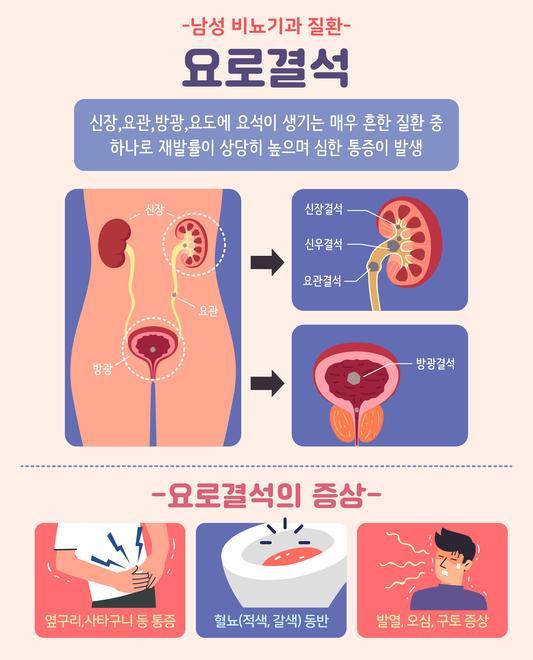
Sudden flank colicky pain is a characteristic symptom of urinary stones. This unbearable severe pain is called 'renal (nephritic) colic.' It occurs when a stone blocks the ureter, causing increased pressure in the ureter and kidney.
However, because the symptoms are not typical, some patients only experience abdominal discomfort and take stomach or digestive medications, or sometimes have no pain at all. If diagnosis is delayed and left untreated in this way, the risk of complications increases.
More than 90% of urine tests show hematuria.
When a urinary stone forms, hematuria frequently appears, and over 90% of patients show microscopic hematuria in urine tests. The diagnosis of urinary stones is conducted through urine tests along with imaging examinations such as pre-voiding urography or computed tomography (CT).
Professor Moon Young-jun of the Urology Department at Severance Hospital said, "Active treatment is necessary if the urinary stone is larger than 10mm, if pain cannot be controlled even with painkillers, if the urinary tract is completely blocked, or if kidney failure occurs."
Sudden severe pain caused by diagnosed urinary stones can be treated immediately, but rarely, painless urinary stones can occur. Professor Choi Jung-hyuk of the Department of Urology at Kyungdong Kyunghee University Hospital said, "If urinary obstruction caused by urinary stones persists for a long period, it can lead to acute pyelonephritis and renal failure, resulting in kidney dysfunction."
Treatment through natural delivery, extracorporeal shock wave lithotripsy, or surgery
The treatment method for urinary stones is determined by comprehensively considering the size, location, and number of stones, as well as underlying diseases, blood test results, and urine test results at the time of diagnosis. For small urinary stones less than 5mm, natural expulsion can be expected through pain management, increased fluid intake, and medication therapy.
However, if natural delivery cannot be expected, a procedure or surgery must be performed. First, there is extracorporeal shock wave lithotripsy, which uses shock waves outside the body to crush the stones and induce natural passage. It can be done as an outpatient treatment.
In addition, there are procedures such as lithotripsy to crush stones with surgery or ureteroscopy to remove stones using an endoscope. Ureteroscopic stone removal is a procedure in which an endoscope is directly inserted into the bladder and ureter through the urethra without an incision. It involves directly visualizing the stones with an endoscope, minimizing damage to surrounding tissues using lasers or other methods, and breaking or pulverizing the stones for removal.
◇ Calcium intake restriction does not prevent it
It is incorrect to believe that urinary stones can be prevented by methods such as restricting calcium intake in the market. Professor Choi Jung-hyuk said, "In the past, calcium intake was restricted to prevent urinary stones, but recent research has shown that appropriate calcium intake, rather than unconditional restriction, is actually more effective in preventing urinary stones."
To prevent urinary stones, it is necessary to maintain adequate fluid intake, dietary management, and lifestyle changes. Drinking enough fluids is the best way to prevent urinary stones. Especially if you have a history of urinary stones, it is recommended to drink about 2.5 to 3 liters of water daily to produce more than 2 liters of urine per day.
Dietary therapy for patients with urinary stones varies depending on the stone composition. First, salt intake should not exceed 3 to 5 grams per day. Second, foods high in oxalate, such as spinach, nuts, and chocolate, which can increase calcium stone formation, should be avoided. Third, the intake of animal protein should be limited to less than 1 gram per kilogram of body weight per day.
Additionally, consuming foods high in citrate, such as orange juice, which increases citrate excretion in urine and inhibits calcium stone formation, can help prevent urinary stones. However, a low-calcium diet increases the risk of urinary stone formation, so it is recommended to consume 1 to 1.2 grams of calcium daily.
Recently, the link between obesity and urinary stones has been identified, and losing weight through dietary therapy and sufficient physical activity helps prevent the recurrence of urinary stones.