

구름방울
뉴스 인터뷰 보니까 의료진 없어서 병원 못가시는 분들이 계신 것 같던데
이 사태가 얼른 마무리되길 바랍니다


Install the Cashdoc app
I have a friend who is battling cancer, and I am very worried.
I hope it gets resolved soon.ㅜ
ㅡㅡㅡㅡㅡㅡㅡㅡㅡㅡㅡㅡㅡㅡㅡㅡㅡㅡㅡㅡㅡㅡㅡ
On the first day of the indefinite strike at Seoul National University Hospital, the hospital atmosphere was calm yet tense. The hospital, with fewer patients than usual, was quiet, but strict control over the entry of outsiders, including the press, signaled the beginning of an indefinite struggle and a sense of foreboding.
On the first day of Seoul National University Hospital's closure, reporters who visited the main hospital located in Jongno-gu, Seoul, on the 17th, were expelled from the premises starting in the morning by security personnel and other hospital staff. The hospital enforced a policy of restricting access to outsiders and maintained a strict atmosphere by deploying police to prevent journalists from taking photos or videos or attempting patient interviews.
The overall atmosphere of the hospital was calm. Most of the waiting areas for new and outpatient registration were empty, and there was ample space in the outpatient waiting area. Although the number of outpatient visitors had decreased, inpatient wards for patients with severe or rare diseases were still maintained. An official from a facility within the hospital said, "I'm not sure about the situation with new patients, but inpatient numbers are being maintained, so the number of visitors seems to be similar to usual."
While essential medical services such as treatment for severe and rare diseases, emergency room, and intensive care unit continue, patients visiting the hospital on this day had mixed reactions. Some patients were unable to confirm the notification that their appointments had been postponed and made unnecessary trips, while others received treatment as originally scheduled. One patient who visited the hospital said, "I came for the scheduled test," and "I came according to the original schedule, and there were no cancellations or changes."
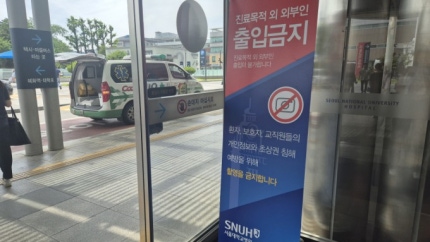
The Seoul National University Hospital's schedule for the upcoming week has not yet changed. The Seoul National University College of Medicine-Seoul National University Hospital Professors' Emergency Response Committee stated on the 17th, "The medical schedule is being changed on a weekly basis," and "There are no changes to the treatment, procedures, and surgery schedules for this week, and the schedule for next week has not yet been changed."
54.7% of the professors from four Seoul National University hospitals—Seoul National University Hospital, Bundang Seoul National University Hospital, Boramae Medical Center in Seoul, and Gangnam Center—participated in the strike on that day. The emergency committee stated that the strike is the "last card" that medical staff can deploy. Bae Jae-seung, the head of the emergency committee's protest team, said on the 17th, "The collapse of the medical system has already begun, and we will do as much as we can," adding, "The government is responsible for the collapse of healthcare."
The Korean Medical Association, which announced a collective strike on the 18th, is also expressing a similar stance. Reconsideration of medical school enrollment increases, cancellation of disciplinary actions against residents, and revision of the essential medical care policy package are conditions for withdrawing the strike.
However, the government is unlikely to accept such demands from the medical community. The government provided guidance on hospitals open during the Lunar New Year and Chuseok holidays, and on the 18th, it announced the clinics that would provide medical services during the collective strike.
The Ministry of Health and Welfare stated, "You can call the Health and Welfare Call Center (129), Emergency Situation Management Center (119), National Health Insurance Service (1577-1100), or Health Insurance Review & Assessment Service (1644-2000) call centers, or check the hospitals providing treatment on the Emergency Medical Portal, Ministry of Health and Welfare, or Health Insurance Review & Assessment Service websites." They also mentioned that "non-face-to-face consultations can be received at clinics, public health centers, and health sub-centers."
Non-face-to-face consultations can be received regardless of whether it is a first visit or a follow-up, but the medication must be collected in person by the patient or an authorized representative. Medical institutions offering non-face-to-face consultations can be checked on the Health Insurance Review & Assessment Service (HIRA) website. Emergency patients can use any of the 408 emergency rooms nationwide. They operate 24 hours, but mild cases are advised to refrain from using them.